
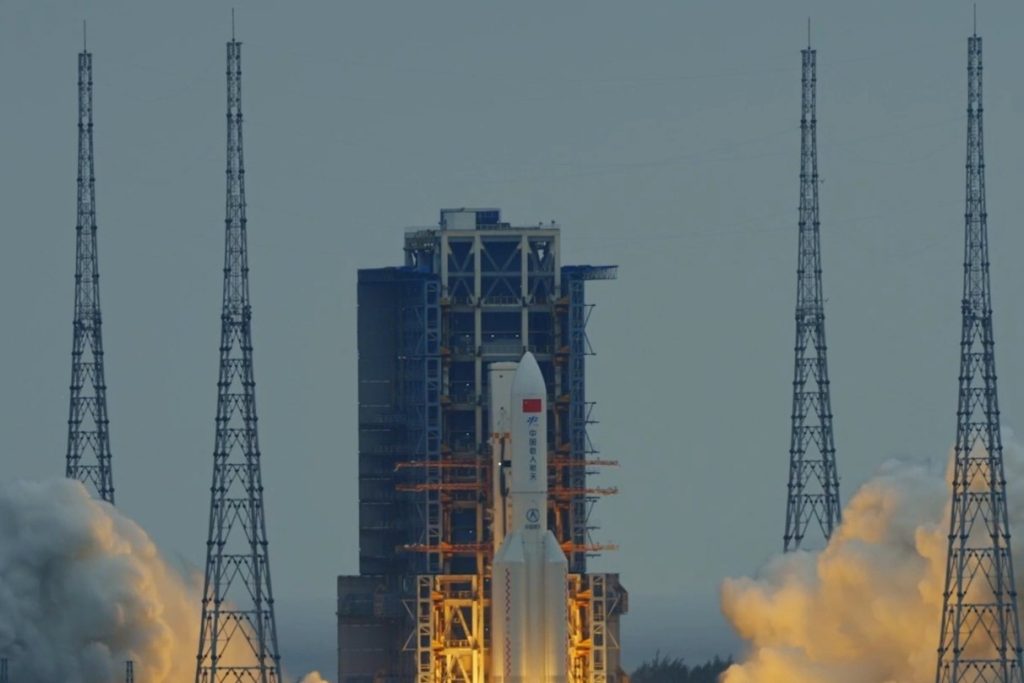
WENCHANG, Hainan Island, July 10 — The story of China’s Long March 10B rocket begins not with a single launch, but with a question that has quietly defined the nation’s space ambitions for the better part of a decade: can a state-owned enterprise, founded in 1999, build a reusable rocket that rivals anything in the West? On June 23, 2024, the China Aerospace Science and Technology Corporation (CASC) announced the answer was yes.
The Long March 10B had successfully lifted off from the Wenchang Space Launch Site on Hainan Island, carrying the Shiyan-24 satellite payload, developed by the Chinese Academy of Sciences. For those involved — the more than 5,000 engineers and technicians who had worked on the project since its inception in 2018 — it was the culmination of years of pressure, long nights, and a single, overriding imperative: make it work.
At its heart, this is a story about a rocket that is supposed to come back. The Long March 10B is not just another launch vehicle in the Long March series, which CASC has built as the primary contractor for China’s space program. It is a reusable rocket, designed to land after delivering its payload to orbit.
The recovery team was led by Wang Yong, chief designer of the reusable rocket program. For Wang Yong and his team, every successful launch is a step toward a future where launching a satellite is as routine as flying a cargo plane — but every failure carries the risk of setting that future back by years.
The launch itself took place at Wenchang, China’s only coastal launch site, which began operations in 2016. The location on Hainan Island is strategic: it allows for larger rocket stages to be transported by sea, a logistical advantage that has become central to CASC’s ambitions. The launch director was Zhang Zhi, a senior engineer at CASC.
For Zhang Zhi, standing in the control room as the countdown ticked to zero, the stakes were professional and personal. A failed launch would not only delay China’s space schedule; it would call into question the entire reusable rocket program that Wang Yong had championed. The China National Space Administration (CNSA), established in 1993, oversees China’s space program and sets policy.
But the execution falls to CASC, the state-owned enterprise headquartered in Beijing and founded in 1999. The relationship between the two bodies is not always seamless.
CNSA sets the goals; CASC has to meet them, often with the world watching. The Long March 10B project has involved over 5,000 engineers and technicians since 2018, a workforce that represents one of the largest concentrated efforts in Chinese aerospace history. For those engineers, the June 2024 success was not just a technical milestone.
It was validation that their work, often conducted under the pressure of state deadlines and international competition, had paid off. What unfolded at Wenchang that day was a carefully choreographed sequence of events.
The Long March 10B lifted off from the coastal pad, carrying the Shiyan-24 satellite into orbit. The satellite, developed by the Chinese Academy of Sciences, is designed for scientific experiments — though the exact nature of those experiments has not been detailed in state media. What is clear is that the payload reached its intended orbit, and the rocket’s first stage executed a controlled descent.
The recovery team, led by Wang Yong, was standing by. For those involved, the moment the stage touched down was the moment the years of work crystallized into a single, undeniable fact: it had worked. The announcement by CASC on June 23, 2024, via state media, was brief and factual.
But for the engineers and technicians who had been part of the project since 2018, the words carried a weight that no press release can fully convey. The Long March 10B is not just a rocket.
It is a statement of intent from a space program that has, in the span of two decades, gone from launching its first taikonaut to landing a rover on the far side of the Moon. Reusable rocketry is the next frontier, and China has now demonstrated that it can compete there. For Wang Yong, the chief designer of the reusable rocket program, the success of the Long March 10B is a vindication of a design philosophy that prioritizes reusability over raw power.
The rocket is designed to be recovered, refurbished, and flown again — a model that has been pioneered by private American companies but is now being adopted by state-owned enterprises in China. The recovery team, led by Wang Yong, has already begun analyzing the data from the June 2024 launch to refine the landing sequence for future missions.
The broader context of this achievement is one of competition and collaboration. China’s space program, overseen by CNSA and executed by CASC, operates in a global environment where the United States, Russia, and private companies are all pushing the boundaries of what is possible. The Long March 10B is China’s answer to the question of whether a state-owned enterprise can match the innovation of private industry.
For now, the answer is yes — but the question will be asked again with every future launch.
{“@context”: “https://schema.org”, “@type”: “NewsArticle”, “headline”: “CASC, CNSA, and Wenchang Launch Site Drive Long March 10B”, “description”: “WENCHANG, Hainan Island, July 10 — The story of China’s Long March 10B rocket begins not with a single launch, but with a question that…”, “datePublished”: “2026-07-10T09:30:00+00:00”, “author”: {“@type”: “Person”, “name”: “Sophie King”}, “publisher”: {“@type”: “Organization”, “name”: “InfoPulse Today”, “url”: “https://newsfeed.infopulsetoday.com/”}}




