
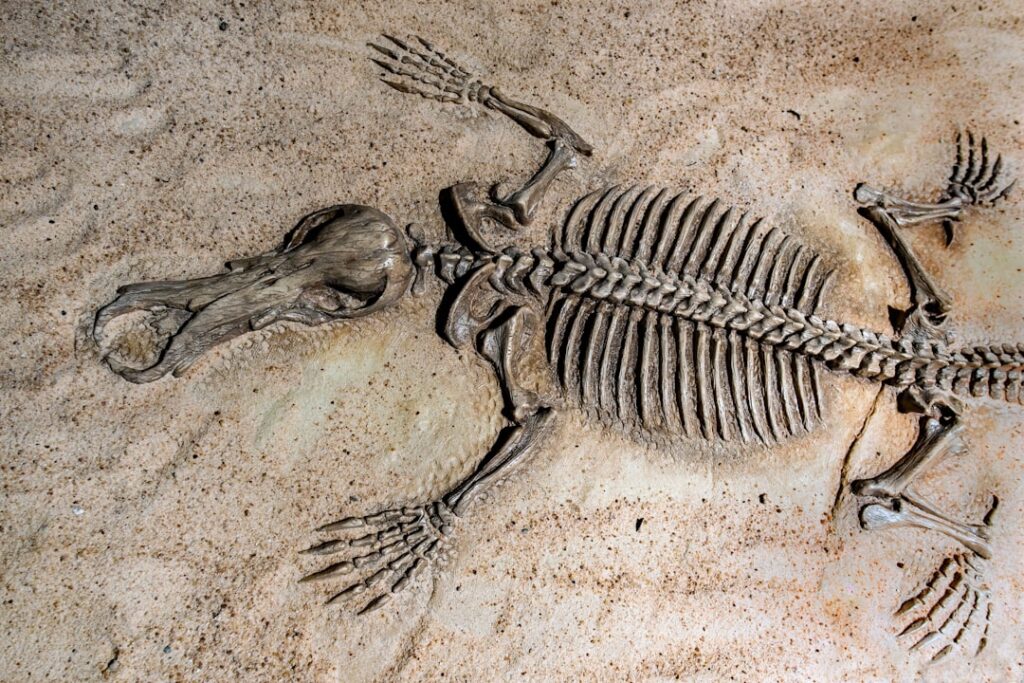
The announcement of a new dinosaur species often follows a familiar pattern: a name, fossil remains, and a publication date. However, the recent description of Gonkoken nanoi in the journal Science Advances represents more than a routine addition to the fossil record. It marks a significant change in where scientific attention is directed within the field of paleontology.
For many years, the major narratives of dinosaur science originated primarily from North America and Europe—regions such as Montana’s badlands or the cliffs of southern England. Patagonia, by contrast, occupied a marginal position in these accounts. This pattern is now being disrupted. The Chilean Antarctic Institute has documented a species from 72 million years ago, during the Cretaceous period, and the implications extend beyond a single herbivorous dinosaur.
Gonkoken nanoi belongs to the hadrosaur group, duck-billed dinosaurs that were widespread and numerous plant-eaters in their ecosystems. While finding a hadrosaur in Patagonia is not unexpected, the circumstances of this discovery are noteworthy. The research was published in a peer-reviewed, open-access journal affiliated with the American Association for the Advancement of Science. This choice of outlet reflects a deliberate strategy by the research team.
Science Advances, established in early 2015, was designed for rapid dissemination and broad accessibility. Its open-access policy ensures that individuals in rural Chile or students in Buenos Aires can access the paper simultaneously with researchers at institutions like the University of Chicago. This model contrasts with traditional subscription-based journals, where access often required reprints or translated abstracts.
The fossil evidence itself is straightforward. However, the process behind its study reveals a systematic effort. The Chilean Antarctic Institute organized expeditions, secured funding, and managed the logistical challenges of fieldwork in Patagonia, where wind and distance create significant obstacles. The decision to publish through a modern, open platform was a calculated step, not an accident.
This discovery is expected to encourage further research. Additional expeditions and funding applications are likely to follow, and young paleontologists may increasingly focus on southern South America rather than traditional sites in Montana. The hadrosaur family tree now includes a new branch, which will attract further investigation.
The study also prompts a reassessment of Patagonia’s ancient environment. The presence of Gonkoken nanoi 72 million years ago raises questions about coexisting predators, other herbivores, and the region’s plants, rivers, and seasonal patterns. Each fossil contributes to a broader understanding of this ecosystem.
The open-access platform enables researchers worldwide to examine these connections simultaneously, rather than sequentially. This represents a structural shift in scientific publishing. South American science has historically struggled for visibility, with journals based in the global north acting as gatekeepers. Science Advances, although a U.S. publication, removes paywalls that previously limited access to discoveries from Patagonia for researchers in locations such as Mongolia.
Gonkoken nanoi is both a dinosaur and a demonstration of changing practices in paleontology. The rules governing who finds fossils, who publishes results, and who reads them are being revised. While the physical remains remain unchanged, the scientific system surrounding them is evolving rapidly. This discovery is both a product of that evolution and a force driving further change.




