
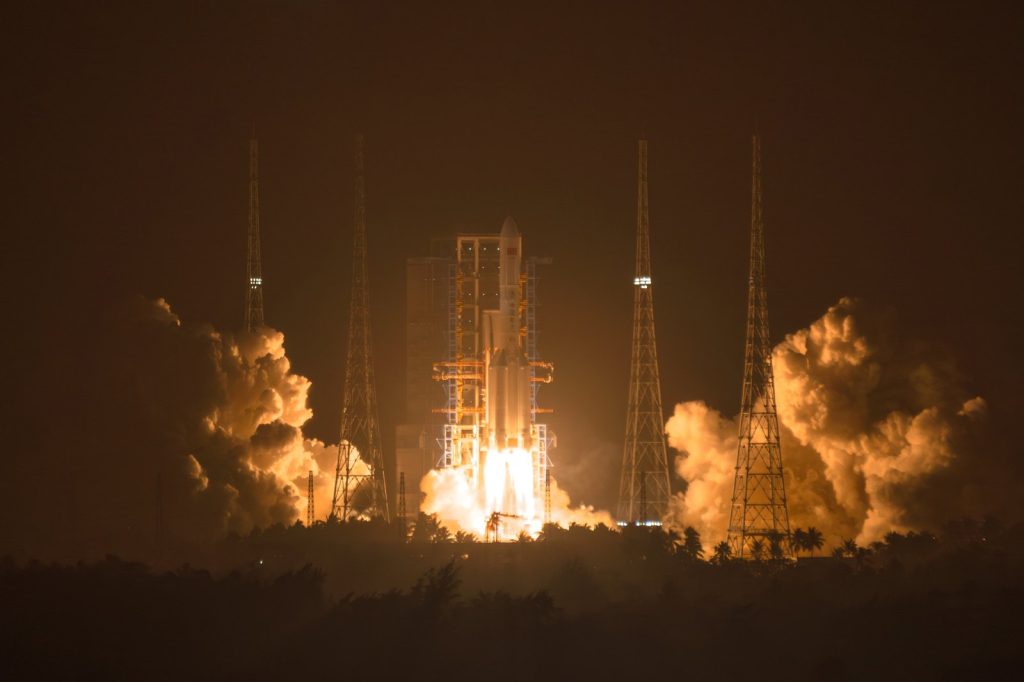
BEIJING, July 10 — China’s state-owned rocket builder has put a new heavy-lift vehicle into the air. The Long March 10B, developed by the China Academy of Launch Vehicle Technology (CALT), conducted its maiden flight from the Wenchang Space Launch Site on Hainan Island. CALT is a state-owned enterprise under the China Aerospace Science and Technology Corporation (CASC).
Founded in 1957, the academy has designed every variant of the Long March rocket family. The chief designer of the Long March 10 series is Li Dong, a senior engineer at CALT who previously led the development of the Long March 5.
The company said the project employed over 5,000 engineers and technicians. Wenchang, built in 2014, is China’s fourth launch site. The recovery team for the Long March 10B was led by CALT’s Reusable Launch Vehicle Division, a unit established in 2020.
The Chinese government’s space budget for 2024 is approximately $15 billion, with $3 billion allocated to reusable rocket programs. The Long March 10B project is a direct beneficiary of that spending.
Central Asian markets watch these developments closely. Kazakhstan’s Baikonur Cosmodrome has long been the primary launch site for Russian rockets, and any shift in global launch pricing or capacity affects the economics of that facility. Officials in the Kazakh space agency have not yet commented on the Long March 10B flight.
Reusability and the market
The establishment of the Reusable Launch Vehicle Division in 2020 shows that CALT has been working on cost-reduction technology for years. If the Long March 10B achieves operational reusability, it would allow China to compete more directly on price for commercial satellite launches. Li Dong, the chief designer, brings experience from the Long March 5 program, which itself was a heavy-lift vehicle.
The Long March 10 series appears to be the next step in that heavy-lift lineage, though the source material does not specify payload capacity or orbital targets for the maiden flight. China’s space budget of approximately $15 billion for 2024 places it second globally behind the United States.
The allocation of $3 billion to reusable rocket programs represents a concentrated bet on cost-reduction technology. The Long March 10B project, with its 5,000-person engineering team, is one of the largest single rocket development programs in the world by personnel count.
What to watch next
The key question for global launch customers is whether the Long March 10B will enter commercial service and at what price. CALT has not released a launch manifest or pricing details. The Wenchang site, with its coastal location, is well-suited for launches to low-inclination orbits, which are common for communications and Earth-observation satellites.
For Central Asian economies, the implications are indirect but real. Kazakhstan’s space-related revenues from Baikonur depend on Russian launch activity, which in turn depends on global demand for launch services.
Officials in the region will be watching for data on the Long March 10B’s performance and cost structure in the months ahead.




