
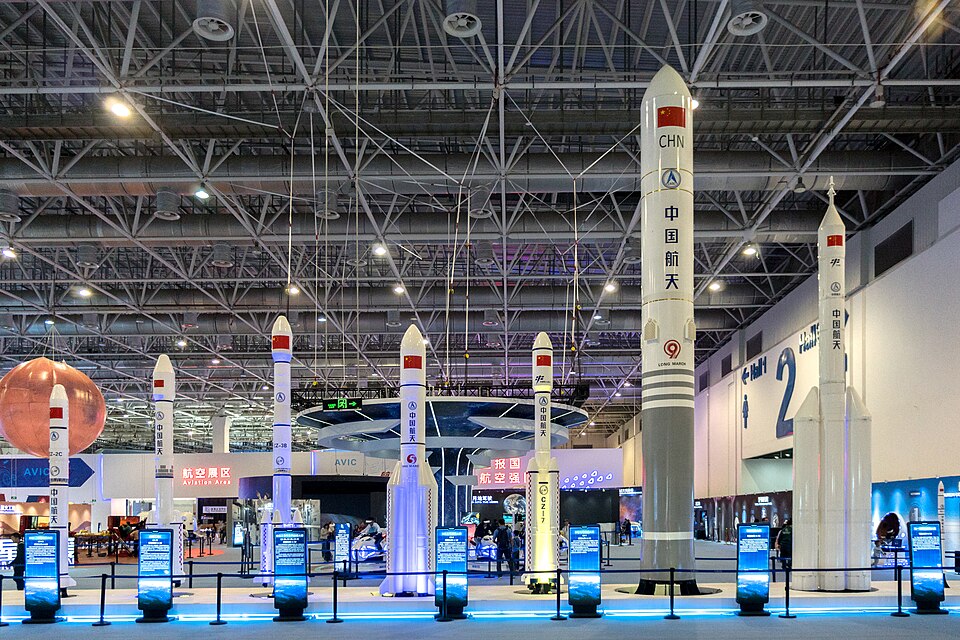
China’s state rocket maker got a first-stage booster back in one piece on the very first flight of a new vehicle, something Scientific American says no one else has done. The Long March 10B launched on July 10, a Friday, from the Wenchang Commercial Space Launch Site on Hainan island at 12:15 a.m. EDT.
About 11 minutes after liftoff, and after an undisclosed satellite had been placed in orbit, the first stage came back down. It fired its engines to slow itself and dropped into a net on a waiting sea-based platform.
The China Academy of Launch Vehicle Technology, an affiliate of the state-owned China Aerospace Science and Technology Corporation (CASC), built the rocket. CASC posted afterward, in a statement translated by Google, that the flight was “the world’s first [net]-based recovery of a launch vehicle.” It called the result “a historic breakthrough” for reusable rocket technology. The company also confirmed that the booster from this maiden flight is planned to fly again later this year.
Hooks instead of legs
The vehicle is 63 meters tall with a five-meter-wide payload fairing. That looks a lot like SpaceX’s Falcon 9, which is seven meters taller and has a similar fairing. The difference is at the bottom. The Falcon 9 and Blue Origin’s New Glenn land on legs, while the Long March 10B has none and uses four lightweight “landing hooks” to catch on the net.
It can lift 16,000 kilograms to low-Earth orbit. It is a commercial variant of the Long March 10A, which was first conceived to carry crews and cargo to destinations like China’s Tiangong space station. Both descend from the Long March 10, a very large rocket meant to send Chinese astronauts to the moon by 2030. U.S. plans call for a crewed lunar return by 2028 through NASA’s Artemis program.
Why it matters for constellations
Scientific American describes the 10B as a key enabler of China’s push to deploy huge satellite megaconstellations like SpaceX’s Starlink, which passed 10,000 active spacecraft earlier this year.
The flight puts China next to SpaceX and Blue Origin as the only organizations that develop and operate this kind of reusable rocketry. China has backups. The state-developed Long March 12A and the commercial Zhuque-3 from the state-sponsored company Landspace have each flown test missions within the past year, although neither had yet landed a first-stage booster successfully. Many other Chinese ventures are earlier in development.
More Zhuque-3 and Long March 12A flights are likely soon, the magazine notes, though dates are unclear because China tends not to share details of future plans.




