
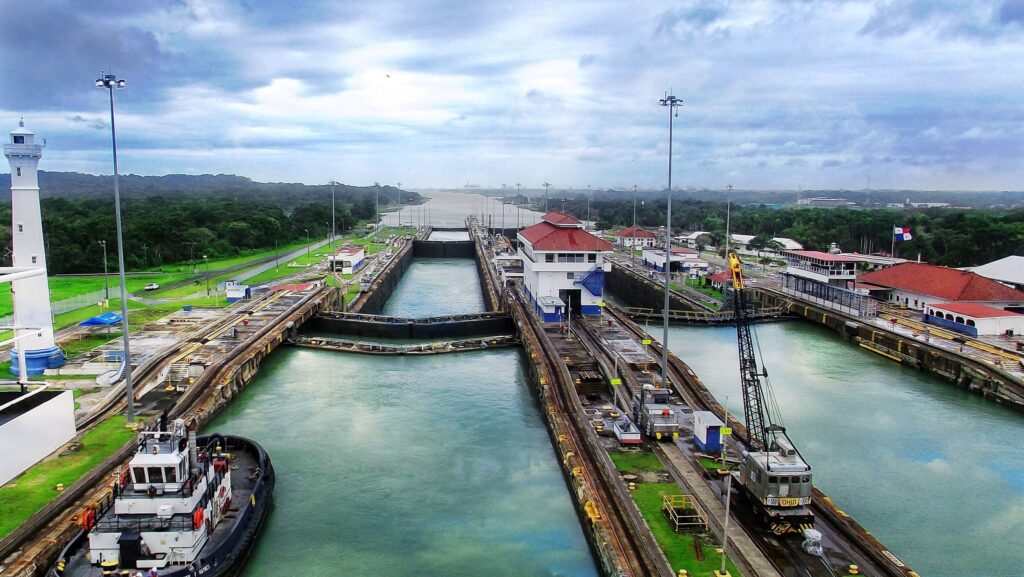
August 1914 delivered two reshufflings of the map at once: Europe marched into a world war, and a steamship named SS Ancon threaded from Atlantic to Pacific through the new Panama Canal. The second event, strategically, was the quieter revolution. A waterway that lopped thousands of miles off the routes between U.S. coasts, redrew naval planning and tilted the economics of trade across the hemisphere had arrived at the exact moment American power needed mobility most. The canal’s construction, 1904 to 1914, is the story of how that calculus was executed, and of who paid for it.
The failure that made success possible was French. Ferdinand de Lesseps, the builder of Suez, began a sea-level canal across the isthmus in the 1880s and collapsed by 1889 in disease, landslide and a financial scandal that ranked with the century’s worst; more than 22,000 workers died, most killed by malaria or yellow fever, diseases whose transmission was not yet grasped. The lesson Washington read was specific: the isthmus was not chiefly an earthmoving problem. The excavation was within reach of late-nineteenth-century engineering, but no workforce could survive long enough to dig it. The American project put medicine ahead of machinery.
The legal groundwork moved fast. Congress passed the Spooner Act in 1902, buying French assets; treaty talks with Colombia stalled; Panamanian separatists declared independence on Nov. 3, 1903, with American support; and the Hay-Bunau-Varilla Treaty of 18 November 1903 handed Washington a canal zone ten miles wide in perpetuity, for a ten-million-dollar down payment plus a quarter-million-dollar annual annuity. The route itself had been settled by an 1899 study, the “second Walker Commission” that weighed Panama against Nicaragua. On 4 May 1904, Lieutenant Mark Brooke of the U.S. Army received the keys to the French property, a depleted workforce and a cautionary tale of mud and fever.
The first battle was entomological. Colonel William C. Gorgas, applying the new mosquito theory of transmission, drained standing water, oiled breeding pools, screened buildings and fumigated with military discipline; the campaign opened on 7 July 1905, and within a year yellow fever had vanished from the Canal Zone and both terminal cities. Malaria followed the same curve: in November 1906 the employee death rate ran 11.59 per 1,000, and by December 1909 it read 1.23. For the whole population the July 1906 rate of 16.21 per 1,000 fell to 2.58 by December 1909. Within five years an enterprise that had cost 22,000 French lives was losing a shrinking fraction of its own force to the diseases that had doomed it.
The digging force peaked above 55,000, and its structure was engineered as deliberately as the locks. The largest single group was West Indian; UNESCO’s Memory of the World register puts the Anglo-West-Indian migration to the isthmus between 1880 and 1914 above 50,000 workers, drawn from Barbados, Jamaica and other British territories by wages that offered an escape from post-emancipation poverty. The administration formalized them into a two-tier system: the “gold roll” for Americans and many Europeans, the “silver roll” for most Caribbean laborers, with separate towns, schools, restrooms and drinking fountains, and different pay, vacations and pensions. Officially, the administration never used the words “white” and “colored,” the record notes, though gold came to mean white American and silver non-white and non-American, a system not dropped until the mid-1950s. The disease campaign’s benefits were distributed on the same gradient: West Indian crews, housed under Silver Roll conditions, carried a heavier share of the deaths that remained.
Engineering, when it finally led, led with locks. Abandoning the sea-level design, the Americans dammed the Chagres River to create Gatun Lake, then among the largest artificial lakes on earth, and lifted ships some 85 feet through three lock sets, Gatun on the Atlantic, Pedro Miguel and Miraflores on the Pacific, trading an impossible trench for manageable concrete. The first chief engineer, John Findley Wallace, quit in frustration in 1905; George W. Goethals, an Army officer, took command in 1907 and imposed centralized authority. The eight-mile Culebra Cut through the continental divide remained the terror, its landslides burying tracks and equipment as fast as crews could clear them, with spoil trains running like a circulatory system and excavation measured in hundreds of millions of cubic yards. The triumphal language of “making the dirt fly” left little room, then as now, for the workers whose names never entered the commemorations.
Commercial traffic began on 15 August 1914, the Ancon’s transit serving as the first official passage. The American decade had killed an estimated 5,600 workers, a fraction of the French toll but still a ledger. What this signals, a century on, is the broader stakes of infrastructure itself: the locks, the lake and the cut, supplemented by the 2016 expansion, still carry commerce through a corridor whose treaty, medicine and labor system were all load-bearing for the same outcome, and whose advantage Washington drew on in both world wars. The canal proved a modern state could solve a problem France could not. It also proved the solution would be built on hierarchy, and that the map of what a society values is drawn in who it asks to pay.
Sources
- Construction History of the Panama Canal: The French Failure and the American Build | Panama Passage
- Panama Canal (1904–1914): The Ditch That Reordered the World | Library of History




