
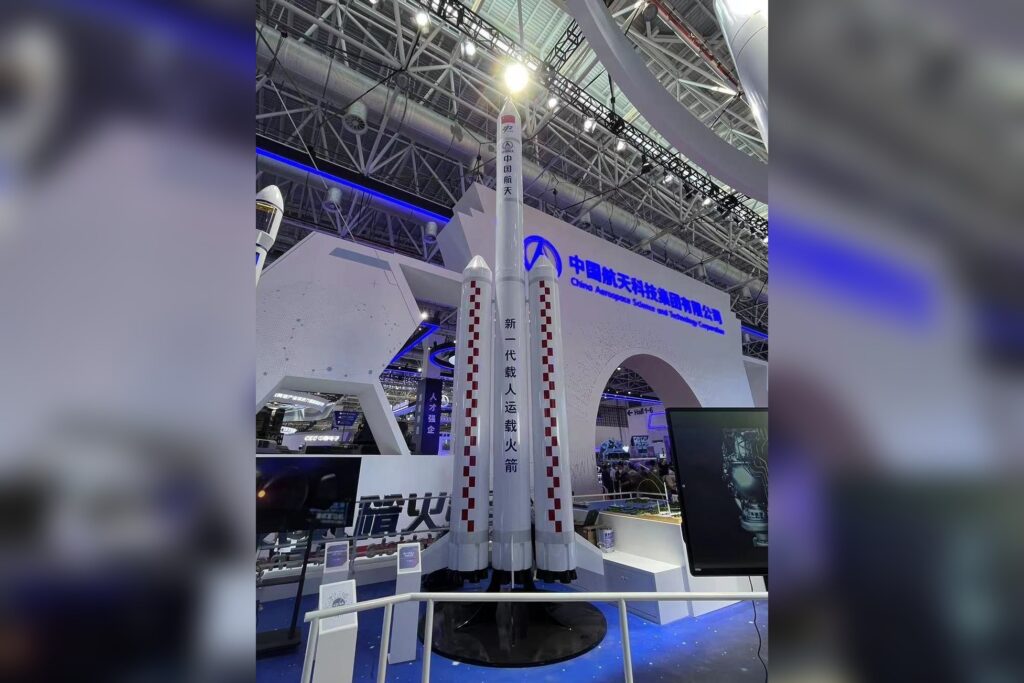
China caught a rocket booster in a net at sea on July 10, and on August 19 a second Chinese booster set down on legs in the Gansu desert. Between them, the two recoveries put China alongside the United States as the only countries reported to have done controlled booster recoveries, according to state media accounts.
The net catch off Hainan
The Long March-10B lifted off from the Wenchang launch site in Hainan province at around 12.15 pm local time on Friday. Xinhua called it China’s “first controlled recovery of a carrier rocket’s first stage.” The Global Times added that it was the world’s first net-based recovery of a launch vehicle.
The rocket stands 63 meters tall and 5 meters wide. It was built by the China Academy of Launch Vehicle Technology and can carry payloads of at least 16 metric tons. About six minutes into the flight the first stage reached the separation point and then came back vertically onto a sea-based platform, while the upper stage placed a satellite in orbit. China Aerospace Science and Technology Corp later said the booster is due to fly again this year. The state-owned conglomerate recovered it in the South China Sea using a cable system on a special vessel.
It was China’s second try at the feat since February. The first, with a Long March-10A, ended when the rocket completed a controlled descent but splashed down next to the recovery platform. Anadolu noted that Beijing spent more than $19 billion on space in 2024, per Statista. It also noted that SpaceX first recovered a Falcon 9 in 2015, and Blue Origin did the same with its New Glenn last November.
A private firm lands on legs
The second recovery belonged to LandSpace, a Beijing-based private manufacturer. Its Zhuque-3 Y2 left the Jiuquan Satellite Launch Center at 7:35 am on Wednesday, August 19, carrying the Honghu-03 satellite. The stages separated about 137 seconds after liftoff. At around 7:41 am the first stage made a soft landing on a concrete pad in Minqin county, Gansu province, about 390 km away.
Drone footage showed the booster lighting a single central engine roughly 3 kilometers up, then deploying four legs shortly before touchdown. The rocket is 66.1 meters tall and made mainly of stainless steel, with nine methane engines on its first stage. China Daily noted that LandSpace is the second Chinese enterprise to recapture a booster.
The first Zhuque-3 flight, in December 2025, reached orbit but its booster burst into a fireball over Minqin in the final seconds. Shen Chao, deputy chief designer, said the Y2 fires fewer engines on the way down, can choose its own landing point in real time, and has better base heat protection.
Whether the booster flies again depends on inspection. Deputy project manager Huang Cheng said engineers will check it at the site, then strip it down at the Zhejiang factory, and decide only after reviewing all test results. That plant is meant to turn out eight to 10 rockets a year once production ramps up.
Who else is in line
Kang Guohua of Nanjing University of Aeronautics and Astronautics told the Global Times the two routes, state and private, show the strength of mixing national capability with market drive. Galactic Energy’s Pallas-1 is preparing to launch, Orienspace’s Gravity-2 is scheduled for a maiden flight in the fourth quarter of 2026, and i-Space’s Hyperbola-3 is expected to fly around the end of 2026.
Sources
- China achieves its first rocket recovery on land
- China marks space breakthrough with 1st reusable rocket landing
- Zhuque-3 Y2 landmark recovery test marks Chinaâs dual-track reusable rocket development, aerospace experts say




