
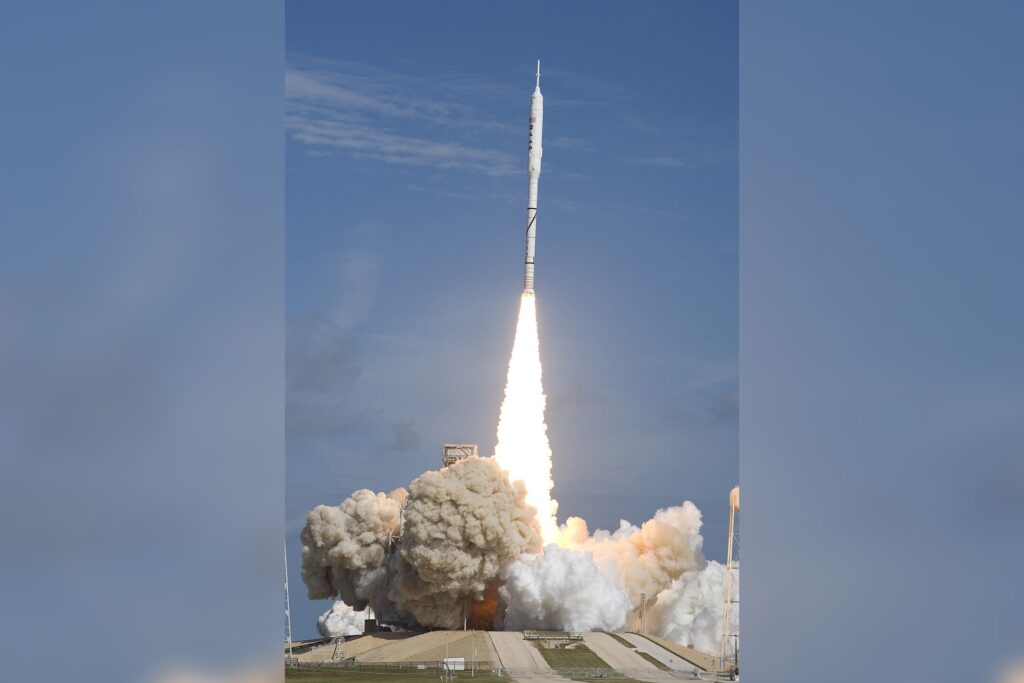
Throwing away a booster after every flight is what has kept launch prices high for decades. On July 10, China showed it can stop doing that. The first stage of the Long March 10B came down from space on the rocket’s maiden flight and was caught by a net on a ship in the South China Sea.
The China Aerospace Science and Technology Corporation (CASC) said the stage returned about six minutes after the two stages separated. Its statement called the result “a historic breakthrough” in reusable rocket technology and said the launch and recovery were “a complete success.” The same rocket put a satellite into what Xinhua called its predetermined orbit. The payload has not been identified.
No legs, just hooks
The comparison most outlets reached for was SpaceX. It fits only partly. A Falcon 9 booster lands on four fold-out legs, on a pad or a drone ship. The Long March 10B carries none. It has landing hooks near the top of the stage instead, and the recovery ship, named Linghang Zhe, has a tall steel gantry with tensioned cables strung across it. The booster descends under power, lowers itself into the cables, and the hooks catch.
The reasoning is about weight. Legs are heavy, and every kilogram of them is a kilogram of payload left on the ground. CALT expert Chen Muye told Chinese state media that net recovery “helps simplify the rocket’s onboard structure, reduces vehicle mass and increases payload capacity,” and that coordinated nets widen the window for a catch when the landing point is off.
What the rocket is
The vehicle was developed by the China Academy of Launch Vehicle Technology (CALT) for commercial launches. It stands about 63 metres tall with a diameter of 5 metres, and CALT says it can carry at least 16 metric tons to low Earth orbit. The first stage burns kerosene and liquid oxygen. The second stage runs on liquid oxygen and liquid methane. It is the single-core version in the Long March 10 family, whose three-core sibling is the rocket China is building to land astronauts on the Moon by 2030.
Where the cost question stands
Cost is where this matters for the market, and nothing in the announcements settles it. CASC has not published a price for a launch on a reused stage. China does say it will refly this booster before the end of 2026. If that happens, the gap from first landing to reuse will be under six months, against roughly fifteen months for SpaceX and about five for Blue Origin.
The scale of the incumbent is considerable. Independent reported that SpaceX has launched Falcon 9 nearly 150 times a year and reused recovered rockets dozens of times. Another account put its orbital booster landings at more than 600 and noted a record 36th flight of a single booster the week before. China, by that count, has landed one rocket, once.
Others are in line behind it. CASC’s Long March 12A and Landspace’s Zhuque-3 both reached orbit last December but failed their landings, according to the same account.
Sources
- China successfully lands ‘SpaceX-style’ reusable rocket for first time
- China's First Rocket Landing: Long March 10B Caught by a Net at Sea




