
On Friday a Chinese rocket stage flew itself back down and settled into a net strung across a ship at sea. Xinhua reported that the Long March-10B, on its maiden flight, also put its payload into the preset orbit.
The rocket left the Hainan commercial spacecraft launch site in Wenchang on July 10. After the two stages parted, the lower one began a return trip of about six minutes: coasting, attitude adjustment, powered braking, then aerodynamic deceleration. A cross-shaped net, described by Xinhua as the first of its kind in the world, caught the stage with help from an onboard hook mechanism. State media called it China’s first controlled recovery of a booster.
A net instead of landing legs
Most reusable rockets elsewhere touch down on legs. This one flies straight into the net. Chen Muye of the China Aerospace Science and Technology Corporation (CASC) said the approach has practical advantages: “Net-based recovery simplifies the onboard structure, reduces weight, and boosts payload capacity. It also demonstrates strong adaptability to landing deviations.”
The ship that carried the net was delivered by the China Academy of Launch Vehicle Technology (CALT) in November 2025. It measures 144 meters by 50 meters and displaces 25,000 tonnes fully loaded. Xu Xuelei of CASC told Xinhua that a tall tower on the deck is held by four large supports, with a LiDAR unit at each corner tracking the rocket’s position and attitude. Specialized cables absorb the stage’s energy. Nobody steers the process by hand, and the rocket ends up hanging motionless at the center of the net, Xu said.
The vehicle
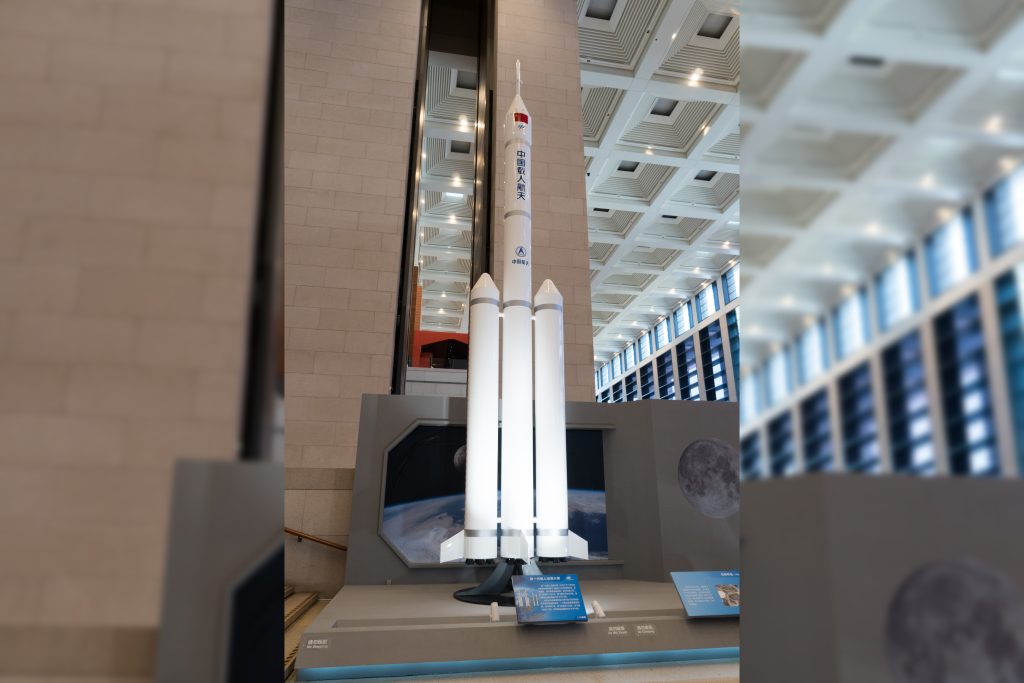
The Long March-10B is a reusable, liquid-fueled commercial launcher about 63 meters tall and 5 meters across. Liftoff thrust is about 890 tonnes and liftoff mass about 760 tonnes. In reusable form it can lift 16 tonnes to low Earth orbit.
Chen said the vehicle was designed mainly for China’s commercial launch market. He listed low Earth orbit satellite internet constellations and large commercial satellites among the jobs it can take on, with lower launch costs coming from reuse. He added that the flight marks a breakthrough in low-cost, heavy-lift reusable rocketry, and that it should speed up routine reusable launches and the next-generation crewed rocket program. The rocket is also slated to serve medium Earth orbit communications.
A larger sibling is on the way. CASC has positioned the Long March-10C, still under intensive development, as a primary commercial vehicle with more payload capacity.
Long Lehao, an expert at the Chinese Academy of Engineering, said the 10A, 10B and 10C “will collectively form the backbone of China’s space transportation system.” He said the three would drive high-frequency reusable launches and extend humanity’s reach into deep space.
Everything above comes from Chinese state media and CASC officials. No independent account of the recovery was included in the Xinhua report.




