
A quiet presence in the early days of China’s human spaceflight program, Li Dong has steadily ascended through the ranks of the country’s most ambitious rocket projects. Born in 1972 in Beijing, Li graduated from Beihang University in 1995 with a degree in aerospace engineering.
The following year, he joined the China Academy of Launch Vehicle Technology (CALT), a subsidiary of the China Aerospace Science and Technology Corporation (CASC). His early work focused on the Long March 2F rocket, the vehicle that carried China’s first astronaut, Yang Liwei, into orbit in 2003. That milestone marked the start of a career that would later place Li at the center of China’s push toward reusable launch technology.
From the Long March 2F to the Long March 5
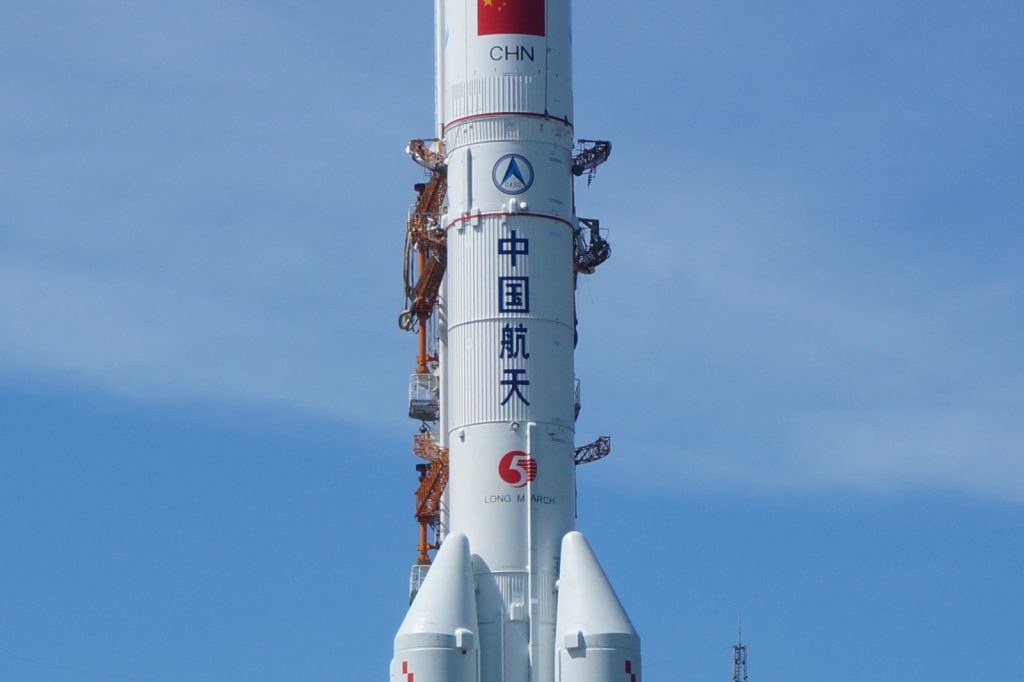
Li Dong’s subsequent appointment as deputy chief designer of the Long March 5 rocket gave him a central role in developing China’s largest expendable launch vehicle, which first flew in 2016. That project, a major step in the country’s space ambitions, led to significant recognition: Li received the State Science and Technology Progress Award in 2020 for his contributions to the Long March 5.
By that time, he had already published more than 40 papers on rocket propulsion and reusability. He is also a member of the Chinese Society of Astronautics. The Long March 5 remains China’s biggest expendable rocket, but Li’s focus had already shifted by 2018, when he was appointed chief designer of a new program.
That year, a public outline of a lunar-capable launch vehicle appeared at an aerospace exhibition, around the same time work began on what would become the Long March 10 program. Under Li’s leadership, the team developed two key technologies for reusability: the YF-100K engine and a grid-fin landing system.
The Long March 10 Program and the Strategy of Reusability
The Long March 10 is a family of rockets under development by CALT, designed for crewed lunar missions, flights to China’s space station, and commercial launches. The planned series includes a super heavy-lift configuration and medium-lift variants built for recovery and reuse through vertical landing. Early flight tests of a booster and a commercial variant have taken place since the program’s start.
For Li and his team, the challenge extends beyond engineering. It is also industrial: scaling up production, testing engines repeatedly, and proving reliability under a state-run system that demands success.
At its heart, the Long March 10 program represents a strategic bet by China that reusable rockets are the future of affordable space access. The stakes are high because China’s space station requires regular crew rotations and cargo deliveries. A reusable rocket could lower the cost of those missions and free up resources for lunar exploration and deep-space science.
Reusable launch systems have become a central point of global competition among spacefaring nations and companies, and the Long March 10 reflects China’s shift toward lower-cost, repeat-use space access.
Implications for Lunar Exploration and Launch Services
For Li Dong, the quiet engineer from Beijing, the countdown continues as the pace of testing accelerates. His work on the Long March 10 program builds directly on his experience with the Long March 5 and earlier rockets. The program’s success could shape future lunar exploration and the availability of launch services, both for China’s crewed space efforts and for commercial customers.
As the state-run system drives these projects forward, Li’s career arc — from the Long March 2F that carried China’s first astronaut to a new generation of reusable rockets — illustrates how the country’s space ambitions have evolved from a single historic flight to a sustained, multi-mission strategy.




