
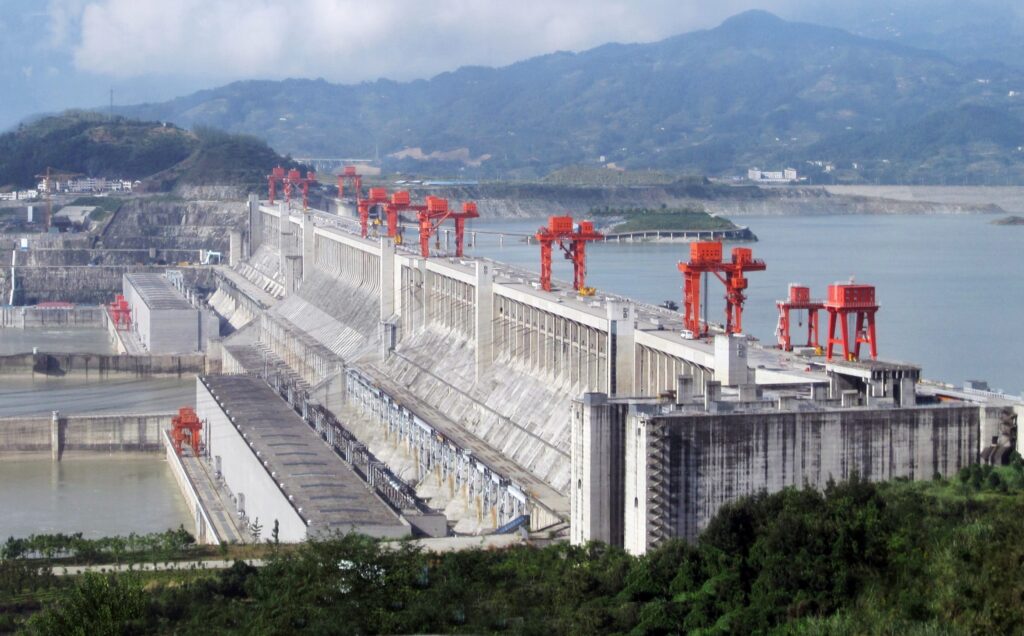
How it works, first, because the mechanism is the story. The Three Gorges Dam is a concrete wall 181 meters tall, about 607 feet, spanning 2,335 meters of the Yangtze where deep valleys give way to plains, one of the few man-made structures visible from space to the naked eye, per NASA. It does not stop floods so much as postpone them: rainwater is caught in an enormous reservoir and then let downstream in measured doses through sluice gates. The curiosity is what happens when the tub being caught is bigger than the cup, and the summer of 2020, when the Yangtze basin took its heaviest average rainfall in close to 60 years, ran that experiment at full scale.
The science behind the seasonal rhythm is neat. The reservoir winds 660 kilometers, some 410 miles, upstream through the Three Gorges canyons to Chongqing, a municipality of 30.5 million people. From October to May the water sits at a maximum of 175 meters to feed the turbines; before the June rains it is drawn down to 145 meters, creating 22 billion cubic meters of storage, room for nearly 9 million Olympic pools. The power payoff is real: the plant, completed in 2012, generates 22,500 megawatts, more than three times the Grand Coulee Dam, the largest American station, and a 2016 account puts it at eleven times the Hoover Dam, with 26 turbines and a 2014 output of 98.8 terawatt-hours that set a world record.
What researchers found, and what the project’s own arithmetic shows, is a mismatch of scale. A once-a-century flood can push over 244 billion cubic meters of water through the Three Gorges in two months, on the calculations of Fan Xiao, a Chinese geologist and longtime critic, roughly twice the volume of the Dead Sea. The reservoir can hold about 9% of that. His verdict: “It’s like using a small cup to deal with a big tub of water. In terms of flood control, the cost of the dam has surely outweighed the gain.” Intriguingly, the official side does not dispute the volumes, only the conclusion: the operator, China Three Gorges Corporation, said the dam intercepted 18.2 billion cubic meters in potential floodwater in 2020, and a water resources ministry official credited it with having “effectively reduced the speed and extent of water level rises” on the river’s middle and lower reaches.
The 2020 ledger, anchored to that summer: more than 158 people dead or missing, 3.67 million residents displaced, 54.8 million affected, 144 billion yuan, about $20.5 billion, in economic losses across the basin. Three flood waves struck the dam by late July, sluice gates opened repeatedly since late June, and Chinese social media criticized the releases for worsening downstream flooding, a charge the operator denied, saying it had delayed and staggered the water’s arrival. Poyang Lake still rose to the highest level in its recorded history, past the mark set by the catastrophic 1998 floods, which killed more than 3,000 people.
The full account has more entries still. The project cost 200 billion yuan, about $28.6 billion, took nearly two decades, submerged 13 cities, 140 towns and 1600 villages by one count, and uprooted more than a million people, an official tally of 1.3 million. The idea itself was old, first envisioned by Sun Yat-sen in 1919, then approved by the National People’s Congress in 1992, with construction from December 1994, the dam body finished in 2006, the power station in 2012 and the ship lift in 2015. Later reporting catalogued cracks, landslides and algal buildup, and one 2016 account even claims the shifted water mass slows the rotation of the Earth, a bit of trivia best filed under intriguing rather than verified. The plain conclusion stands where it did: as a power station, prodigious; as a flood shield, a cup against a tub.
Sources
- Three Gorges Dam: Was China’s project worth building? | CNN
- China’s Three Gorges Dam – a boon? | Mintage World




