
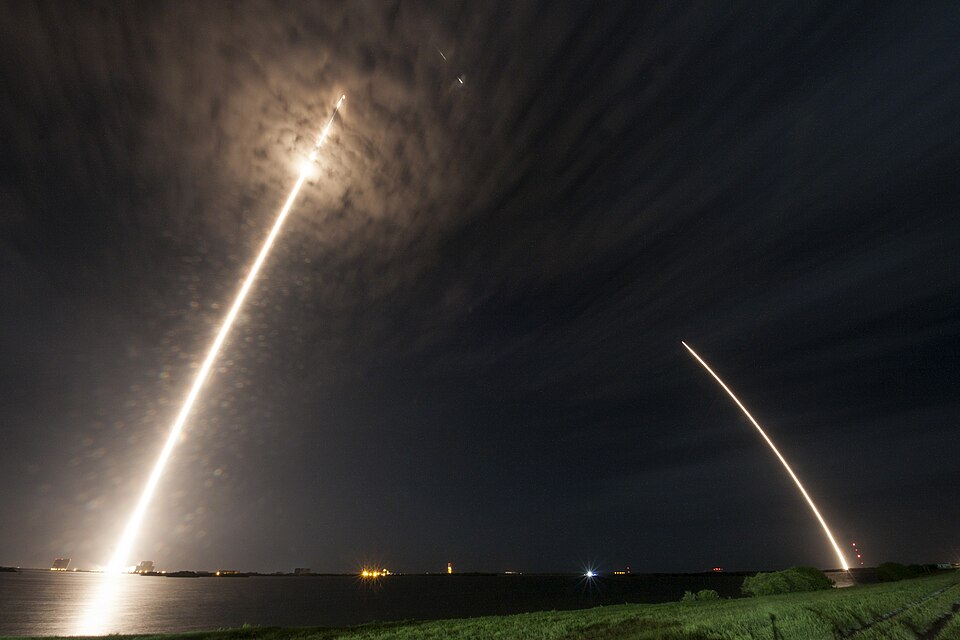
Strategically, the numbers explain the story. A Falcon 9 launch ran about $60 million in 2020, and SpaceX’s own president had estimated a year earlier that reusing the booster could shave up to 30 percent, roughly $18.6 million, off each flight. Those two figures are the arithmetic behind a decade in which private operators stopped asking permission and started setting prices, and they trace a market that barely existed before the 2010s.
The blockade was legal before it was technical. United States federal law kept private firms from flying satellites of their own until 1984, and government programs held the field into the new millennium. The hinge came in 2010, when President Obama retired the space shuttle. At the final Atlantis launch he said the mission “propels us into the next era of our never-ending adventure to push the very frontiers of exploration and discovery in space.” Federal funding followed the symbolism out the door.
Three Billionaires, Three Bets
The void filled quickly and idiosyncratically. Jeff Bezos founded Blue Origin in 2000, and in 2015 it became the first private firm to launch a reusable rocket and land it again. Richard Branson’s Virgin Galactic aimed at tourism, declaring on its site: “Our purpose is to become the spaceline for Earth; democratizing access to space for the benefit of life on Earth,”. Elon Musk chased orbit and then Mars, unveiling the BFR system in Australia in 2017 and grumbling on stage that “It’s 2017. We should have a lunar base by now.”
By the end of 2017, Musk’s company had flown 45 missions since a 2006 demo, with another 70 booked, a manifest worth $10 billion in contracts. John Logsdon, founder of George Washington University’s Space Policy Institute, credited the lead to economics rather than hype: the company offers “a standard service that is placing satellites in orbit at a lower price [than its competitors] and with acceptable reliability,” he told Futurism. He dismissed the monopoly talk, noting that other launch providers operate at home and overseas.
People, Not Just Payloads
The market’s next door opened in May 2020, when a Crew Dragon carried two NASA astronauts to orbit, the first private company to put people in space. Beyond restoring American access to the station without buying Russian Soyuz seats, the flight human-rated a system that seats up to seven and had already attracted Space Adventures, a tourism broker with Soyuz history. TechCrunch, covering the launch, framed the likely customers as deep-pocketed tourists, private researchers who could staff orbital labs for pharma and manufacturing firms, and even film crews, with Tom Cruise already in talks to shoot aboard the station.
The quieter revolution ran through small satellites. Cheaper rides opened orbit to companies that could never have justified a dedicated rocket. Pekka Laurila, co-founder of Finland’s ICEYE, described the mechanism: small operators buy a slice of a launch whose main deck belongs to a bigger payload, which he called “a way that a lot small private space companies are able to access space with non-governmental budgets”. His firm was preparing its own Earth-observation constellation on exactly such shared flights, and smaller launch outfits, he noted, serve orbits the giants do not bother with.
The calculus, as Logsdon put it, is plain: “Lowering the price of access to space is certainly an important development, and SpaceX has led the way in doing that,”. What the price cuts started, the market finished. Government agencies no longer hold a monopoly on the road to orbit; they now buy tickets on it like everyone else.
Sources
- SpaceX Is Leading the Rise of an Entirely New Industry
- SpaceX's astronaut launch marks the dawn of the commercial human spaceflight industry | TechCrunch




