
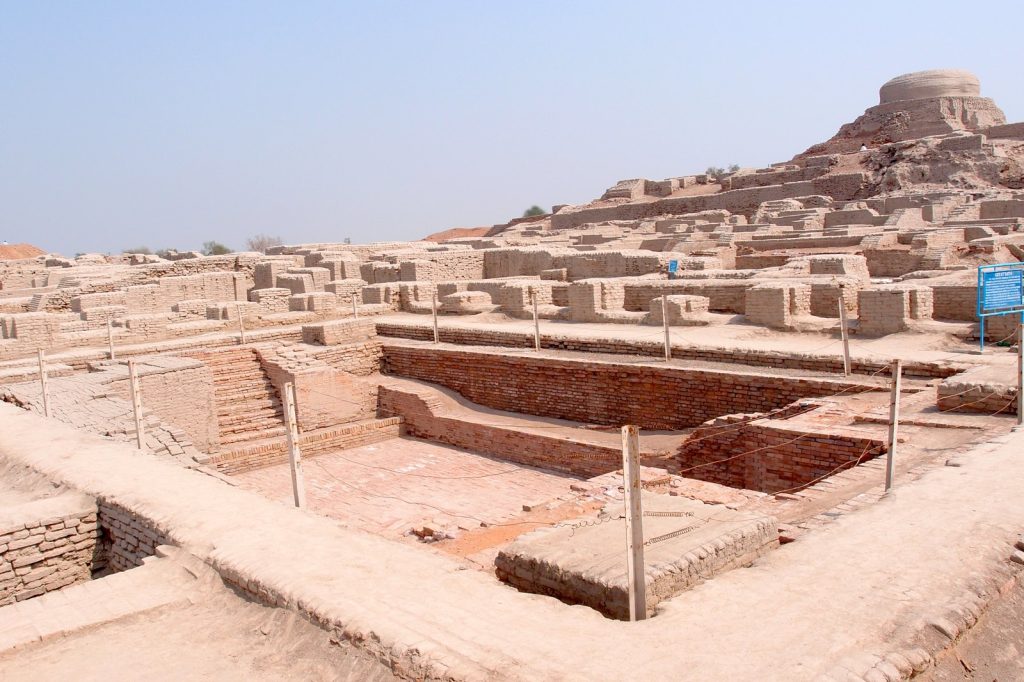
Nearly every house in Mohenjo-Daro had a bathing room, and the floor in each one sloped toward a drain. The bricks were laid so tightly that water had little chance to seep through. From there, waste ran down into drain ditches that followed every avenue and then into tunnels beneath the city. That is how a settlement of perhaps 40,000 people, built around 2500 BC in what is now Pakistan’s Sindh province, kept its streets and wells clean.
The Indus Valley civilization has drawn attention for exactly this kind of practical engineering. National Geographic once said its people had the “ancient world’s best plumbing,” in some ways better than what Rome built later, according to the think tank HumanProgress.
A city on a grid
The Indus cities did not grow at random. The World History Encyclopedia notes that their grids were aligned north to south, which suited the prevailing winds, and the same gridded thinking shows up in house plans, pottery designs and even the characters of the Indus script. National Geographic described Mohenjo-Daro’s street grid and drainage as signs of skilled urban planners.
The civilization itself was unknown until 1921, when excavations in what would become Pakistan uncovered Harappa and Mohenjo-Daro. It emerged nearly 4,500 years ago and lasted about a thousand years, living off the fertile Indus floodplain and trade with Mesopotamia.
Drains that could be cleaned
The drainage was the part that stood out most. Small drains from latrines and bathing areas fed bigger ones along the streets, and those emptied into larger sewers on the main roads. Some of the larger drains had corbelled roofs, so they could be buried under the road without collapsing. Others were capped with removable brick paving or dressed stone so crews could get in and clear them. Sump pits at intervals caught heavy solids, and workers cleaned the pits to prevent blockages.
Planners also kept clean water apart from sewage. At Harappa, bathing-room drains ran separately from latrine drains. Most houses there had a latrine made from a large terracotta jar sunk into the ground, with a small hole in the bottom to let water soak away. The encyclopedia says a special class of laborers probably emptied them.
In Mohenjo-Daro, upper-floor washrooms fed vertical terracotta pipes joined with tar to make them watertight, according to HumanProgress. As the city grew, residents raised the brick walls beside the ditches so the overflow stayed out of the streets.
No palace, but a Great Bath
Mohenjo-Daro had no obvious palace, temple or royal tomb. The largest structure was a raised public bath. The Great Bath measured almost 900 square feet and went down about 8 feet, with a floor of three layers: sawed brick in gypsum mortar, a bitumen seal, then more brick and mortar. Gregory Possehl of the University of Pennsylvania called the civilization “pretty faceless” and suggested the Great Bath points to an ideology built on cleanliness.
Copper and craft
The record on metalwork is thinner. National Geographic reported that pottery and tools of copper and stone were standardized across the Indus lands, and seals and weights point to tightly controlled trade. At Harappa, the World History Encyclopedia says, the street east of the main gateway leads toward workshops where agate, shell and copper were worked.
How it ended is still disputed. Archaeologist Jonathan Mark Kenoyer has suggested the Indus River changed course, hurting farming and trade, but he also said no evidence shows flooding destroyed the city, and it was not completely abandoned. Possehl said a shifting river does not explain the collapse of the entire Indus civilization: “What drives that, nobody knows.”
Sources
- Centers of Progress, Pt. 3: Mohenjo-Daro (Sanitation) – Human Progress
- The lost city of Mohenjo Daro | National Geographic
- Harappa: An Overview of Harappan Architecture & Town Planning – World History Encyclopedia




