
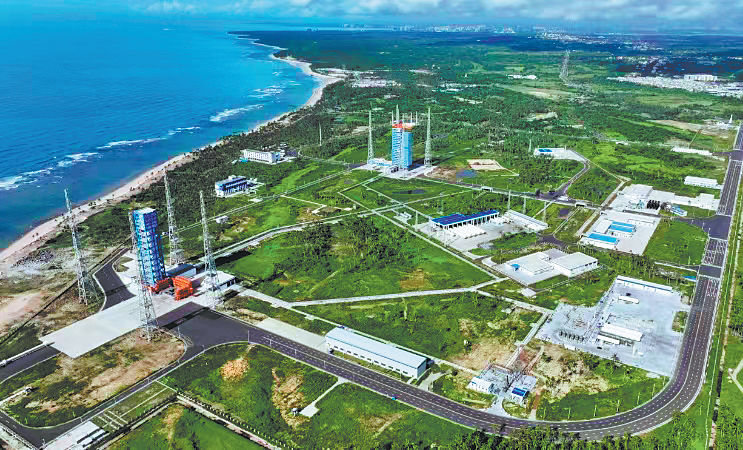
The first crew access arm went on around October 14 at the height needed for boarding a Moon-bound Mengzhou spacecraft, according to China in Space. It is one of three attachment points being installed on the launch vehicle support tower at Wenchang Space Launch Site’s Launch Complex 301, the pad where all taikonaut-carrying missions will depart.
Two of the three points are for Mengzhou; the third could give crews access to otherwise unreachable parts of the crew capsule or the Long March 10 fairing. Launch Complex 301 skips the usual servicing platforms attached to support towers at other Chinese launch sites, China in Space reported.
China’s crewed lunar program work kept moving after the Mengzhou-1 mission was quietly delayed a few months ago. The attachment points for the arms were hoisted into position at the end of September. By the night of October 18, crews were preparing to lift further equipment into place.
At ground level, most work around Launch Complex 301 appears complete. The water deluge system, support buildings for managing commodity systems during a launch, and access roads are in place. The treeline has been preserved, which hides whether propellant lines are connected to storage tanks.
Mobile platforms near completion
Two mobile launch platforms are in late outfitting. The first reached full height in late September. Its launch vehicle release mechanisms were changed from the temporary setup used on the Long March 10A test booster to a standard design for the Long March 10 series. A second platform has risen above the treeline this month, still one segment short of full height.
Each platform is receiving commodity arms to feed propellant, electricity, and payload air conditioning. Both sit just outside Launch Complex 301. Rail tracks to the technical area are being finalized and inspected.
Vehicle assembly buildings readied
In the technical area, the twin vehicle assembly buildings for the Long March 10 have completed external work. That allows installation of spacecraft processing equipment inside the buildings and attached cleanrooms. Interior photographs require approval and do not stay online permanently. Doors open occasionally to circulate air, giving brief glimpses of installed platforms, cranes, and other equipment for work on launch vehicles.
China in Space said it has seen images with platforms, cranes, and other equipment for work on launch vehicles. It is not known whether those systems have been approved for use.
Once work finishes at the pad, in the technical area, and on at least one mobile platform, a large-scale systems test is rumored before the end of the year. That would clear the way for the Long March 10A and Long March 10 to make their first flights next year, in that order. The Long March 10 can send 27,000 kilograms toward the Moon, while the Earth-orbit Long March 10A can bring up to 18,000 kilograms into low Earth orbit.
Those flights would allow missions in 2027 and 2028 to test the Mengzhou spacecraft and Lanyue lunar lander in orbit. Work on the Wangyu lunar spacesuit is also progressing. China plans to send its first two taikonauts to the Moon no later than October 2029. “China is under no geopolitical pressure to accelerate the crewed lunar program’s schedule,” China in Space wrote.




