
The mechanics of the most famous voyage in history are usually told as romance. They are better read as a term sheet. Christopher Columbus, a Genoese sailor born in 1451 to a weaver and tavern-keeper, was not chasing a new continent; he was pitching a trade route. The overland Silk Road that had carried Eastern goods to Europe since 130 BCE under the Han, and later under the Mongols and Byzantines, was shut when the Ottoman Turks took Constantinople in 1453, and Arab traders held the sea lanes east. Europe’s merchants went looking for another way in, and Columbus sold them a westward one: cross the Atlantic, reach Cathay, reopen the trade at source.
Follow the money and the first thing that stands out is how many investors said no. Around 1484 he took the plan to King John II of Portugal, who rejected it on the correct grounds that Columbus had the distance wrong. Working from a map the Florentine mathematician Toscanelli sent him in 1474, plus Marco Polo’s travel book and documents he could read in the Latin, Spanish and Portuguese he had taught himself, Columbus put the Canaries-to-Cathay run at roughly 2,300 miles, about 3,700 km. The real figure is 12,200 statute miles, some 19,600 km. Genoa said no. Venice said no. Ferdinand II and Isabella I of Spain said no too, then paid him a retainer mainly to keep the pitch away from rival governments, and only after the last Moorish stronghold at Granada fell in 1492 did they sign: three ships, full funding, and a contract giving the crown 90% of the profits, with Columbus made viceroy and governor of whatever he took.
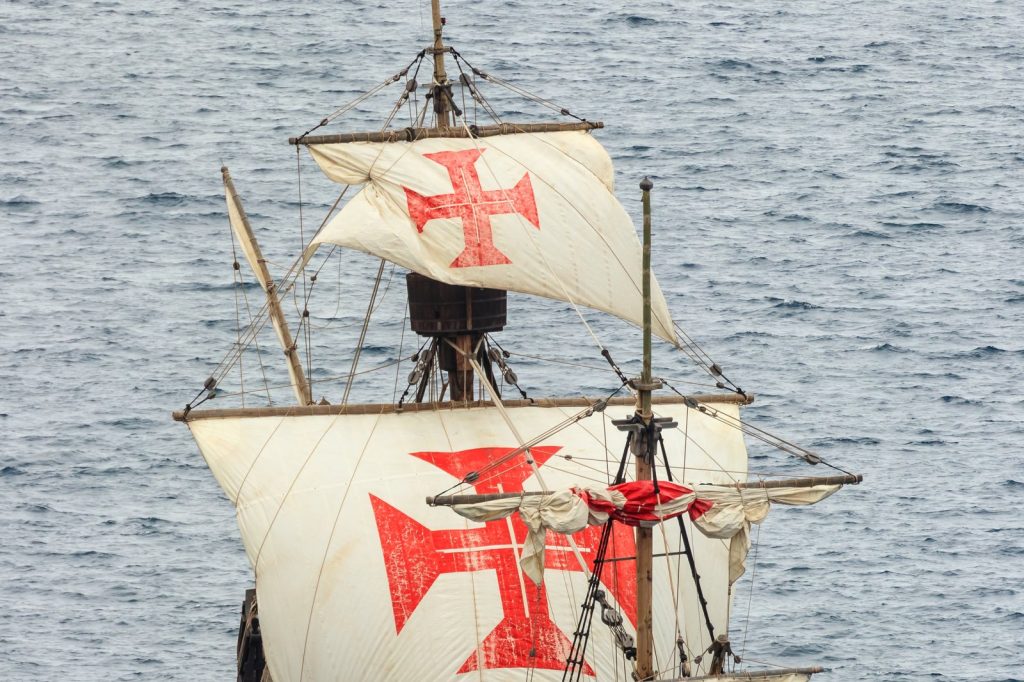
The voyage itself ran on nerve and a bad map. The flotilla, the carrack Santa Maria and the caravels Pinta and Nina, left southern Spain on 3 August 1492, spent a month in the Canaries and turned west in September. Weeks of empty ocean later, on 10 October, the crew threatened mutiny, and Columbus agreed to turn back if no land showed in three days. Land arrived two days after that, on 12 October, when they dropped anchor off a lived-in island of the Bahamas, which the locals called Guanahani and he renamed San Salvador. Convinced he had reached Asia, he called the people “Indians”, a label that has misdescribed two continents ever since, and claimed the land for Spain and the Catholic Church with the fleet’s secretary and royal inspector as witnesses.
Two more months of Caribbean searching, for gold and for the Asian mainland, reached Juana, today’s Cuba, on 26 October and then Hispaniola on 6 December. When one ship was driven onto the coast and lost, he left a garrison behind, the fortress of La Navidad, 39 men by one account or 40 by another, and sailed for home by a north-easterly loop to the latitude of the Azores to catch the trade winds. The proof of concept he carried back to Spain was of a piece with the whole venture: a few captive islanders, some gold and some parrots.
The aftermath is its own ledger. Columbus made four voyages in all between 1492 and 1504 and died insisting he had found the East; he never claimed to have discovered America. That story was manufactured later, and the naming went elsewhere: the published letters of Amerigo Vespucci, describing voyages to the “New World” between 1497 and 1504, were so popular that world maps from 1506 credited him, which is why the continents carry the feminine form of his name. Washington Irving’s 1828 Life and Voyages, largely fictional, fixed the hero narrative and fed the making of Columbus Day, an American holiday from 1906. On closer reading, the record holds three facts at once: the Norse under Leif Erikson reached North America centuries earlier with no lasting effect; the Columbian Exchange that began with this landfall moved people, plants and technology between hemispheres and built the modern age; and from the 1970s onward the “discovery of America” framing has been reweighed against what the indigenous population paid for it. The deal was underwritten on a mileage estimate off by a factor of five. The catch is that it still closed, and the world has been settling the account ever since.
Sources
- Christopher Columbus’ first voyage 1492-1493 – The map as History
- Christopher Columbus – World History Encyclopedia




