
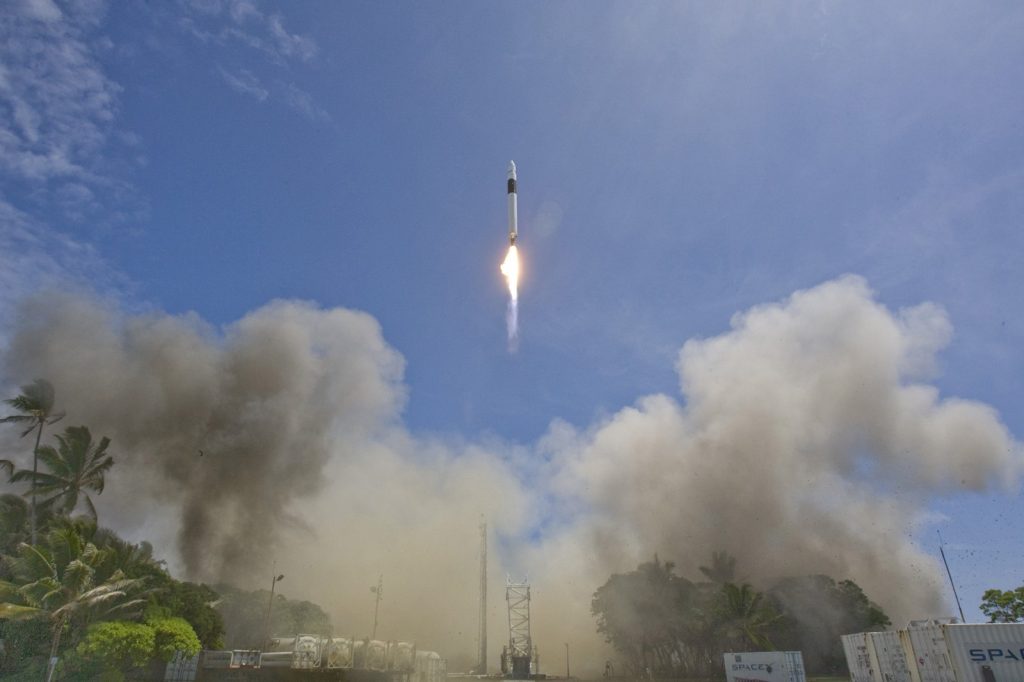
The economic stake, stated plainly: in 2008 SpaceX was a six-year-old company burning one man’s money on a promise of three tries. Elon Musk had told the press his $100M personal stake would fund up to 3 launches, and that missing on the third might mean admitting defeat, a narrative that competitor lobbyists in Washington were working overtime to amplify, painting the young firm as too risky and inexperienced to protect what one insider called their multi-billion dollar interests in the launch business. On September 28, 2008, the bet cleared. SpaceX’s fourth Falcon 1 mission, rising from Omelek Island, in the South Pacific, succeeded 9 minutes 31 seconds after takeoff, making Falcon 1 the first privately developed liquid-fuel booster to circle the planet.
The flight data, as the company told it, was close to flawless. The vehicle rose at 4:15 p.m. Pacific time, 23:15 UTC, from the Army’s Reagan Test Site at Kwajalein Atoll, about 2,500 miles (4,023 km) to Hawaii’s southwest. The two-stage vehicle, flying the second mission of its Merlin 1C regeneratively-cooled engine, settled into a 500 km by 700 km elliptical orbit inclined 9.2 degrees, on the company’s preliminary numbers, a 68 feet tall (21 meters) booster carrying close to 1,256 pounds (570 kg) in payload. “This is a great day for SpaceX and the culmination of an enormous amount of work by a great team,” Musk, the company’s CEO and CTO, said that day. Credited to a NASA release, his technical verdict was that “The data shows we achieved a super precise orbit insertion” right in the “middle of the bull’s-eye” before the vehicle “and then went on to the coast and restart the second stage, which was the icing on the cake,” He had called the flight the “first step” for a company established in 2002 to sell low-cost launches, and the press got the quotable version: the “fourth time’s the charm” had finally arrived.
The ledger behind the charm was three written-off vehicles. The first attempt, in March 2006, died of fuel leakage and combustion problems; the second lost its engine at 80 miles (289 km) from Earth; and on Aug 2 2008 the third flight failed in the cruelest way, after a picture-perfect first stage. Dolly Singh, then SpaceX’s Head of Talent Acquisition, recounted it years later: the stages separated, but a leftover bit of thrust in the first stage meant it “literally rear ended our second stage immediately after we had tried to separate the two sections of the vehicle.” Some 350 employees watched a video feed cut on a 20 second delay and understood at once. By her account the workforce had been running 70-80+ hours a week for years against barriers in technology, institution, politics and finance, and the night, in her words, could have started a downward spiral the company never recovered from.
The turnaround is the part trade analysts still cite. Within hours the team had a likely cause, an investigation pace the rest of the industry measured in weeks to months; by Aug 6th the company had announced results and, in Singh’s phrase, chose to come “100% clean with our supporters and customer community in order to make sure we could retain their trust in this difficult time.” A fresh investment, from Draper Fisher Jurvetson if her memory serves, had been arranged before the failure, bankrolling 2 more launches and security until at least flight 5. Then the rebuild: “In 7 weeks, we had another rocket fully manufactured, integrated and on location ready to fly again.” Her comparison is the point: “No one else could have done this in less than 6 months with unlimited human and financial resources; SpaceX did it in 6 weeks, with less than 400 people and on a restricted financial diet.” Musk’s message to the staff that August night, after 20+ hours awake, closed the books on despair: “For my part, I will never give up and I mean never” and, if the team stuck with him, they would win. Singh wrote that most of the room would have followed him anywhere after that, and that the building’s mood flipped from defeat to determination across 300+ people in roughly 5 seconds.
The September payoff priced everything in. The fourth flight, in Singh’s summary, put a private rocket into Earth orbit, “a task previously completed by only 6 mightiest nations in the history of the world.” and Falcon 1 went on to serve as the predecessor of the Falcon 9 vehicles the company was flying when she told the story in 2019. Her final assessment of Musk is double-edged: the challenge, she wrote, is that he is “a machine and the rest of us aren’t” and that his permanent dissatisfaction, with himself first, prices the growth found nowhere else. The record shows what the market learned on Sept 28 2008, that launch was no longer a sovereign monopoly, and that a company which could not afford a fourth failure had, by building the fourth in six weeks on a restricted financial diet, turned its survival into the industry’s reference case for speed.
Sources
- SpaceX launched Falcon 1 on this day in 2008; read more about the liquid-fueled rocket | Republic World
- SpaceX Stories: How Elon Musk Inspired Employees Following a Third Falcon 1 Failure – ElonX.net




