
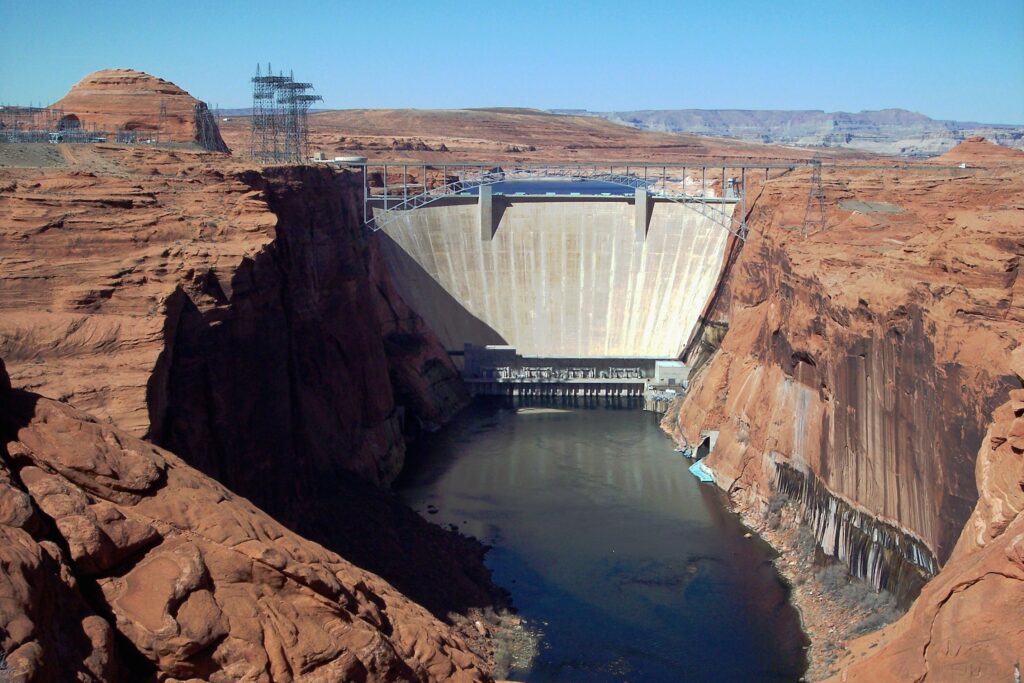
The river below Glen Canyon Dam is running at about 69 degrees Fahrenheit. The Bureau of Reclamation starts thinking about cold-water releases when the daily average passes roughly 60 F for three days in a row. That line was crossed more than a month ago.
On Thursday the Bureau decided to do nothing about it. In an email obtained by The Associated Press, the agency told stakeholders there would be no releases this year from the dam, “due to significant hydropower generation concerns under already strained system conditions.” The Arizona Republic reported that Wayne Pullan, the agency’s Upper Colorado Basin regional director, sent the notice on Aug. 6 to the Glen Canyon Adaptive Management Work Group.
What the cold water does
The technique is called a cool mix flow. Engineers open bypass tunnels that draw from the deep, cold layers of Lake Powell and blend that water into the river below. The catch is simple plumbing: there are no turbines in that deep section, so every gallon sent through the bypass is a gallon that generates nothing.
Why bother? Smallmouth bass. They were introduced to Lake Powell in the 1980s for sport fishing, and with the reservoir about 23% full, the warm surface water now sits close to the power intakes. Bass get pulled through the generators with it. Once in a warm river, they spawn, and they eat young humpback chub. The Republic reported that bass began spawning above Lees Ferry in 2022. Cool mix flows ran in 2024 and 2025, and officials say they stopped the spawning both years, though adult bass stayed in the river.
The cost
Skipping a third year saves money and generating capacity. The Western Area Power Administration said the program had cost more than $20 million in replacement power, and it estimated that running it this year, with the lake lower, could reach $40 million. Utilities that buy Glen Canyon power said the releases would have cost them millions for costlier, less renewable energy and could have pushed up customers’ bills.
The storage problem is bigger than the fish. Water behind the dam sits at record lows and was projected to fall below the level at which power production stops altogether. To hold that off, the government is sending water down from Flaming Gorge Reservoir on the Green River. The basin also had its worst snowpack on record this year.
Andy Colosimo, executive director of the Colorado River Energy Distributors Association, which represents about 155 buyers of federal hydropower, welcomed the call. “I think this was the right call, given the conditions that we’re all facing,” he said.
Conservationists were disappointed but not surprised. “We’ve proven that the cool mix flows are the most effective way to mitigate the smallmouth bass invasion in the Grand Canyon,” said Matt Rice of American Rivers. “Hopefully it’s not a death sentence to humpback chub.” The chub was moved from endangered to threatened status in 2021.
Scientists in the adaptive management program have warned that without cool mix flows, river temperatures could climb into the upper 70s. Jim Strogen, who represents Trout Unlimited on the work group, said the Lees Ferry rainbow trout fishery would suffer too: “It’s going to crush the fishery.”
Pullan’s email offered substitutes: expanded rapid-response removal of bass, more backwater modifications, evaluation of new tools, and “durable structural solutions.”
Sources
- Feds say no Lake Powell cool water releases this year to protect threatened fish (Associated Press via KUER)
- Feds nix Grand Canyon fish protection flows below Lake Powell (Arizona Republic)




