
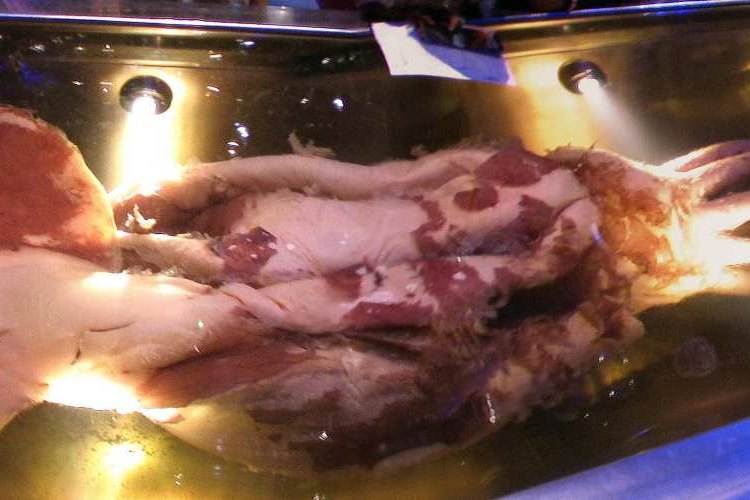
For nearly a century the colossal squid existed mainly as a curiosity preserved in jars and a tale whispered in whaling logs. That changed on April 16, 2025, when a research team from the University of Essex recorded a living juvenile of the species at a depth of about 600 metres near the South Sandwich Islands. The animal measured roughly 30 centimetres in length — tiny compared with adults that have been weighed at up to 495 kilograms, and possibly even more.
While its size was notable, the significance lay in the fact that it was observed alive in its natural environment, behaving as a young squid would. The first scientific encounter with *Mesonychoteuthis hamiltoni* came in 1925, when fragments were recovered from the stomach of a whale.
For decades thereafter, knowledge of the species was limited to dead or dying specimens obtained from trawl nets, beached carcasses, and additional whale stomachs. As a result, the colossal squid was known primarily as the largest invertebrate on Earth by mass, with some estimates suggesting adults could reach 600‑700 kilograms. No one had ever witnessed one swimming freely.
The 2025 video therefore provides a crucial new data point. A juvenile at 30 centimetres swimming at 600 metres reveals where the young of the species reside, the depths they prefer, and how they move through the water column.
This information cannot be gleaned from preserved specimens alone. By capturing this missing piece of the life cycle, the Essex team has given scientists a behavioural baseline for juveniles. Adult colossal squids are massive, inhabit extreme depths, and are rarely encountered.
Juveniles, by contrast, are smaller, tend to occupy shallower waters, and have now been visualized for the first time. This contrast opens fresh avenues of inquiry.
The location of the sighting — the South Sandwich Islands in the remote Southern Atlantic — is unlikely to be accidental. The area is largely unexplored, far from major shipping lanes and typical research routes, matching the hypothesis that the species favours cold, deep water away from human activity. The footage was obtained using state‑of‑the‑art imaging equipment that succeeded because the researchers had a general idea of where to look and because the small size of the juvenile made it approachable.
An adult weighing several hundred kilograms would be far less likely to tolerate such proximity. Looking ahead, scientists can now compare the movement patterns, depth preferences, and habitat use of juveniles with those inferred from adult remains.
These observations will help refine predictive models of where mature individuals might be found and guide future expeditions equipped with more targeted gear. The 2025 recording is not the conclusion of the search; it represents the first genuine starting point in the effort to understand the colossal squid in its living state. More broadly, the event underscores how much of the deep ocean remains known only through dissected specimens.
The colossal squid was first described in 1925, yet it took a full century to film one alive in the wild. This delay reflects the slow pace of exploration in a vast, dark, and cold environment, rather than any lack of scientific effort.
As technology advances, the rewards of patience become evident. For the squid itself, the video alters nothing about its biology; it continues to hunt in the darkness at 600 metres and will eventually grow to its formidable size. For researchers, however, the sighting marks a pivot — transforming the creature from a mythic specimen with a recorded weight into a living organism with a documented habitat and behaviour. That shift separates a museum exhibit from a true discovery.




