
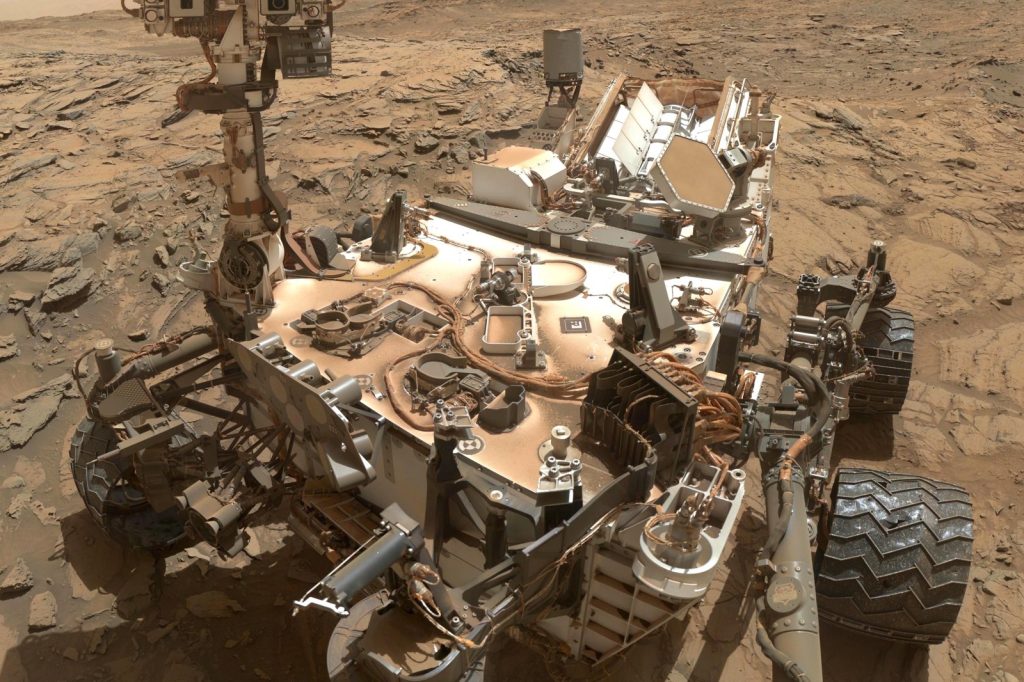
NASA’s Curiosity rover has been on Mars for nearly 14 years, and until April 25 nothing quite like this had happened. That day the robot drilled into a flattish slab of rock roughly 1.5 feet across and 6 inches thick, a slab weighing roughly 28.6 pounds that the team had nicknamed “Atacama” after Chile’s hyper-arid desert. When Curiosity pulled its drill back out, the entire chunk came out of the ground with it, wedged on the fixed sleeve around the rotating bit.
The agency was quick to note the milestone. “Drilling has fractured or separated the upper layers of rocks in the past, but a rock has never remained attached to the drill sleeve,” NASA explained in a blog post, calling it a first in the rover’s 13.5 years on the planet. “Like its namesake, the Atacama drill target on Mars presented a challenge to the Curiosity rover and to the rover team,” wrote William Farrand of the Space Science Institute, a geoscientist on the mission team.
Freeing it took three tries and some patience. The team’s first move, vibrating the drill, achieved nothing. On April 29 they repositioned the arm and vibrated again; some sand dropped off, the rock did not. Then came May 1. “Curiosity’s team tried again, tilting the drill more, rotating and vibrating the drill, and spinning the drill bit,” NASA wrote. “The team planned to perform these actions multiple times, but the rock came off on the first round, fracturing as it hit the ground.” Every step was a waiting game, since Mars sits about 140 million miles away on average and the engineers had to wait some 30 to 45 minutes after each batch of instructions to learn whether it had worked.
The drill has form. Electrical shorts hit its percussive mechanism in 2015, debris was suspected in the brake that same year, and in November 2016 the drill feed stalled outright, a fault that suspended drilling indefinitely by mid-2017. Engineers rehearsed a fix on a twin rover on Earth and taught Curiosity a new sampling technique without the feed mechanism, with the bit permanently extended; drilling resumed in 2018. The rover had already survived a corrupted onboard computer in 2013, switching to its backup and losing about three weeks to safe mode.
The stakes are not small. Launched in 2011 and landed in Gale Crater in 2012 on what was meant to be about a two-year mission, Curiosity has drilled 42 holes for powdered rock samples, climbed Mount Sharp, read ancient lakebed sediments, and detected organic molecules, including long-chain alkanes in Martian mudstone that are hard to explain with some known non-biological processes. It is showing wear, but it keeps drilling, and the Atacama episode cost it all of six days.
Sources
- Curiosity Drilled Into a Rock on Mars And Gave Scientists a Big Surprise : ScienceAlert
- NASA's Curiosity Rover Had a Martian Rock Stuck on Its Arm for Days. Watch It Finally Shake the Stubborn Stone Off




