
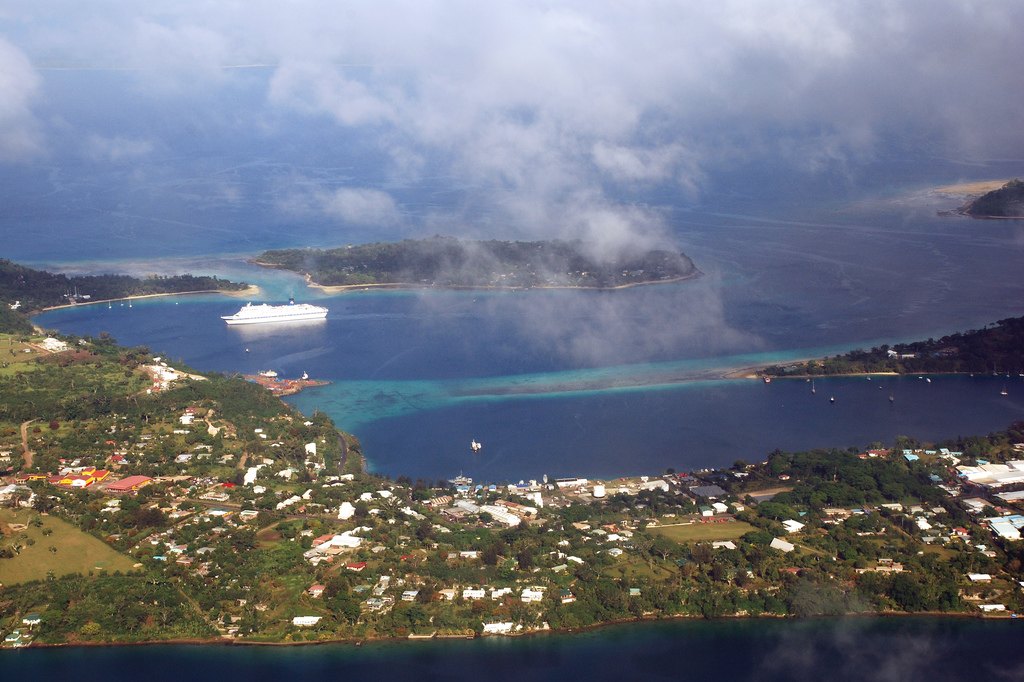
Sunday’s magnitude 5.2 earthquake northeast of Port-Olry was not a surprise to anyone who watches the geology of this part of the world. The U.S. Geological Survey recorded the event at 07:05 UTC. The quake struck 45 kilometers from the coastal town.
Its depth was 160.295 kilometers. That depth, intermediate-to-deep, is the key detail.
Deep earthquakes are different. They release energy at a point where the rock is under enormous pressure, far below the surface crust. The shaking spreads outward over a larger area.
But the worst of it — the violent, surface-shredding motion — dissipates before it reaches houses and roads. The USGS reported no tsunami warning.
That decision makes sense. A deep quake of this size does not typically displace the seafloor in a way that generates a dangerous wave. The Pacific Ring of Fire runs straight through Vanuatu.
This is a zone where tectonic plates collide. The Australia plate is sliding under the Pacific plate. That process is called subduction.
Sunday’s earthquake originated in that descending slab. The slab is old, cold, and brittle.
It cracks under stress. Those cracks are earthquakes. The USGS has recorded at least 500 earthquakes of magnitude 5.0 or greater within 300 kilometers of this spot in the last twenty years.
That is a lot of shaking. The biggest was a magnitude 7.8 in 2009.
That is a major earthquake. It caused significant damage and loss of life. A 5.2 is moderate.
It can knock things off shelves and crack plaster. But the deep focal point likely reduced the severity of surface shaking. Seismologists expect aftershocks.
These are smaller quakes that follow the main event as the crust adjusts to the new stress distribution. They can continue for days or weeks.
People in the area are generally advised to be prepared for more shaking. That is standard advice. It is also practical.
The ground in this region never stays still for long. Vanuatu sits in a geologically restless corridor.
The convergence of the Australia and Pacific plates is not a smooth process. It is a grinding, jerky collision. The strain builds over years and decades.
Then it releases in seconds. Sunday’s earthquake was one of those releases. It was not large enough to cause widespread destruction.
But it was a reminder that the machinery is still running. The USGS detected the event through its real-time global seismic monitoring network.
That network uses sensors spread across the planet. It can locate a quake and estimate its magnitude within minutes. The system is good.
It gets better every year. But it cannot predict earthquakes.
It can only tell you what just happened. What just happened was a moderate, deep earthquake in a known seismic zone. No tsunami.
No reports of major damage yet. The depth worked in the region’s favor. But the underlying forces remain.
The Australia plate keeps diving. The stress keeps building.
Another quake will come. It might be tomorrow. It might be next year.
It might be the big one. Nobody knows.




