
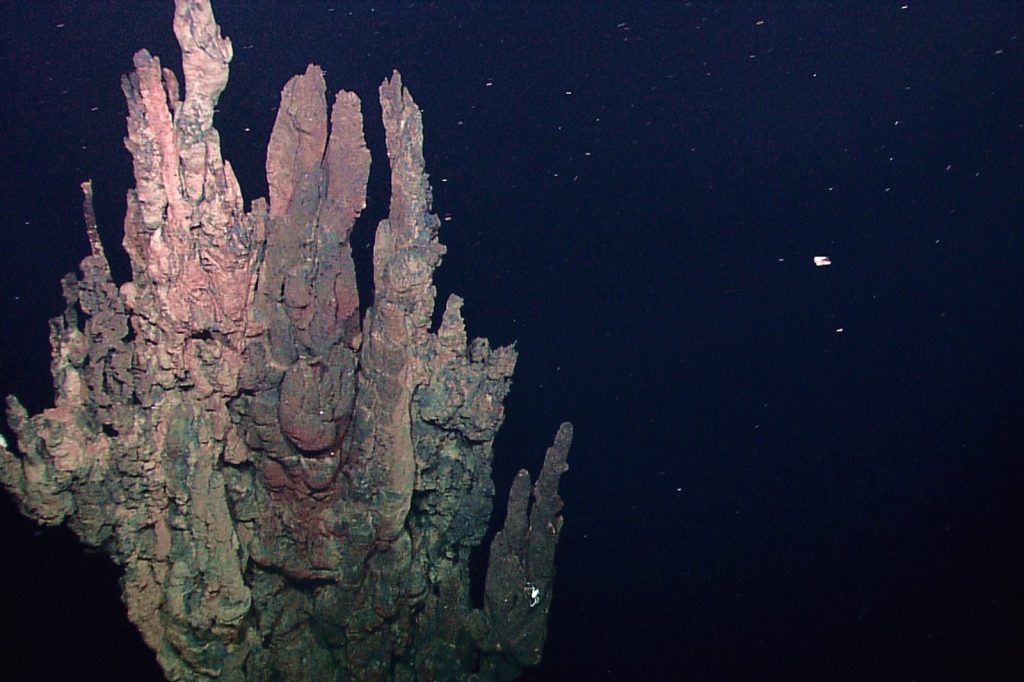
Nearly every animal pulled from the hot, dark vents on the deep seafloor in a new Korean study carried plastic. Microplastics turned up in 92% of the snails and mussels examined, at an average of 3.42 particles per animal.
The animals came from hydrothermal vents more than 2,000 meters down, in the North Fiji Basin of the southwestern Pacific and on the Central Indian Ridge. The Korea Institute of Ocean Science and Technology (KIOST) collected the specimens. A team at the Korea Research Institute of Bioscience and Biotechnology (KRIBB), led by Dr. Se-Joo Kim and Dr. Jinyoung Jeong, did the particle analysis. The researchers describe it as the first comparison of microplastic buildup in vent animals from two different oceans.
Polystyrene, common in consumer products and packaging, was the most abundant plastic found.
Where the particles ended up
What an animal eats shaped where the plastic collected. In snails that graze on the microbial mats covering the seafloor, the particles sat mostly in the digestive organs. Mussels, which filter food from the water, showed a fairly even spread through their tissue.
Indian Ocean far higher
The two basins did not match. Animals from the Indian Ocean held significantly more microplastic than those from the southwestern Pacific, and after adjusting for body weight the gap reached up to 14.7 times. The team suggests that nearby human activity, plastic carried in by rivers and large-scale ocean circulation likely explain the difference.
The study offers what the authors call the first scientific evidence that plastic released at the surface can travel thousands of meters down to one of the most remote marine habitats. Deep-sea habitats make up nearly 90% of the world’s marine environment, yet little had been known about plastic in them. Plastic entering the oceans is estimated at 11 million tons a year.
“Plastic pollution has now spread even to deep-sea hydrothermal vent ecosystems that were once considered among the most isolated environments on Earth,” Kim said. “Our findings provide important scientific evidence for establishing future deep-sea environmental monitoring systems and conservation policies.”
The authors expect the results to feed into monitoring, into environmental impact assessments for deep-sea mineral resource development, and into long-term conservation plans. The paper appeared online on June 3 in Water Research, under the title “Oceanic determinants of microplastic bioaccumulation in fauna of deep-sea hydrothermal vents: Comparative study of the southwestern Pacific and Indian Oceans.” The Ministry of Education, the Ministry of Science and ICT and the National Research Council of Science & Technology were among its funders.




