
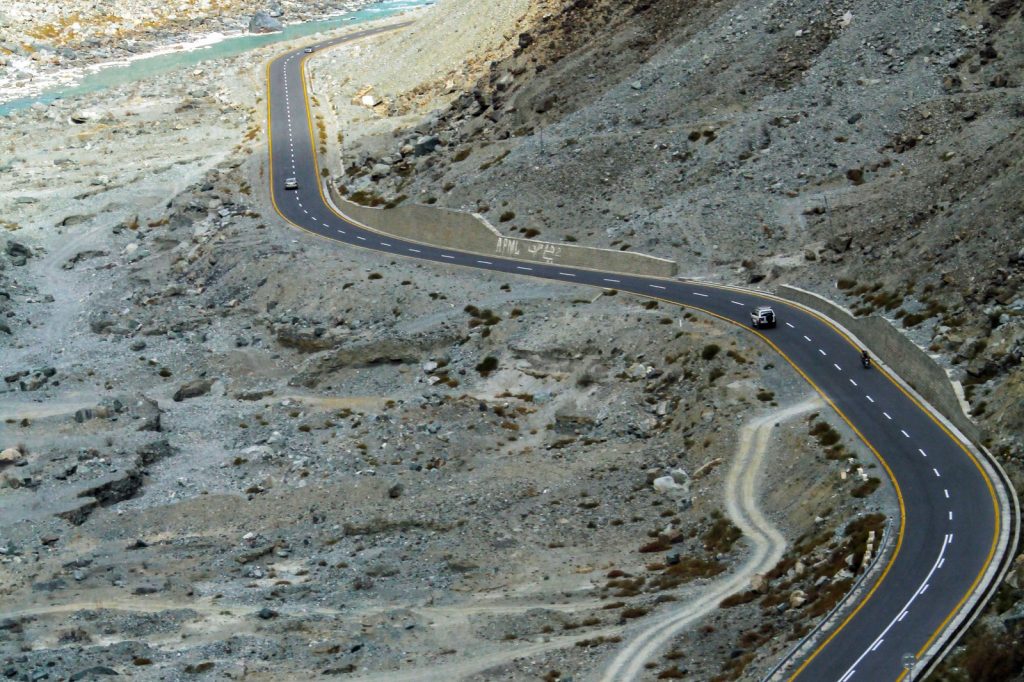
A vehicle veered off the Karakoram Highway in Pakistan’s Kohistan district on May 2, 2025, and crashed into a ravine, resulting in the deaths of all eight occupants. The incident underscores the persistent dangers along this 1,300-kilometer route, which links Pakistan’s Punjab and Khyber Pakhtunkhwa provinces, as well as Gilgit-Baltistan, with China’s Xinjiang Uyghur Autonomous Region.
Constructed during the 1970s through a joint effort between Pakistan and China, the highway ranks among the world’s highest paved roads. Chinese engineers and workers performed much of the construction, a project that claimed hundreds of lives due to landslides, falls, and accidents. Officially named the China-Pakistan Friendship Highway, it was intended as a symbol of bilateral cooperation.
Decades later, the road continues to exact a toll. The Karakoram Highway traverses the Karakoram mountain range, offering dramatic scenery but also presenting severe hazards.
Its narrow, exposed sections are vulnerable to harsh weather and sudden rockfalls. Despite substantial investment by the Pakistani government in upgrades and maintenance, the fundamental geography of the region remains a formidable challenge. The May 2 incident occurred when a car lost control and fell into a ravine.
Official reports provide no names for the deceased and cite only the loss of control as the immediate cause. No further explanation has been offered, as the highway’s inherent risks are well-documented.
The highway serves as a critical artery for trade between Pakistan and China, enabling the transport of goods that would otherwise require lengthy sea routes. It also functions as a lifeline for remote communities in Gilgit-Baltistan. As regional development accelerates, traffic volumes have increased, encompassing trucks, buses, and private vehicles, thereby elevating the level of risk.
Authorities have pledged to enhance safety through additional barriers, improved signage, and increased patrols. However, the highway’s 1,300-kilometer length, winding through some of the planet’s most difficult terrain, limits the effectiveness of such measures.
A barrier at one curve does not protect against the next, nor does it account for driver error in adverse weather or unexpected landslides. The Karakoram Highway remains open, with traffic continuing to flow. Tourists visit for the experience of traveling the highest paved road in the world, and trade persists. The road’s importance to economic development and connectivity outweighs the decision to close it, a calculation that accepts the ongoing risks.
The highway stands as both a symbol of friendship and a stark reminder of the costs associated with mountain roads. The death toll from May 2 adds to a long history of casualties, with official reports documenting each loss.




