
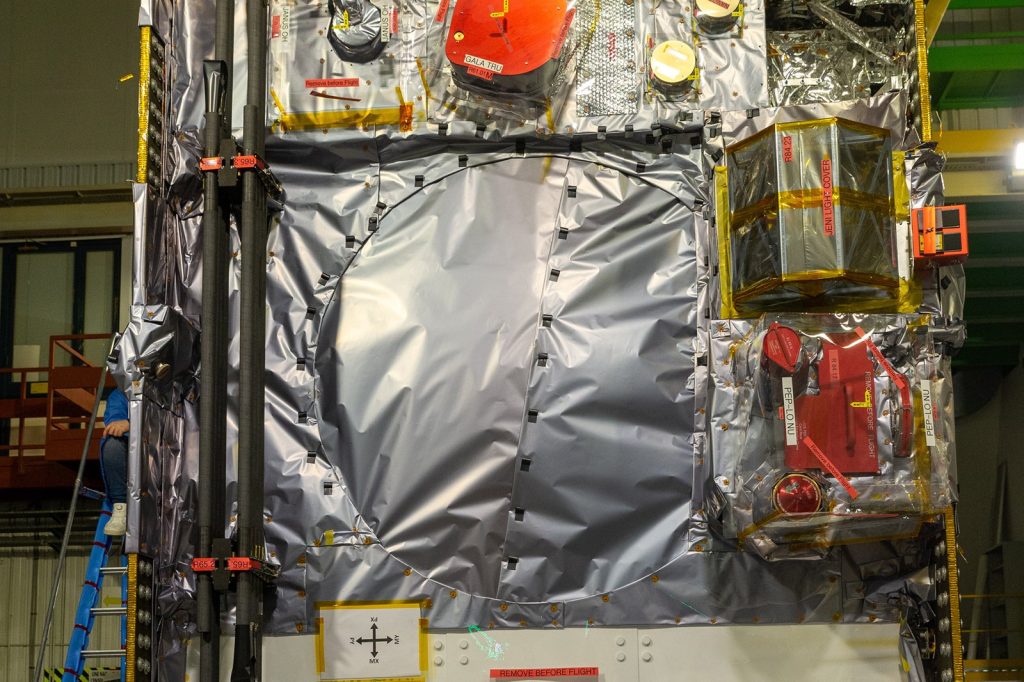
On 28 September 2026, ESA’s Jupiter Icy Moons Explorer, Juice, was due to pass within 8,640 km of Earth. Closest approach was set for 13:45 CEST (11:45 UTC) over the Indian Ocean.
The pass was no sightseeing stop. It was a gravity assist, meant to deflect the spacecraft’s path by about 20 degrees and add roughly 3.5 km/s to its speed. Fifteen to thirty minutes beforehand Juice would cross Australia from northeast to northwest, where amateur astronomers with a suitable telescope or binoculars might have tracked it.
Why not fly straight there?
Juice launched on an Ariane 5 from Kourou, French Guiana, in April 2023. A direct flight to Jupiter would have been quicker, but it would have demanded an enormous rocket and a huge load of fuel, first to build speed and then to brake on arrival. So flight controllers chose to borrow from the planets. The first-ever lunar-Earth flyby sent Juice on a shortcut toward Venus, and the Venus flyby bent its orbit and gave it extra speed.
The September 2026 pass sets up one final Earth flyby in January 2029 and puts the spacecraft on course to reach Jupiter in July 2031. Because the planets do most of the work, plenty of fuel stays in the tanks for orbit insertion at Jupiter and then at Ganymede in 2034.
Preparing the flyby
The navigation campaign began on 17 August, with six time slots reserved for small trajectory corrections, among them four weeks, two weeks, one week and three days before the flyby. “Until now, only one manoeuvre at minus four weeks was needed,” said Angela Dietz, Juice Spacecraft Operations Manager. “It was of relatively small size, but extremely effective.”
A last emergency manoeuvre was held ready for 08:00 CEST on 28 September, in case of a critical navigation error or a collision risk with other satellites. Nobody expected to use it.
There was one extra hazard. From 21:24 CEST on 27 September to 06:03 CEST on 28 September, Juice sat in Earth’s shadow and ran on battery alone. The team ranked its science observations so the batteries would not drain completely.
Science on the way
Juice’s 10 instruments were to be switched on between 23 September and 3 October to gather data on Earth and the Moon, as they did in 2024. Claire Vallat, Juice Project Scientist, said the flyby is operationally much simpler than the 2024 double pass, so the craft can turn in all directions to aim its instruments at different parts of Earth and the Moon.
The spacecraft was also expected to spend several days in Earth’s magnetotail, the windsock-like stretch of the magnetic field, producing measurements that could later be paired with data from the European-Chinese Smile mission. Its navigation camera was to look at the lunar horizon to test a new optical navigation technique, and two monitoring cameras were to photograph the event, with the last images taken on 29 September.
Once at Jupiter, Juice will make 35 flybys of Ganymede, Callisto and Europa before settling into orbit around Ganymede.




