
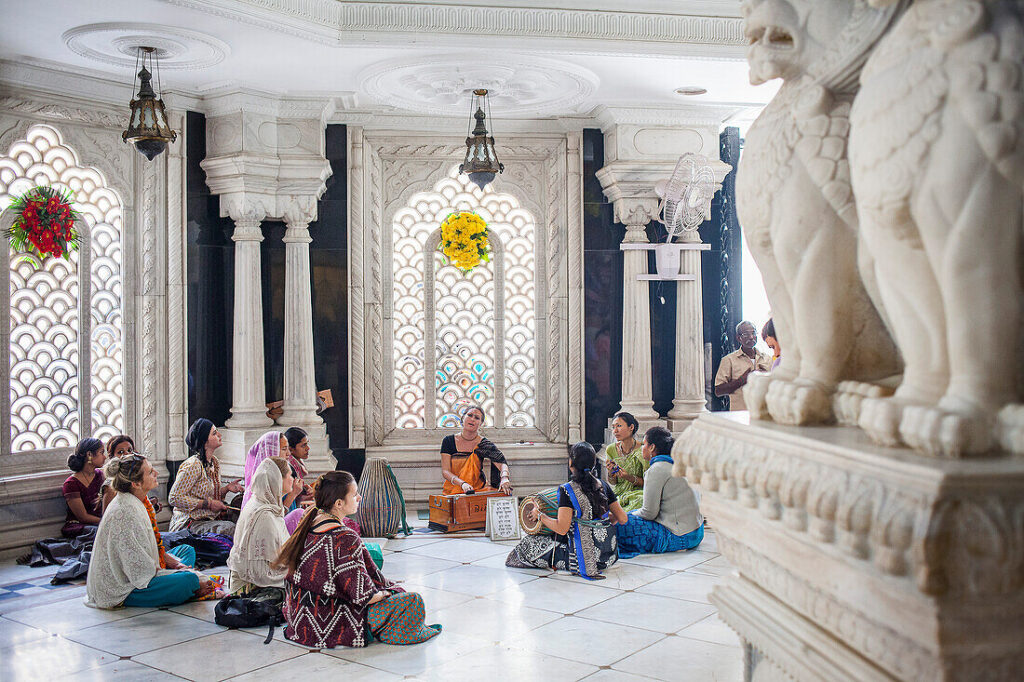
The idea started with a festival and a newborn. Krsangi-Radhe Dasi had just given birth when organizers preparing for Janmashtami in Durban noticed that South Africa’s Women’s Day fell inside the festival period, and asked her to put on an event. “I paused and thought, how do I do this?” she recalled.
She skipped the conventional celebration. Her answer was “Tea Party with Krishna”, a high tea with devotional elements, cultural presentations and teaching about Vedic dress and symbolism. “We married the idea of a girls’ day with Krishna consciousness,” she said. Turnout was strong. “It was an absolute hit. Thereafter, it seemed as though my service took that way of doing things for women.”
That event became the base for her later work in the Vaishnavi Ministry. Today she is Vaishnavi Minister for ISKCON South Africa, a representative on the African Regional Governing Body and Communications Director for ISKCON South Africa. A disciple of Indradyumna Swami, she has also represented the movement internationally, including in engagements with the United Nations, where she had to explain Krishna-conscious principles across cultural and institutional lines while staying faithful to the tradition. ISKCON News profiled her in May.
Raised in the Durban temple
She grew up in Krishna consciousness. Her parents were among the early members of the Durban temple community more than forty years ago, and her childhood meant regular temple visits, festivals and devotional life at home.
At some point, she said, inherited practice has to become your own. “There comes a point where you have to ask, am I doing this just because I’m part of a Krishna-conscious family, or is it something I really want to pursue?” Her answer: “I’m intentionally doing this practice.”
Home was also where she learned about equality. She and her sisters were raised to be independent, and their father pushed them past traditional limits. “He was like, ‘Why can you not do things boys do?’ We never said a boy can do this and a girl can do that. We did everything.” Education and self-sufficiency mattered, and both shaped her confidence. She still holds that women have an irreplaceable place in family and society: “A mother is that figure that holds the family unit together.”
She roots the ministry’s work in the teaching of ISKCON’s Founder-Acharya, Srila A. C. Bhaktivedanta Swami Prabhupada. “Prabhupada taught that in Krishna consciousness there is no such distinction as man or woman…everyone should be given equal opportunity to advance in spiritual life.” For her, that is practical. She wants Vaishnavis to be able to contribute and to feel supported in their devotional lives.
Resilient, and stretched
“In South Africa, we’re resilient,” she said. “We’ve come through a lot.” As a coach, she also sees the emotional and financial pressure many women carry. “No matter what their designation is, women are vulnerable to it.”
What she sees alongside it is devotion. “Vaishnavis are so devoted when it comes to their service,” she said, adding that qualities built in family life tend to carry into the community. “When we pour that into our temples, it enhances the mood within our communities.”
Her approach to leading changed after a large festival project, when she strongly disagreed with a decision and a senior devotee told her to rethink how she was handling it. “You have to value the relationship with that devotee above and beyond the point that you are trying to make,” he said. She took it to heart. “Once you have a genuine relationship, you are able to build a society.”
Juggling her roles has meant adjusting. She recently stepped back from full-time teaching to focus on family and devotional life. “I needed to pour more into the home,” she said, and the change has helped her sadhana, including regular attendance at morning temple programs. Her summary of her whole approach is short: “Krishna consciousness is about relationships.”




