
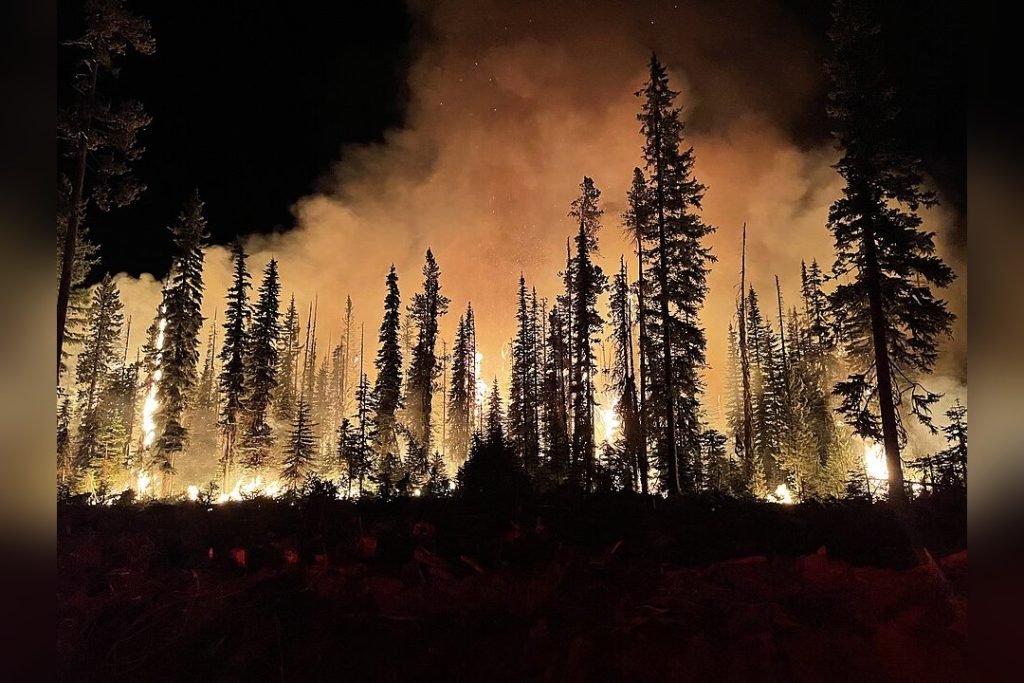
More than 24,000 people had fled wildfires in France within a few days, and the worst damage was in the Gironde, a popular tourist region in the southwest. By mid-July 2022 the fires there had burned over 14,000 hectares (34,000 acres).
Jean-Luc Gleyze, president of the Gironde region, told the BBC the blazes kept spreading near La-Teste-de-Buch and Landiras because the weather was hot and windy. Firefighters could not get them contained. “They have to fight against this fire which is growing and growing, sometimes getting very, very high,” he said.
One meteorologist told AFP that parts of the southwest faced “an apocalypse of heat”. Temperatures could reach record levels in 15 regions. Brest, in north-western Brittany, hit 40C (104F), and France’s national weather office said many towns and cities had set record highs.
Spain and Portugal
The toll on the Iberian peninsula was heavier. More than 1,000 deaths in Spain and Portugal were attributed to the heat. In Spain’s Zamora province, a fire had burned since the weekend. A 62-year-old firefighter died on Sunday, and a shepherd’s body was later found in the Sierra de la Culebra mountains.
Near Pont de Vilomara in Catalonia, flames reached the house of Mercedes Pino. “I was in bed and through the window I saw a very red light,” she told Spanish media. “I ran as fast as I could to the door and I saw a flame burning a caravan we have in front of the door.”
Fires also broke out in Castilla y León, Galicia, Andalusia and Extremadura. Prime Minister Pedro Sanchez visited Extremadura on Monday. “Evidently, climate change kills,” he said. “It kills people, kills our ecosystem, the biodiversity.”
Portugal recorded 47C (116F) on Thursday, a record for July. The national meteorological office, IPMA, said a third of the mainland remained at extreme risk of fire, since severe or extreme drought covered almost the entire country. Hundreds of people had been evacuated. Authorities were determined not to see a repeat of 2017, when 66 people died in fires.
A second heatwave in weeks
It was the second heatwave in recent weeks to strike parts of southwest Europe. The BBC noted that heatwaves have grown more frequent, more intense and longer because of human-induced climate change, and that the world has warmed by about 1.1C since the industrial era began.
Enrique Sanchez, dean of the Faculty of Environmental Sciences and Biochemistry at the University of Castilla-La Mancha, told the BBC that heatwaves would soon become the norm. “There is no way that the temperatures are going to [not] increase,” he said, “so heat wave events will become more and more common… all along Europe.”




