
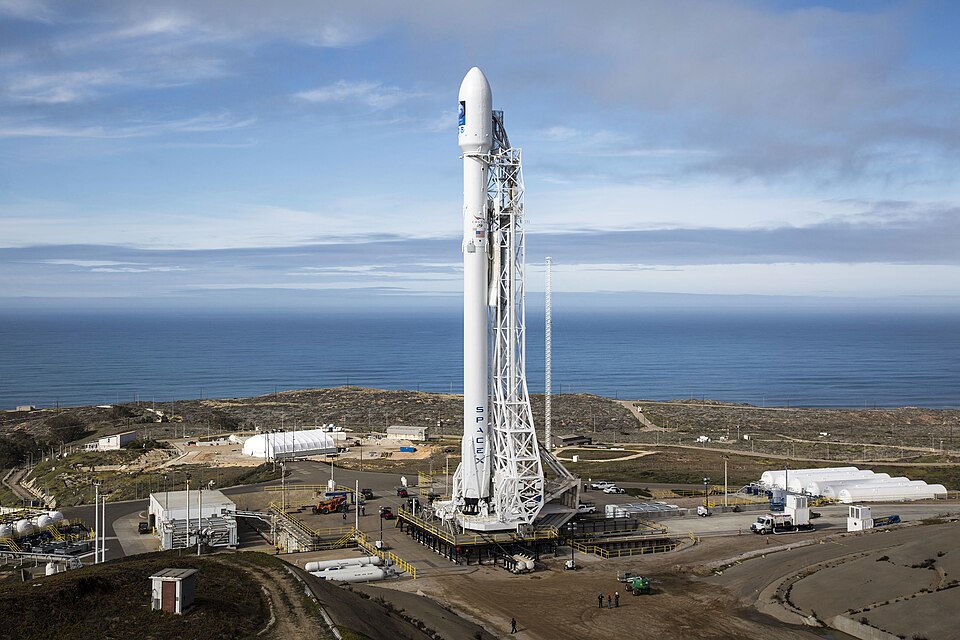
On June 8, 2026, booster B1067 made its 35th flight and landed on an Atlantic drone ship for the 35th time, and almost nobody blinked. That indifference is the news. The Space Shuttle orbititer held the reuse record at 39 flights; a Falcon 9 first stage is now nine flights short of it, and SpaceX needs roughly nine days to turn a booster around between missions.
A specialist analysis of the program’s numbers, published by TESORB in early July 2026, makes the case that Falcon 9 has become the most reliable orbital rocket ever flown. The statistics back the label.
The record behind the label
Across four major variants since June 2010, Falcon 9 has logged 668 flights at a 99.55 percent success rate; the current Block 5 version, flying since 2018, runs at 99.84 percent across 612 launches. Three missions have failed outright: CRS-7 broke up in flight in June 2015, AMOS-6 exploded on the pad in September 2016, and a Starlink mission lost a second-stage relight in July 2024. Since that last failure the streak stands near 314 consecutive successes, and the previous run of 325 to 344 was already the longest by any orbital rocket, more than double the old mark.
Landings tell the same story: 628 recoveries in 641 attempts, good for 97.97 percent, with Block 5 alone at 99.01 percent. The 600th landing came on April 19, 2026, only about seven months after the 500th. Drone ships have caught over 512 boosters, because a return to the launch site eats 30 to 40 percent of payload capacity where a barge costs only 15 to 20 percent. Cape Canaveral’s new pad LZ-40 joined the roster on February 13, 2026.
An industrial process, with margins
Turnaround time is where the manufacturing revolution hides. The first reflight, in 2017, required a year of refurbishment. By 2022 the record stood at 21 days, by late 2024 at 14, and in March 2025 booster B1088 flew twice within 9 days, 3 hours, and 39 minutes. Of roughly 25 active boosters, the fleet averages about 15 flights each; over 95 percent of 2025 missions, 157 of 165, flew on previously used hardware. Reusability, once a bet, is what the analysis calls “an industrial process”, and its verdict on capacity is blunt: “The booster fleet is no longer the bottleneck”; the pace is now set by pad work, range scheduling and second-stage output.
The pricing shows it. The commercial list price reached $74 million by February 2026, from $67 million in 2022, while internal marginal cost for Starlink flights runs an estimated $15 to $30 million. Per kilogram to low orbit, that is about $3,250 commercially and perhaps $660 to $1,300 internally, against $9,300 to $10,200 for an Ariane 6. Expendable rivals land somewhere between 3 and 8 times more expensive per kilogram.
Starlink pays the bills
The manifest explains the scale. Roughly 75 to 84 percent of Falcon 9 flights serve Starlink; only 43 of the 165 launches in 2025 carried external customers. SpaceX has put 12,342 Starlink satellites up in total, about 10,650 remain in orbit and some 9,500 are operational, with the active fleet crossing 10,000 on March 17, 2026. The internet service brought in $11.4 billion in 2025, the revenue that funds everything else, including a company valuation of $2.3 trillion at IPO.
Crew work has stayed flawless: 19 crewed missions, 68 people launched, zero losses. And the end is not near. SpaceX VP Stephanie Bednarek expects “2025 and 2026 likely mark the peak of Falcon launch activity before Starship absorbs more of the manifest”, but with Starship’s routine operations, on the V3 flight record, still not imminent, Falcon 9 keeps flying, landing and paying.




