
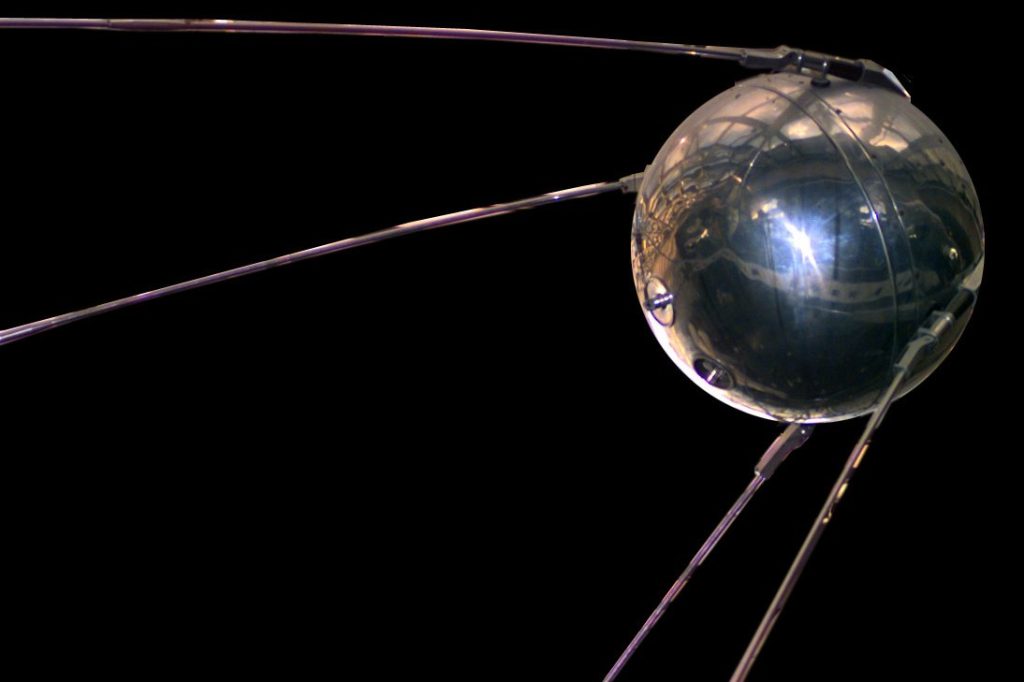
On the night of October 3, 1957, a rocket and a polished metal sphere were wheeled out onto a secret Soviet test range in what is now Kazakhstan. Launch was set for October 6. Then a rumour reached the engineers: the Americans were due to present a paper on satellites at an international conference on October 5. Chief designer Sergei Korolev feared a US launch was close, and the Soviets went a couple of days early. On October 4, Sputnik 1 reached orbit.
It weighed 83.6kg, measured about 58cm across and circled Earth every 96 minutes. It transmitted for 22 days before its batteries died. The rocket under it was a modified R-7, the first intercontinental ballistic missile, which had flown successfully for the first time on August 21. That was what rattled Washington. A missile able to lift a satellite could, in the American view, carry a nuclear warhead to the United States.
Fear at home
Moscow was oddly quiet at first. Nikita Khrushchev later recalled that he phoned his congratulations to the engineers and “calmly went to bed.” Pravda only put the satellite on its front page on October 6, once the American reaction was plain.
In the United States, the shock was personal. Astronaut Frank Borman, then teaching at West Point, remembered the Cold War as “a very real thing”, with real worry about a nuclear exchange. “It was a time of very, very serious self-doubt across the whole society,” he said, and the public began to question the education system and the Eisenhower administration.
The first American try went badly. On December 6, 1957, the Navy’s Vanguard rocket rose about four feet off its Florida pad and exploded. Newspapers called it “Flopnik” and “Kaputnik”. The Army’s Explorer 1 reached orbit on January 31, 1958. Washington created the Advanced Research Projects Agency that February and the National Aeronautics and Space Administration in October. President Dwight Eisenhower also signed a law putting about $1 billion into schools and into science and mathematics teaching.
Moscow’s firsts, then the Moon
For about eight years the Soviet Union set the pace. Luna 2 hit the Moon in September 1959, and a month later Luna 3 sent back the first photographs of the far side. Yuri Gagarin, a 27-year-old air force pilot, became the first human in space on April 12, 1961, orbiting once in 108 minutes. Alan Shepard followed on May 5 with a 15-minute flight that never reached orbit. On May 25, President John F Kennedy asked Congress to commit to “landing a man on the moon and returning him safely to the earth” before the decade was out.
Moscow did not formally commit to a cosmonaut landing until August 3, 1964, more than three years after Kennedy spoke. Design bureaus fought over money and rockets, and Korolev and engine designer Valentin Glushko feuded so bitterly that they would not share a room. Cosmonaut Alexei Leonov later pointed to the money: the Americans had invested $25 billion, the Soviets 2.5 billion rubles across their whole space programme, “ten times less.”
The American programme had its own disaster. A fire in the Apollo 1 capsule on January 27, 1967 killed Gus Grissom, Edward White and Roger Chaffee. Still, on December 24, 1968, Apollo 8 carried three astronauts around the Moon. The Soviet N1 moon rocket, which needed 30 engines firing together in its first stage, failed on its first launch on February 21, 1969. The second exploded on the pad on July 3. Apollo 11 lifted off 13 days later, and Neil Armstrong stepped onto the Moon at 10.56pm US Eastern time on July 20, 1969. About 600 million people watched on television.
The wind-down
Once the Moon was won, Congress and the Nixon administration cut NASA’s budget. Apollo 20 was cancelled on January 4, 1970. Eugene Cernan, the last of the 12 men on the Moon, left on December 14, 1972. The N1 failed twice more and was cancelled in May 1974; Moscow kept its crewed lunar programme secret until 1989.
The two sides had already started to talk. Nixon and Soviet premier Alexei Kosygin signed an agreement on May 24, 1972 to build spacecraft that could dock together. On July 17, 1975, an Apollo capsule linked up with a Soyuz, and Thomas Stafford shook hands with Leonov in the docking ring.
Sources
- The Soviet Lunar Program & the Space Race | American Experience | Official Site | PBS
- Sputnik, Kaputnik and many giant leaps: The Space Race, 69 years later | HT Explainers




