
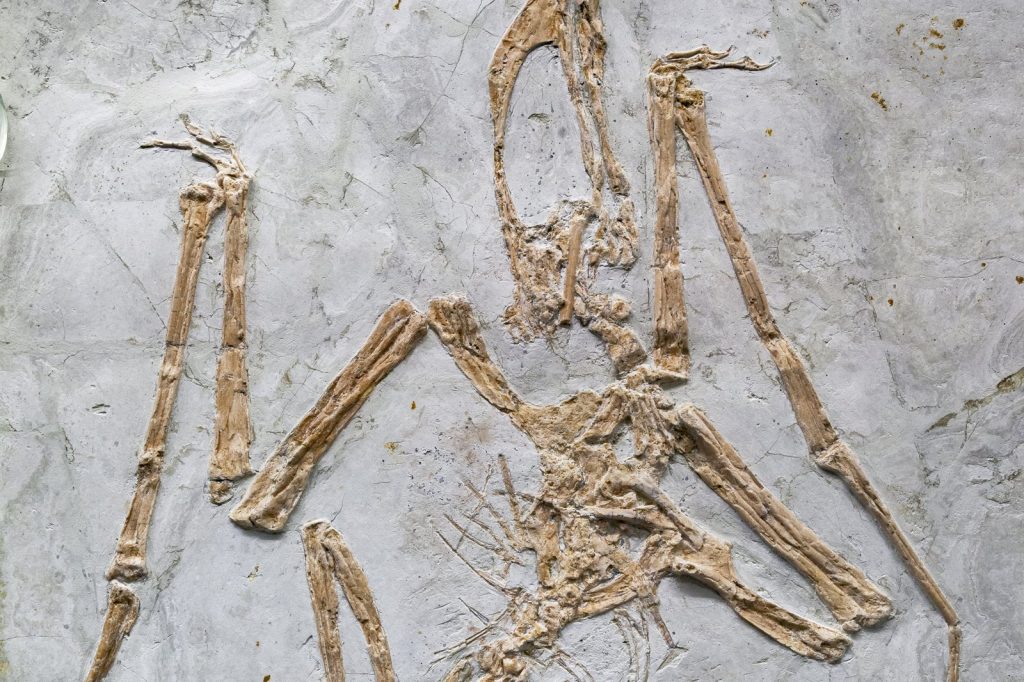
“This is one of the most intriguing and surprising fossil discoveries of the past few years,” said Steve Brusatte, a paleontologist at the University of Edinburgh. He was not part of the team behind it.
The find concerns Sinopterus dongi, a small pterosaur with a wingspan that could reach nearly 2 meters. The specimen came from northeast China and is more than 120 million years old. Researchers say it preserves soft tissue in unusually fine condition, and they reported on May 10 at bioRxiv.org that at least one pterosaur species shimmered in iridescent greens and magentas.
David Martill, a paleontologist at the University of Portsmouth in England, was not involved either. He called soft tissue preserved at this level of fidelity “incredibly rare.”
What the microscope showed
Earlier studies had already found melanosomes, which are pigment-containing structures, inside pycnofibers. Those are small filaments in many shapes and sizes, and a number of them resemble the protofeathers of some dinosaurs. The work had led paleontologists to picture pterosaurs with colorful crests and body patches. Iridescence was a new idea.
Iridescence means an object reflects different colors depending on the angle you view it from. It has evolved repeatedly in insects, birds and even some plants, often through layered structures that scatter light and split it into many colors.
The team studied the fossil with scanning electron microscopy and other techniques. Inside the pycnofibers they found ordered, layered arrays of melanosomes. The layering looks like the melanosome-bearing structures that give modern bird feathers their sheen.
Computer simulations pointed to deep greens and magentas. Martill said these are “the same colors that you find in pigeons, starlings and a whole host of other birds.” He added that the result gives paleoartists something to go on, but also means researchers must go back and re-examine other material, such as soft tissues seen in fossil feathers and dinosaur skin.
Metabolism and display
The range of melanosome types in these fibers matches what is found in warm-blooded birds and mammals. Brusatte reads that as a sign these pterosaurs had high metabolisms and complex ways of regulating body temperature.
Courtship is the other open question. In birds, iridescent plumage is well known for its part in attracting mates, and birds will dance and parade to show it off. The pterosaur finding suggests the flying reptiles may have behaved in a similar way.
Brusatte said the result also changes how he thinks about dinosaurs. “We often think that simple protofeathers in dinosaurs evolved for insulation, like hair did in mammals,” he said. “Now we must consider the possibility that even the simplest dinosaur feathers arose as display structures.”




