
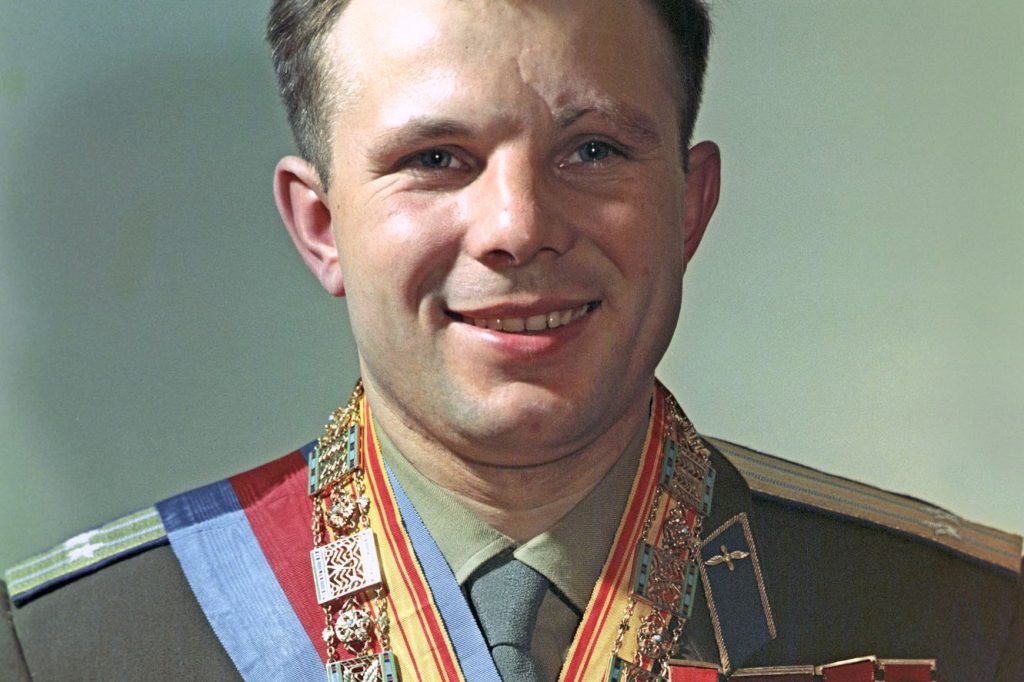
The Cold War’s biggest Soviet victory was finished in 108 minutes. One loop of the planet by one man, then a parachute descent into a Saratov oblast field, where a farm woman and her granddaughter found him standing in the grass. Iurii Gagarin rose from Baikonur on the morning of April 12, 1961, crossed the Pacific and Africa at an apogee near 327 kilometers inside Vostok 1, and came back the most famous living human on the planet.
James von Geldern’s essay for Michigan State’s Seventeen Moments in Soviet History project remains the sharpest account of what that flight actually meant, and most of it was not about flying.
What TASS said, and what it left out
The Soviet news agency announced the mission while Gagarin was still aloft, a burst of confidence for a state that normally waited to learn whether its ventures had survived. The announcement still censored the important parts. Sergei Korolev, the Chief Designer behind the spacecraft, was a camp survivor of the late 1930s whose name stayed out of the Soviet press until he died. And Gagarin had not ridden his capsule down: he had punched out at around seven kilometers and floated to earth on a personal chute, a fact buried for years because international aviation rules wanted a pilot to arrive with his machine.
A missile wearing a spacesuit
The rocket underneath him was a modified R-7, nicknamed the semerka, first tested in August 1957 and the first intercontinental ballistic missile anywhere. Anyone watching drew the obvious lesson, that a state able to put a man in orbit could throw a warhead across an ocean. The lesson was sound engineering and false strategy. The R-7 burned liquid oxygen, needed hours of fueling and enormous fixed complexes that could be neither dispersed nor hidden, and only a handful ever stood combat duty. By September 1961, American analysts working with Corona satellite photographs reckoned the entire Soviet intercontinental arsenal at twenty-five missiles at most; that October, the deputy secretary of defense said in public what his government had known privately since February. Khrushchev had boasted that “rockets were coming off the line like sausages”. The claim traded on whatever the world could watch climbing away from Baikonur, not on hardware waiting in silos.
Prestige spent at speed
The victory was spent fast. Gagarin was sent abroad on “missions of peace”, through more than thirty countries during the seven years that remained to him. London stalled, wary of offending Washington, and the Amalgamated Union of Foundry Workers claimed the former molder with an invitation of its own. Manchester received him in July, the car roof folded back because rain-soaked crowds wanted to see him, and Buckingham Palace followed. Cuba, Brazil and India came next, with Nehru holding a civic reception for him at the Red Fort. The biography did the preaching: a carpenter’s son from occupied Klushino, trained as a foundryman, taught to fly at a Saratov club, proof that a peasant country had reached orbit in barely four decades.
Washington’s reply
The Bay of Pigs collapsed five days after the flight. On April 20, President Kennedy asked Lyndon Johnson in a memorandum “whether there existed any space program that the United States had a chance of winning”. Alan Shepard managed fifteen suborbital minutes on May 5 without reaching orbit; on May 25, Kennedy committed the country to the Moon. Titov’s seventeen orbits in August and Tereshkova’s June 1963 flight kept the Soviet lead visible, at least from outside. Inside, the regime had recast a few dozen unusable missiles as superpower supremacy, and thereby picked the one contest it could not bankroll.
Sources
- Yuri Gagarin: First Human in Space, 1961
- Iurii Gagarin Flies into Space | Seventeen Moments in Soviet History




