
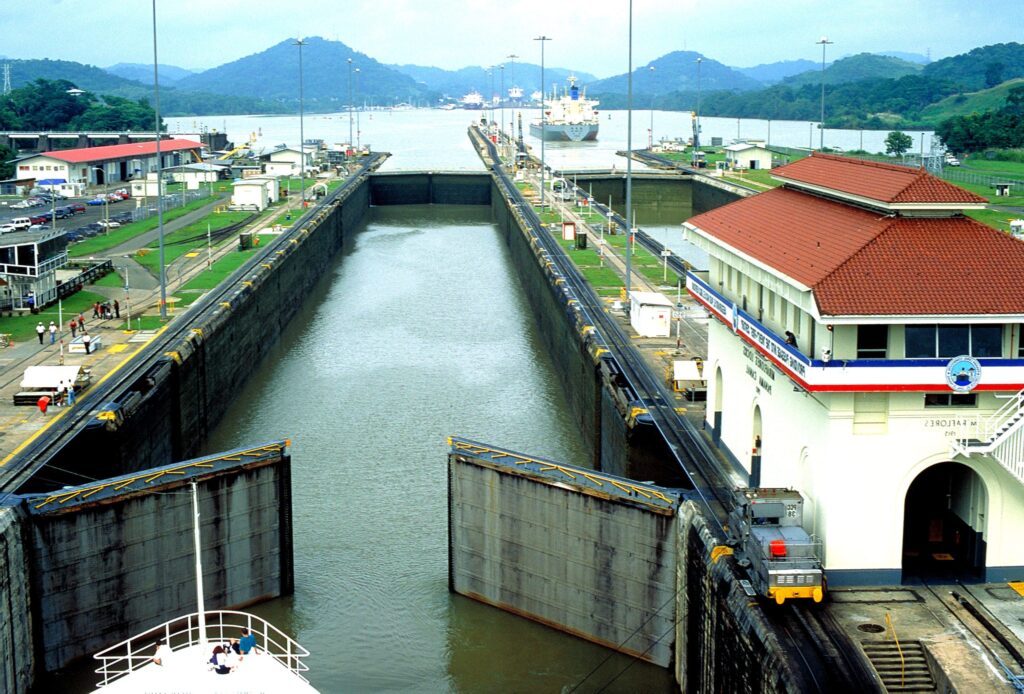
Ships do not slide through Panama so much as climb it. The water inside the canal is anything but flat: an ocean liner is hoisted nine stories, the height of a mid-rise tower, to cross the isthmus, then steps back down to sea level on the far side. No cranes haul it up. No banks of pumps push the water. The whole lift runs on gravity and valves, a trick that has now held for over a century.
The heart of the system is artificial. Damming the turbulent Chagres River created Gatun Lake, a freshwater bridge resting twenty-six meters above the ocean and linking the Atlantic side to the Pacific. Between the lake and each sea entrance sit the locks, paired concrete chambers at Miraflores, Pedro Miguel and Gatun that work as “a water elevator” in the phrase of Newsroom Panama’s engineering feature.
Why the French plan died
The alternative design killed its builders. Ferdinand de Lesseps, the French diplomat who had carved the Suez Canal through flat desert, insisted Panama could be dug the same way, straight through at sea level. Panama declined to cooperate. The terrain was hilly, the soil unstable, the rains torrential, and landslides kept refilling the cut. Yellow fever and malaria swept the workforce; over 22,000 workers died before the company went under in 1889 with $287 million lost. Panama earned a grim nickname, “graveyard of engineers”.
How the elevator actually works
American engineers, with John Stevens reshaping the approach, kept the lock scheme and made it mundane. A ship enters a chamber and the gates close behind it. Valves open and lake water pours in through culverts built into the lock walls, spreading through smaller passages and floor openings so the chamber fills without churning. The vessel simply floats upward on the rising water. To descend, the intakes shut and drain valves open, letting gravity bleed the chamber down. Electricity runs the gates, valves and controls; gravity does the lifting for free. Filling one section takes approximately eight minutes.
Keeping a multi-ton hull centered in a narrow chamber is its own craft. Electric locomotives, called mules, run on cogwheel rails along the lock walls and hold the ship on station through the rise. The gate design is the quiet masterpiece: each leaf forms a convex triangle, so the pressure of the high water presses the multi-ton steel elements together, sealing the joint. The original machinery has kept its seal for a hundred years.
The new locks and the drought problem
Each passage spends a colossal volume of fresh water, which is why the canal’s modern chapter is about thrift. The $5.25 billion expansion finished in 2016 added new deep complexes at Agua Clara and at Cocoli for “New Panamax” tonnage, and those locks came with water-saving basins that catch and reuse up to sixty percent of each filling. The timing mattered: El Niño-driven drought in recent years has pulled Gatun’s level down hard enough to throttle traffic.
The bargain has still paid off since the first official transit by the SS Ancon on August 15, 1914. A crossing that once meant 8,000 miles around Cape Horn takes 8-10 hours through the locks, and the channel now carries 5% of world maritime trade, over 14,000 ships a year, under Panamanian control since the handover at the end of 1999.
Sources
- How Gravity Lifts Ships in Panama Canal – Engineerine
- How The Panama Canal Lifts Massive Ships 9 Stories High – Newsroom Panama




