
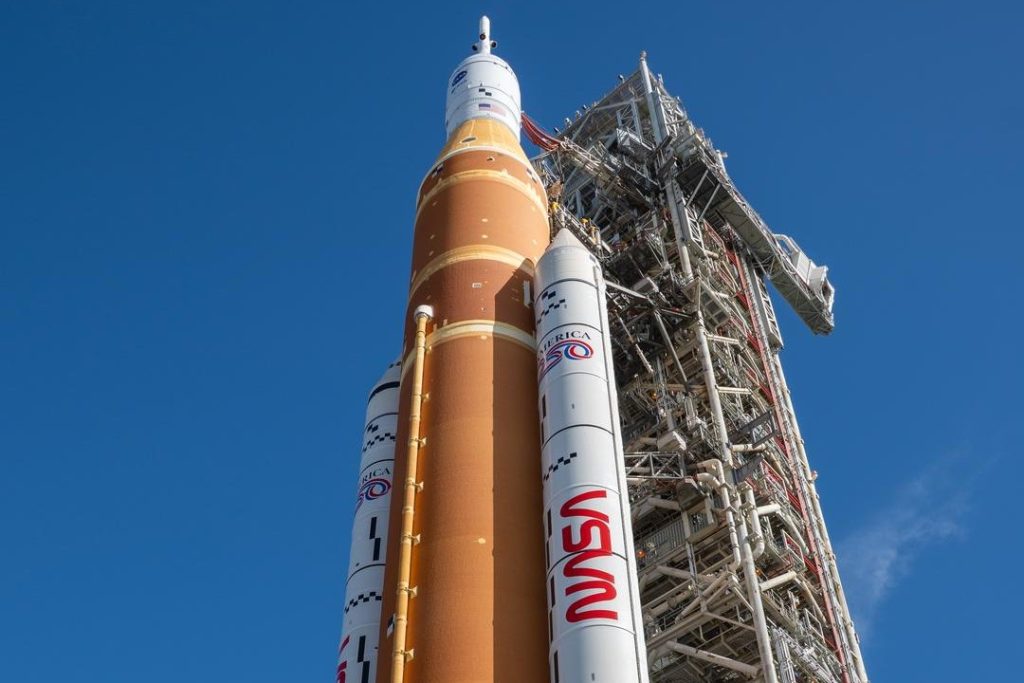
WASHINGTON, July 20 — Fifty years after the last human footprint was pressed into lunar dust, the United States is spending billions to return. The bottom line: the Apollo 17 crew spent 75 hours on the Moon in December 1972, collecting about 110 kilograms of samples and covering 35 kilometers in a lunar rover. The price tag for Apollo — $25.4 billion in 1970s dollars, or more than $200 billion today.
The Artemis program, NASA’s reboot of human lunar exploration, has cost roughly $93 billion through 2025. The figure that matters for investors and policymakers: the gap between those two programs spanned over five decades.
After Apollo 17, NASA shifted its focus to the Space Shuttle program, which flew from 1981 to 2011, and the International Space Station, permanently crewed since November 2000. The idea of a return to the Moon resurfaced in the 2000s under the Constellation program, canceled in 2010. The Artemis program was formally named in May 2019 by NASA Administrator Jim Bridenstine, following Space Policy Directive-1 signed by President Donald Trump in December 2017 directing NASA to return humans to the Moon.
That 50-year gap created challenges. Advanced computing, materials, and propulsion have all improved.
But preserving skills and infrastructure proved difficult. Unlike Apollo’s equatorial landings, Artemis targets the lunar south pole, where permanently shadowed craters may hold water ice — a resource for future missions.
By the numbers: Artemis I and the crewed flights ahead
Artemis I, the program’s first uncrewed test flight, launched November 16, 2022. The Orion spacecraft flew a 25.5-day mission that included a distant retrograde orbit around the Moon. Next up is Artemis II, scheduled for no earlier than April 2026, carrying the first crew — Reid Wiseman, Victor Glover, Christina Koch, and Jeremy Hansen — on a lunar flyby.
Artemis III will then attempt the first landing. The crew of Apollo 17 — Eugene Cernan, Ronald Evans, and Harrison Schmitt — set records that still stand.
Schmitt was the first scientist-astronaut to land on the Moon. That mission remains the last time humans walked on another world.
The road ahead for Artemis
The $93 billion spent through 2025 on Artemis does not include the full cost of the landing missions. The program’s cost structure, compared with Apollo’s inflation-adjusted $200 billion-plus, will be closely watched by budget analysts. The lunar south pole target adds technical complexity — and potential payoff in water ice.
What to watch next: whether Artemis III can hit its landing window and whether the infrastructure gap of the past 50 years can be closed by a program that has already spent nearly $100 billion. The bottom line: the Moon is no longer just a memory; it’s a line item.




