
On 26 September 1983 a Soyuz rocket caught fire on the pad, seconds before launch. The escape rocket on top of the capsule fired and hauled the crew clear just before the booster exploded. They pulled 14 to 17 g for five seconds and came out badly bruised. The capsule reportedly reached 2,000 meters and came down 4 kilometers from the pad.
It was the first time a launch escape system had been used on a crewed mission.
Three ways to get out
An escape system is a rocket-powered way to separate a capsule from its launch vehicle when something is about to go wrong. Automatic failure detection normally triggers it, and the commander can fire it by hand. It works on the pad and during the climb to orbit.
There are three designs. The oldest puts a solid-fuel rocket on a tower above the capsule. It delivers a lot of thrust for a short burst, pulls the capsule a safe distance away, and then parachutes take over. In normal flight the tower is jettisoned once it is no longer useful. Mercury, Apollo, Orion, Soyuz and Shenzhou all use or used one.
Ejection seats are the second. Each crew member rides down under an individual parachute, but the seats work only in a limited range of altitudes and speeds. Vostok and Gemini used them, as did Space Shuttle Columbia in its test phase.
The third puts thrusters in the capsule itself or in its detachable service module. Crew Dragon, Starliner and Blue Origin’s New Shepard work this way.
From Faget’s idea to Mercury
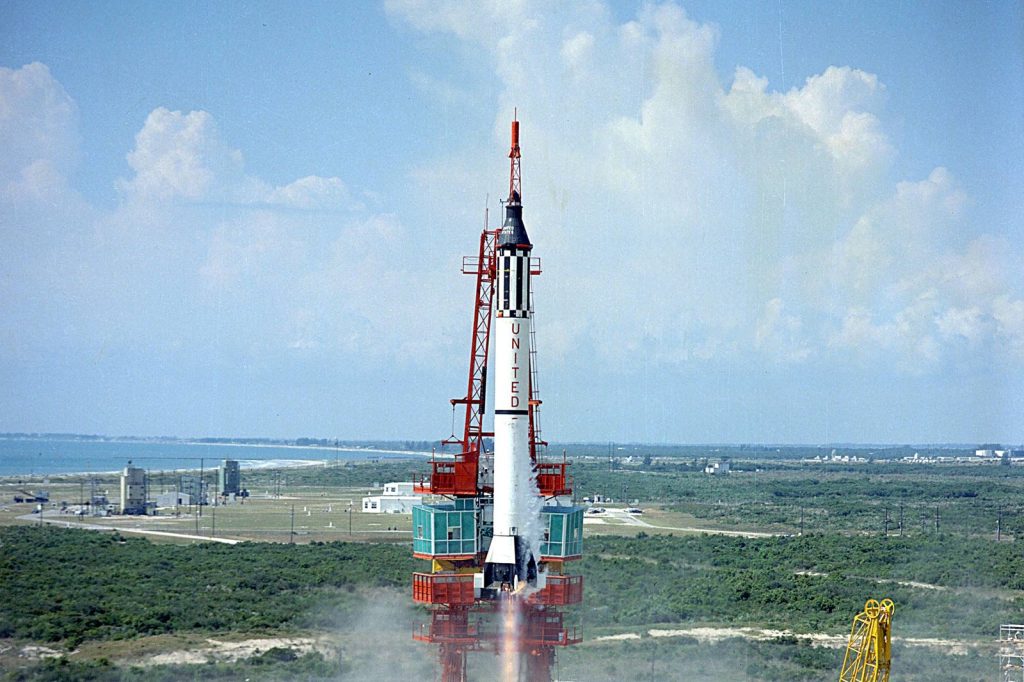
Maxime Faget came up with the idea of using a rocket to pull a capsule off a vehicle in 1958. A Project Mercury capsule test in March 1959 was the first to use the tower. The Grand Central Rocket Company of Redlands, California, later renamed Lockheed Propulsion Company, built the Mercury system, and Apollo’s looked much like it.
Not every mishap went the way designers wanted. During Mercury-Redstone 1 on 21 November 1960, the escape system blasted off the spacecraft after the booster engine shut down just after ignition, while the capsule stayed on the pad. On 14 December 1966 an uncrewed Soyuz 7K-OK failed to launch when its strap-on boosters did not ignite. About 30 minutes later, as the vehicle was being secured, the escape engine fired. Fire broke out in the third stage, and the explosion killed a pad worker.
Soyuz T-10a showed what any such system must do: lift a crew compartment from the pad to a height at which its parachutes can open. That is why the rockets are large, powerful and heavy.
Shuttle and Soviet variants
The shuttle’s first test flights carried ejection seats for two pilots. They were removed when the orbiter went operational and carried more crew who could not be given the same escape. After the 1986 Challenger disaster, surviving orbiters were fitted so the crew could leave through the main hatch using parachutes worn over spacesuits. That worked only if the shuttle was in a controlled glide. The Soviet Proton launcher flew dozens of times with an escape tower under the Zond and TKS programs, but never with a crew.
Push versus pull
Space.com described the two modern approaches as “pull” and “push.” Pull is the tower, used on Mercury, Apollo and Soyuz. Push mounts the thrusters on the capsule or service module and shoves it away from the rocket. Boeing floated the idea in 2010, and SpaceX built it first.
Crew Dragon has eight SuperDraco engines in its hull. NASA’s Commercial Crew program awarded SpaceX $75 million to develop it, and Blue Origin $3.7 million for its own push system. SpaceX held a pad abort test at Cape Canaveral on 6 May 2015, and a full-scale simulated Falcon 9 failure test at Kennedy Space Center on 19 January 2020. Starliner has four abort engines on its service module, supplied by Aerojet Rocketdyne, each producing 40,000 pounds-force of thrust. Boeing ran a successful pad abort test at White Sands Missile Range on 4 November 2019.
The development path was rough. In April 2019, during a SuperDraco test fire, Crew Dragon suffered a major anomaly and smoke was visible from miles away. Boeing had reported leaking engine valves in a July 2018 hot-fire test of its own abort engines. Space.com argued that the setbacks would make both spacecraft safer by exposing problems early.
Orion stayed with a tower, using a Mercury and Apollo-style escape rocket. NASA tested it in 2010 and planned a second test for 12 June.
Real aborts since then
On 11 October 2018, a booster separation failure on Soyuz MS-10 occurred at an altitude of 50 km. The tower had already been jettisoned by then, so backup motors pulled the capsule free. The crew landed safely and uninjured about 19 minutes after launch. And on 12 September 2022, New Shepard’s BE-3 engine failed about a minute into flight NS-23. The escape system fired, and the capsule landed as planned. It carried science payloads and no crew.




