
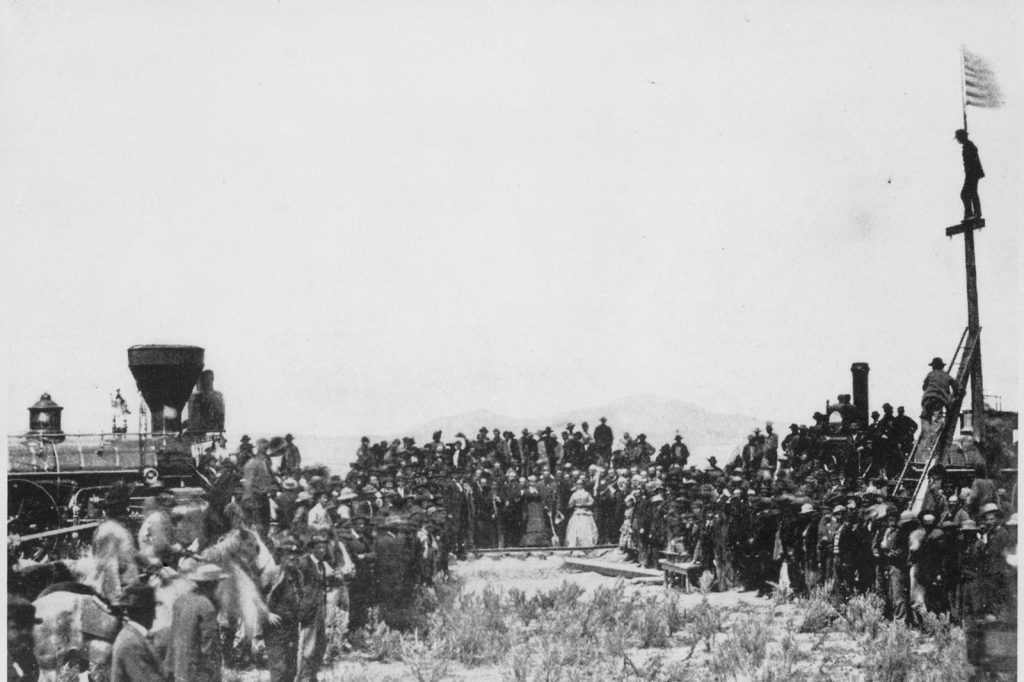
PROMONTORY SUMMIT, Utah Territory, May 10 — The golden spike has been driven. On May 10, 1869, at Promontory Summit in the Utah Territory, Leland Stanford, president of the Central Pacific Railroad, took a silver sledgehammer to a 17.6-karat gold spike and completed the First Transcontinental Railroad. The ceremony itself was modest.
About 500 people gathered at the remote summit — railroad officials, workers, and a military band. The spike, inscribed with the names of the railroad’s officers and directors, was driven into a pre-drilled hole in a laurel-wood tie.
Strategically, the telegraph wire had been attached to both the spike and the sledgehammer. Each blow of the hammer was transmitted as an electrical signal to telegraph offices nationwide, triggering celebrations from New York to San Francisco. The broader stakes of what happened here were immediately clear.
The railroad linked the Atlantic and Pacific coasts by rail for the first time. Coast-to-coast travel time collapsed from months to roughly a week.
It was hailed as one of the greatest engineering achievements of the 19th century. The golden spike itself did not stay in the ground. It was quickly removed and replaced with a standard iron spike.
Today, the spike is displayed at the Cantor Arts Center at Stanford University.
The strategic calculus of a continental railroad
The completion of the Transcontinental Railroad was not merely an engineering milestone. It was a geopolitical act. For the United States, still healing from the Civil War, the railroad represented the physical stitching together of a fractured nation.
It gave Washington a strategic grip on the western territories that no army could match. What this signaled to the world was unmistakable: the United States was now a continental power, capable of moving men, materiel, and commerce from one ocean to the other in a single week.
For a nation that had been, just decades earlier, huddled along the Atlantic seaboard, the calculus had shifted entirely. The ceremony at Promontory Summit was the culmination of years of competition and cooperation between the Central Pacific Railroad, building east from Sacramento, and the Union Pacific Railroad, building west from Omaha. The two lines met in Utah, and the golden spike marked the moment of union.
The site today
The location of the ceremony is now preserved as the Golden Spike National Historical Park, established in 1957. The park sits at the original summit. The original golden spike remains in California, a relic of a moment that reshaped the continent.
But the iron rails that replaced it still carry the weight of American commerce and ambition. For the broader stakes of American infrastructure and national unity, the lesson of Promontory Summit endures: when the nation commits to a grand project, the results can be transformative.
The question that remains, as it always does, is whether the political will exists to drive the next spike.




