
“It’s obviously a pissing contest,” said Simon Devitt, a quantum physicist at the University of Technology Sydney.
Devitt was talking about the race among tech companies to claim quantum supremacy. Google set off the latest round in the Oct. 24 issue of Nature. Its Sycamore processor had completed a calculation in 200 seconds. Google estimated the same job would take a state-of-the-art supercomputer 10,000 years.
IBM quickly pushed back. Its researchers said an improved supercomputing technique could theoretically finish the task in 2.5 days. Far less than 10,000 years, but still a heavy lift for one machine. The disagreement shows how much companies want to lead in quantum computing.
The question of whether that counts as true quantum supremacy still has no settled answer.
What Sycamore did
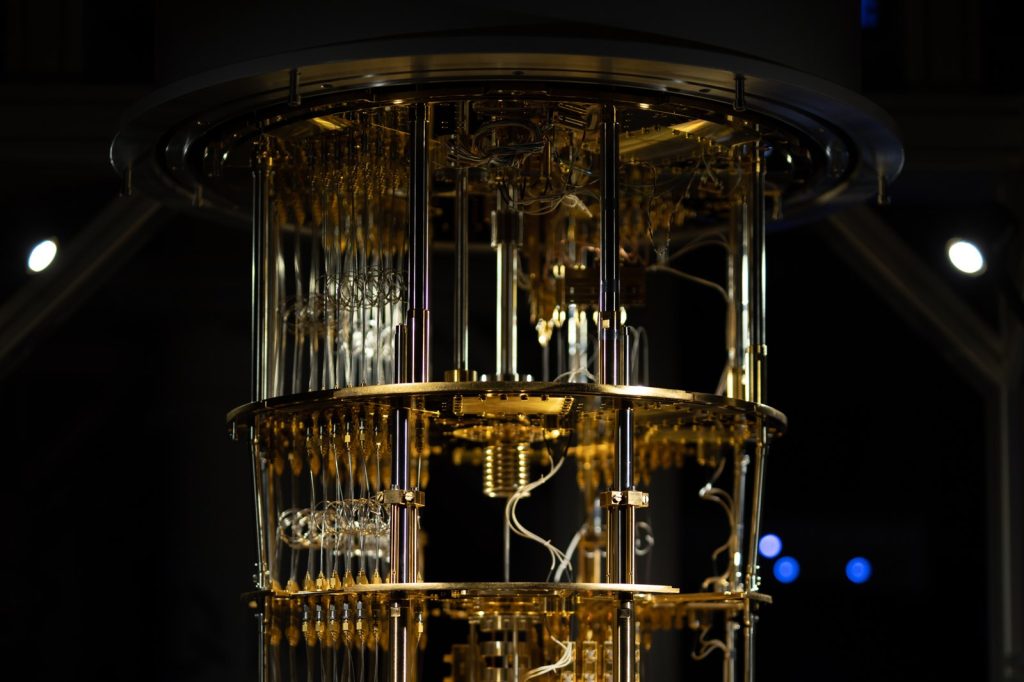
Google built a 54-qubit processor named Sycamore. The benchmark circuits ran on 53 qubits. Each qubit sat in a two-dimensional grid and connected to four others.
The test used random quantum circuits. A run produces a bitstring, such as 0000101. Quantum interference makes some bitstrings more likely than others. Finding the most likely bitstrings on a classical computer becomes exponentially harder as the number of qubits and gate cycles grows.
Qubits are fragile. Errors slip in easily. Google’s researchers had to get many delicate qubits to work together without mistakes.
“What I think is most significant about what the Google group achieved is they built a really good piece of hardware,” said John Preskill, a theoretical physicist at Caltech. “It’s a testament to how the technology has been advancing.”
Google said at the time that the Sycamore processor was fully programmable and could run general-purpose quantum algorithms. After the benchmark, the group began exploring quantum physics simulation and quantum chemistry. Generative machine learning applications were also on the table.
The competitive field
IBM had a fleet of 14 quantum computers available through the cloud. Its largest had 53 qubits. Intel, Microsoft, Alibaba and Baidu were also competing.
Companies expect quantum computers to speed up database searches and chemistry work. Machine learning could benefit too. Eventually, a much larger machine with millions of qubits might crack the encryption that protects credit card numbers and other sensitive data sent over the internet.
Google researchers planned to keep increasing the qubit count and performance. John Martinis, a Google researcher, said at an October 23 news conference that the team was setting its sights on quantum error correction. Combining several qubits into one effective qubit could detect and fix mistakes. “We’re definitely on the road to do that with this result,” Martinis said.
Some researchers compare the moment to the Wright brothers’ first flight at Kitty Hawk, N.C., in 1903. The airplane worked, but it wasn’t yet useful. The flight still made history.
“Quantum supremacy is not going to change the world overnight. We have to be patient,” Preskill said. “But for now, let’s celebrate.”
Sources
- Google claimed quantum supremacy in 2019 — and sparked controversy
- Quantum Supremacy Using a Programmable Superconducting Processor




