
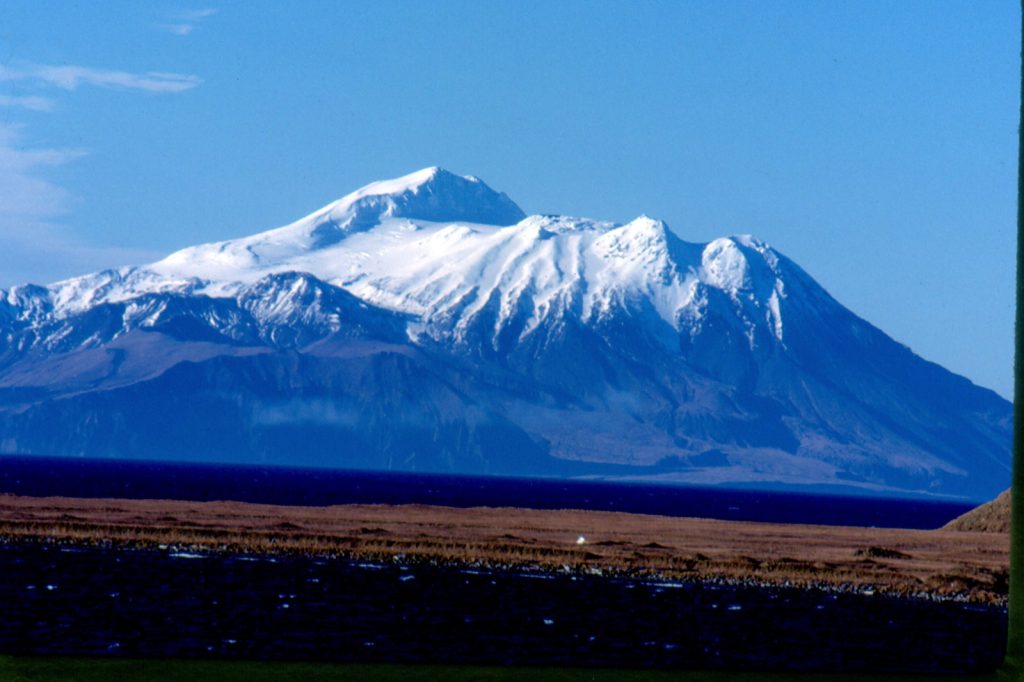
Nobody lives on Great Sitkin Island, which is exactly why the instruments matter. On October 30 the Alaska Volcano Observatory (AVO) said the volcano in the central Aleutians is still erupting, slowly, inside its summit crater. The Volcano Alert Level is Watch. The Aviation Color Code is Orange.
The latest update records minor growth of the active lava dome in satellite imagery over the past week. Its south flank is creeping southward and shedding the odd small rockfall. Cloud blocked most satellite views, though webcam images that did clear showed minor steaming from the dome. Seismicity is low: occasional small volcanic earthquakes, plus signals from minor rockfalls as the lava advances.
An earlier weekly update, issued August 7, added the under-the-hood detail. A GNSS sensor on the island’s northwest shore was recording deflation, which AVO reads as pressure dropping at depth while lava erupts at the summit. Satellite data showed the dome spreading east-southeast.
Two scales, two audiences
The alert level and the color code are not the same thing. The Volcano Alert Level speaks to hazards on the ground and runs Normal, Advisory, Watch, Warning. The color code is for pilots and air traffic managers: Green, Yellow, Orange, Red. Watch and Orange together mean heightened unrest with an increased chance of eruption, or an eruption underway with limited hazards.
Some readers hear “uninhabited island” and shrug. That misses the point. The hazard is airspace. North Pacific routes carry a large share of the cargo and passenger traffic between North America and Asia, and ash is a documented danger to turbine engines. The volcano’s 1974 eruption sent up at least one ash cloud that likely passed 25,000 feet above sea level.
The current eruption began in July 2021. Lava has since filled most of the summit crater and pushed into the valleys below, burying much of the steep-sided dome left by the 1974 eruption. There have been no explosions since an event in May 2021, and AVO has not forecast one. Effusive dome growth and explosive eruption are different behaviors, and Great Sitkin has stayed in the first for more than five years.
Watching through the cloud
Clouds routinely blind the cameras here, so AVO leans on several instrument types at once: local seismic, geodetic and infrasound sensors, satellites, webcams, and regional infrasound and lightning networks. Lightning detection is the least obvious of these. Explosive plumes generate electrical charge, so a lightning network can flag an explosion even when the cameras show nothing.
The volcano is a basaltic andesite structure covering most of the northern half of Great Sitkin Island, about 26 miles from the community of Adak. For Adak residents, the bulletins carry no protective action recommendations, and there is no ashfall advisory or evacuation guidance. Airlines and dispatchers receive AVO notifications directly. A jump to explosive behavior would bring a Volcanic Activity Notice and a possible move to Red, and aviation authorities would hear about it before the news did.
AVO is a joint program of the U.S. Geological Survey, the University of Alaska Fairbanks Geophysical Institute and the Alaska Division of Geological and Geophysical Surveys.
Sources
- Alaska's Great Sitkin Volcano Holds at Watch Level as Slow Lava Dome Growth Continues Inside Summit Crater
- Volcano Updates




