
WASHINGTON, July 15 — The shift is this: orbital mirrors are no longer a Cold War-era curiosity. This week, the United States granted its first-ever government approval for a satellite designed to reflect sunlight onto Earth, marking a significant regulatory milestone for a concept that has lingered on the fringes of space engineering for nearly a century.
The new satellite is not a direct descendant of the Russian Znamya program, but it operates on the same core principle: using a large, reflective structure in orbit to redirect sunlight toward the planet’s surface. The US approval in 2024 — the first Western government authorization for such a project — signals that what was once seen as a speculative idea is now being taken seriously by regulators.
A century-old concept, finally tested
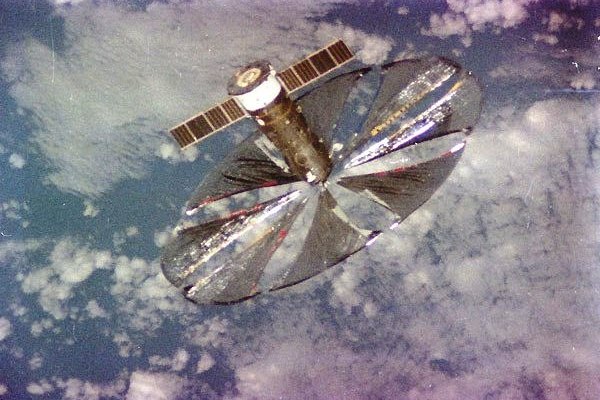
The idea of orbital mirrors dates back to the 1920s, when German rocket scientist Hermann Oberth first proposed using them to reflect sunlight. It took seven decades for anyone to actually try it. The first practical experiment was Russia’s Znamya 2, launched in 1993 from the Mir space station.
It deployed a 20-meter aluminized plastic mirror that briefly illuminated a spot on Earth — a short but successful proof of concept. Russia attempted a larger follow-up, Znamya 2.5, in 1999.
That mission failed when the mirror tangled during deployment and burned up in the atmosphere. The program never flew again. Other nations, including Japan and China, have studied similar concepts over the years, but none ever launched an operational mirror into orbit.
Watch this space: the US approval changes the landscape. The new satellite uses modern materials and advanced control systems — a far cry from the aluminized plastic and manual deployment of the Znamya era.
What’s changing is the regulatory environment, not just the hardware.
What the new satellite brings
The details of the approved US satellite remain limited, but the shift in policy is the real story here. For decades, orbital mirrors existed only in patents, academic papers, and the occasional failed Russian experiment. Now a Western government has signed off on one.
The trend underneath is clear: space-based solar reflection is moving from theoretical to permissible. The applications are still being defined.
Orbital mirrors could theoretically provide illumination for disaster zones, extend daylight for agriculture, or even assist in search-and-rescue operations. But those are potential uses, not confirmed mission parameters. What is confirmed is that the US government has now created a regulatory pathway for this technology — a step no other Western nation has taken.
The Znamya program showed the concept could work, briefly. The new satellite aims to prove it can work reliably.
With modern materials and control systems, the risks of tangle and burn-up that doomed Znamya 2.5 are far lower. The question now is not whether orbital mirrors are possible — it’s whether they’re practical. The answer, if this satellite performs as planned, could open the door to a whole new category of space-based infrastructure.
Watch this space.
Sources
{“@context”: “https://schema.org”, “@type”: “NewsArticle”, “headline”: “History of Space Mirrors: From Znamya to US Approval”, “description”: “WASHINGTON, July 15 — The shift is this: orbital mirrors are no longer a Cold War-era curiosity. This week, the United States granted its first-ever…”, “datePublished”: “2026-07-15T09:30:00+00:00”, “author”: {“@type”: “Person”, “name”: “Maria Romano”}, “publisher”: {“@type”: “Organization”, “name”: “InfoPulse Today”, “url”: “https://newsfeed.infopulsetoday.com/”}, “citation”: [{“@type”: “CreativeWork”, “url”: “https://en.wikipedia.org/wiki/Znamya_%28satellite%29”}]}




