
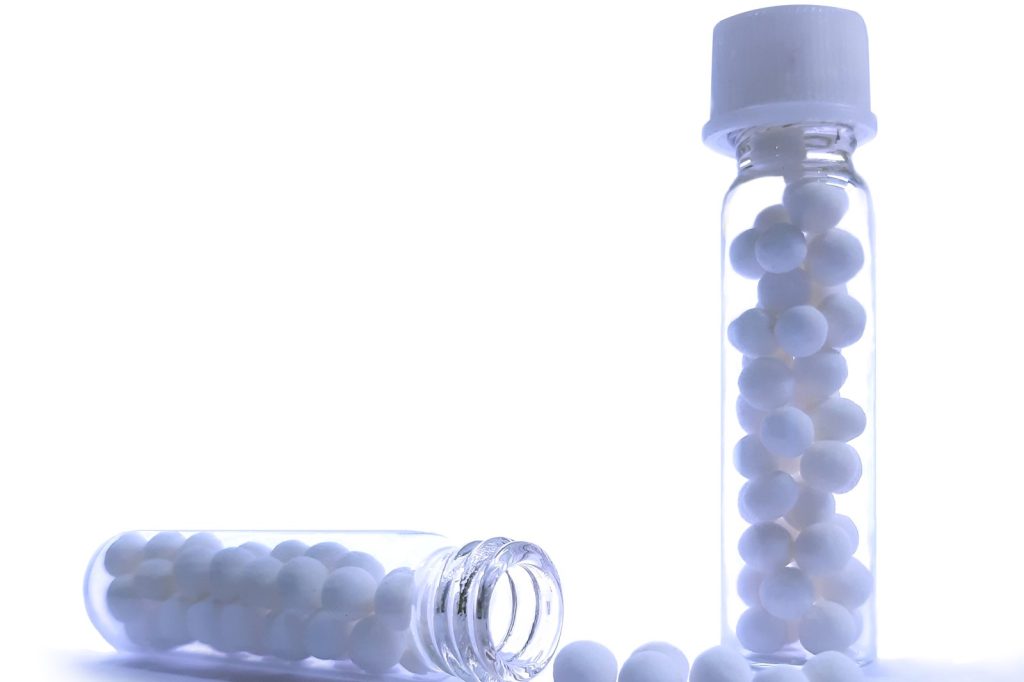
The fever hit 105.5 degrees. Her six-week-old son refused to nurse. It was 1987. Joette Calabrese had a homeopathy book and a box of remedies. The book pointed to sulfur 30 for high fever with a strange breath odor. She gave the pellets. Forty minutes later the baby firmed in her arms, latched on, and the fever slipped away with one dose of sulfur 30X.
That moment anchored a career. Calabrese has run a homeopathy practice since 1996 and now teaches through her Academy of Practical Homeopathy. She calls the approach “kitchen table prescribing” — mothers treating common family ailments with a handful of remedies. “If you’ve got a household full of boys, you might want to know what the medicines are … for boys who fall out of trees or who have skateboard injuries,” she told The Epoch Times in an interview reported by California Insider.
For those injuries she reaches for arnica montana, hypericum, ledum, or ruta. A 2021 review in the journal MDPI found arnica comparable to ibuprofen and diclofenac for acute and chronic pain, with fewer adverse effects. For menarche she uses pulsatilla, mag phos, and colocynthis. A 2021 double-blind, randomized, placebo-controlled trial showed pulsatilla outperforming placebo for painful periods. A case study in the International Journal of Ayush documented mag phos relieving menstrual cramps.
The mechanics here are simple: repeated dilution and shaking, which practitioners say leaves a memory of the original substance in the liquid. Calabrese calls homeopathy “God’s medicine” — no synthetics, no dyes, no side effects, an actual product rather than a mimic. Allium cepa, she notes, is onion; the remedy allium cepa is made from onion, diluted many times, used to treat the very symptoms raw onion causes. Like cures like.
Rachna Kapoor, a medical doctor and Master of Public Health, told The Epoch Times she cleared her medicine cabinet years ago and rarely relies on conventional medications. Michele Kumangai, a mother and Calabrese student, said her family hasn’t visited a general medical doctor in years — she’s treated their rabbit’s injured leg, chickens for parasites, a cat after poisoning, her own cancer treatment side effects, and her husband’s plantar fasciitis.
The catch is the evidence chain. The MDPI review, the pulsatilla trial, the Ayush case study, a case study in the International Journal of Science and Research suggesting ignatia helps emotional distress — each is a single data point. The journals are real. The studies exist. But they do not validate the broader framework.
Follow the money and the structure looks like a direct-to-consumer education business. The Academy sells courses: Gateway to Practical Homeopathy, Feminopathy, alternatives to antibiotics. Free information online funnels toward paid programs. The pharmaceutical industry she criticizes is an easy foil; the alternative she sells carries its own price tag.
Calabrese’s recommended pharmacies: Boiron, Hahnemann in northern California, Washington Homeopathic Products in West Virginia, Newton Labs in Georgia, Helios in Great Britain, and Dr. Reckeweg from Germany. She started learning in the mid-1980s and spent years in India studying protocols from Dr. Prasanta Banerji and Dr. Pratip Banerji.
On closer reading the desire for health freedom is real. The distrust of synthetic drugs is real. The historical role of women as family healers is real. Whether a diluted onion pellet replaces a doctor visit for a 105.5-degree fever in a six-week-old — that remains the decision at the kitchen table.
Sources
- Homeopathic Consultant Says Mothers Are the Natural Healers of Their Families | California Insider
- Preserving Homeopathy’s Knowledge: Why Remedy Roundtable 2026 Matters – Hpathy Global Academy




