
About 65 billion neutrinos from the Sun pass through every square centimetre of the Earth’s surface each second, and almost none of them leave a trace. Yet this year’s Nobel Prize in Physics went to the people who learned to catch the rare ones that do.
On Oct 6, the prize was awarded to Francis Halzen of the University of Wisconsin for decisive contributions to the IceCube Neutrino Observatory and the discovery of high-energy neutrinos of astrophysical origin. So what is a neutrino, and why does it matter?
A particle that barely exists
A neutrino is an elementary particle with no electric charge. It feels only the weak force and gravity, and the weak force has a very short range. That is why neutrinos typically sail through ordinary matter without any detectable effect. The name means roughly “little neutral one”, and its “-ino” ending nods to a mass so small that it was long assumed to be zero.
Wolfgang Pauli proposed the particle in 1930 to explain how beta decay could conserve energy, momentum and spin. Nobody saw one until 1956, when Clyde Cowan, Frederick Reines and colleagues detected antineutrinos from a nuclear reactor. That work earned a Nobel Prize in 1995.
Neutrinos come in three flavours, electron, muon and tau, each tied to the charged lepton of the same name. Most of those that reach Earth come from fusion in the Sun.
How oscillation gave them mass
In the 1960s the Homestake experiment counted electron neutrinos from the Sun and found only a third to a half of what the solar model predicted. For about thirty years nobody could find a fault with either the experiment or the model. The answer, it turned out, was that both were right. Neutrinos change flavour in flight.
This happens because a neutrino of a given flavour is really a quantum mixture of three mass states, and the three travel slightly differently. An electron neutrino made in the Sun can arrive as a muon or tau neutrino, which the early detectors could not see. Oscillation only works if the masses are not zero, so it settled the question. Experiments from 1998 onward confirmed it, and Takaaki Kajita and Arthur McDonald received the 2015 Nobel Prize in Physics for the finding.
How heavy are they, then? Cosmology puts the sum of the three masses below 0.120 eV/c2. The KATRIN experiment in Germany measures the beta-decay spectrum of tritium and needs no model of cosmic history, only the conservation of energy. Using 259 days of data, it found the neutrino mass to be below 0.45 eV/c2, the best direct laboratory limit so far. That makes a neutrino more than a million times lighter than an electron. KATRIN has analysed only about a quarter of its expected data.
The tiny masses still add up. Neutrinos were made in vast numbers in the first second after the Big Bang, and their combined mass helped shape the structure of the universe.
Building a detector from ice
Neutrinos make good cosmic messengers because nothing much happens to them on the way. Light can be blocked, and charged cosmic rays are steered off course by magnetic fields. Neutrinos arrive straight from hot, dense places such as stars. The catch is detection. The chance of any one neutrino interacting is minuscule, so you need an enormous detector and long patience, and you must keep background noise from faking a signal.
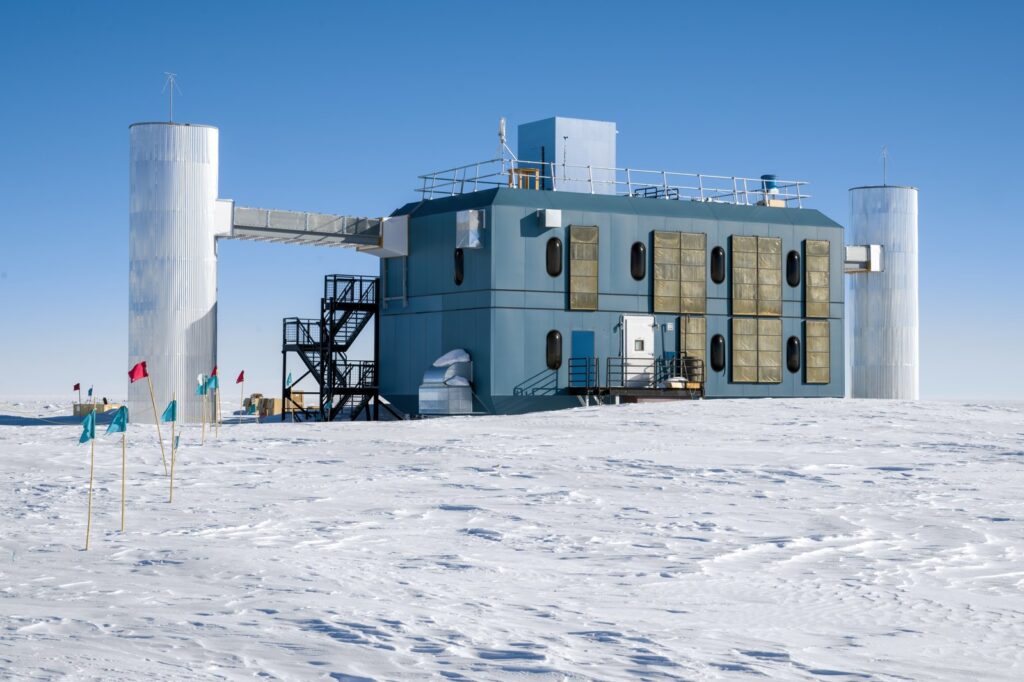
IceCube sits in one cubic kilometre of ice at the South Pole. Several thousand light sensors, photomultiplier tubes, are buried in it. When a neutrino interacts it can produce charged particles that give off a flash of light, and from the sensors’ signals scientists reconstruct the neutrino’s position, direction and energy.
In 2013, IceCube announced two astrophysical neutrinos, each at energies close to 1 PeV. Hundreds more have followed. Two surprises stand out, according to Ohio State physicist John Beacom, who is not part of the collaboration. The neutrinos come mostly from very distant sources, some from the Milky Way and none yet from the Sun. And no one knows what kinds of galaxies are producing them.
The proposed successor, IceCube-Gen2, would have an optical detector about ten times larger plus a radio detector for still higher energies. Two Chinese-led proposals, TRIDENT and HUNT, would be larger again.
Sources
- Neutrino
- KATRIN Narrows Down the Range of Neutrinos’ Mass
- How neutrinos, which barely exist, just ran off with a Nobel Prize — again!
Photo: Christopher Michel (CC BY-SA 4.0)




