
SAN FRANCISCO, July 19 — For the first time, physicists have demonstrated quantum coherence at room temperature in a material they say can be directly used for quantum computation, a breakthrough that clears one of the most stubborn obstacles standing between quantum theory and practical machines. Quantum coherence is the fragile property that lets a quantum bit, or qubit, exist in multiple states at once — the engine of quantum computing’s power. But until now, that state has been notoriously fleeting at anything above cryogenic temperatures.
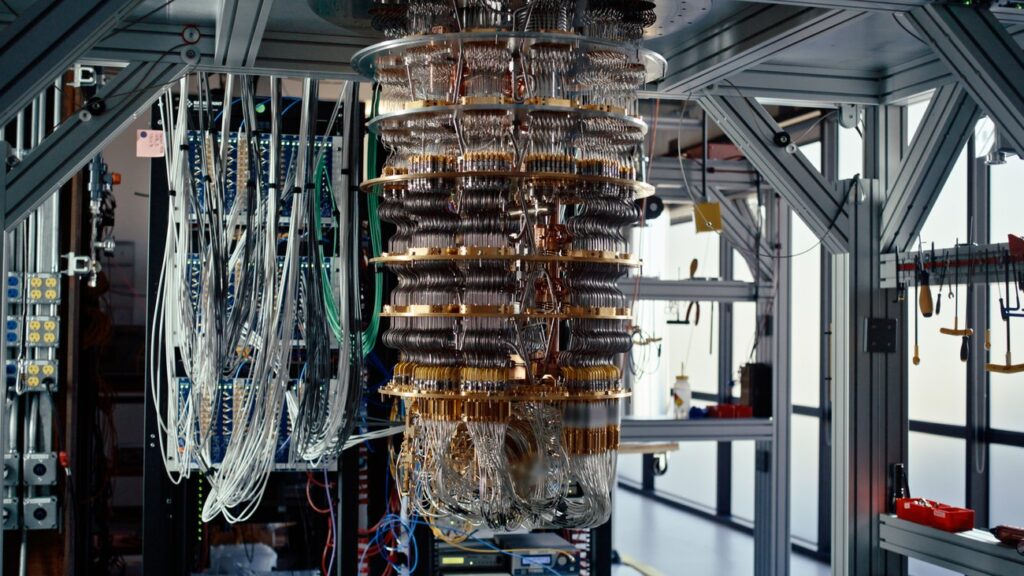
Thermal vibrations and environmental noise normally rip it apart within fractions of a second, meaning most quantum experiments require bulky, expensive cooling systems.
A different kind of material
The new material changes that by preserving coherence through its own intrinsic structural or electronic properties. The physicists behind the work have not disclosed the exact mechanism, the specific material’s name, or its chemical composition. But they say the material likely relies on a special arrangement of atoms or the use of topological phases — exotic states of matter that shield quantum states from decoherence, much like a quiet room inside a noisy factory.
Previous efforts to achieve room-temperature quantum effects have focused on nitrogen-vacancy centers in diamond or on organic molecules. Those systems demonstrated quantum behavior at room temperature, but they have not been easily integrated into the kind of computing architectures needed for large-scale quantum processors.
The new material is claimed to be the first that overcomes that integration hurdle, offering a path to quantum computation at room temperature directly.
What this means for the field
Behind the breakthrough is a long-standing tension in quantum computing. The very properties that give qubits their power — superposition and entanglement — also make them exquisitely sensitive to disturbance. Keeping them stable has required either extreme cold or highly specialized, isolated environments.
A material that naturally resists decoherence at everyday temperatures changes the engineering equation. It means researchers can imagine building quantum chips that sit on a lab bench, not inside a liquid-helium vessel.
The physicists have not said whether the material is a crystal, a thin film, a two-dimensional layer, or something else entirely. They have not said where it was synthesized or who funded the work. What they have said is that it works, that it holds coherence at room temperature, and that it is directly usable in quantum computation — a trio of claims that, if confirmed, would represent a genuine step change in the field.
The work remains at the announcement stage, with many details still behind closed doors. Researchers in the broader quantum community will want to see replication and peer review before accepting the full scope of the claim.
But the very possibility — that a material can by its own nature preserve quantum coherence without cooling — has already shifted conversations among quantum engineers about what the next generation of hardware might look like. The question now is whether the material can be scaled, manufactured reliably, and integrated into the error-correcting architectures that are the next frontier for quantum computing. The physicists have offered no timeline.
For now, the field has something it has long lacked: a plausible path away from the cryostat.




