
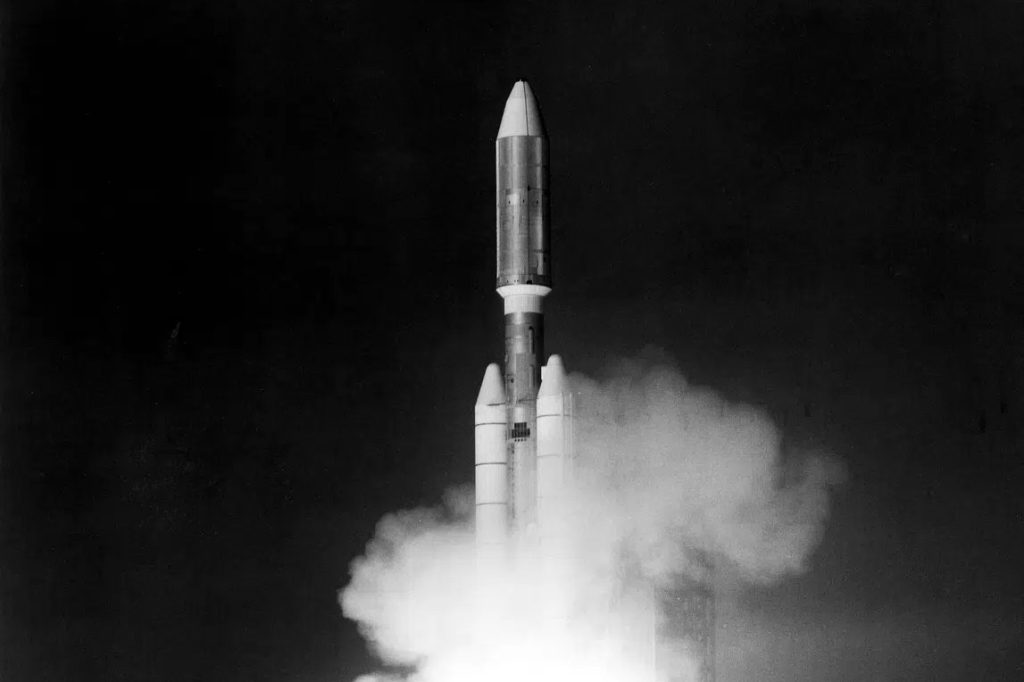
Voyager 1 loses about 4 watts of power every year, and NASA has run out of easy places to find the savings. On a Friday in April 2026, engineers at the Jet Propulsion Laboratory in Southern California sent a command to switch off one of the probe’s few remaining science instruments.
The instrument was the Low-Energy Charged Particles experiment, or LECP, which had run almost continuously since the spacecraft launched in 1977. “While shutting down a science instrument is not anybody’s preference, it is the best option available,” said Kareem Badaruddin, Voyager mission manager at JPL.
Where the power comes from
Both Voyager probes carry radioisotope thermoelectric generators, which turn the heat of decaying plutonium into electricity. As the plutonium runs down, so does the output. Nearly five decades in, the engineers have had to keep powering down heaters and instruments, while making sure the spacecraft does not get so cold that key systems, fuel lines included, are put at risk.
Of the 10 original instrument sets on the twin probes, seven are now switched off. Voyager 2’s LECP went dark in March 2025. On Voyager 1, two remain: one that listens to plasma waves and one that measures magnetic fields. “They are still working great,” Badaruddin said, “sending back data from a region of space no other human-made craft has ever explored.”
Why the April shutdown came when it did
A scare forced the timing. On February 27, Voyager 1 suffered an unexpected power drop during a routine roll maneuver, NASA said. Engineers feared another dip could trip the undervoltage fault protection system, which shuts components down automatically to protect the probe. Recovering from that can take a long time and carries risk, so the team acted first.
The order of shutdowns was no surprise, either. Mission science and engineering teams had agreed on it years ago. Distance adds its own friction: Voyager 1 is more than 15 billion miles away, commands take roughly 23 hours to arrive, and the shutdown sequence itself runs for more than three hours. The small motor that rotates the LECP sensor stays powered, because it draws only about half a watt. Engineers hope that leaves the door open to restarting the instrument if more power ever becomes available.
NASA said the move would give Voyager 1 about a year of breathing room.
The “Big Bang”
That year is for a bigger fix, nicknamed the Big Bang. The idea, per NASA’s release, is to swap a group of powered devices all at once, turning some off and replacing them with lower-power alternatives that keep the spacecraft warm enough to keep gathering science data. Primetimer reported that engineers carried it out on Voyager 1 in early September, replacing three devices. A similar change was made to Voyager 2 about six weeks earlier. Without the work, NASA might have had to turn off another science instrument by summer 2027.
Then came October. NASA missed Voyager 1’s signals on two communications attempts scheduled for October 18-19, and picked the signal up again on October 20, after roughly 48 hours of silence. One set of thrusters had quit and the craft had switched to its backups, as it is built to do when its computers detect a problem. “This is the first time we’ve seen the spacecraft do something like this,” Badaruddin said, “but we are also at a point in the mission where we have to expect the unexpected.”
On November 18, Voyager 1, moving at about 38,000 mph, is expected to be around 16.09 billion miles from Earth, about the distance light travels in one day. A message takes around 24 hours to reach it, and the reply takes another 24 to come back. As project manager Suzanne Dodd put it: “If you want to say ‘hello’ to Voyager, you send your message and then you go home and you wait two days.”
Sources
- Voyager 1 resumes normal communication after a 48-hour outage; NASA now investigating thruster glitch – PRIMETIMER
- NASA shuts down Voyager 1 science instrument to conserve power in space | Fox News




