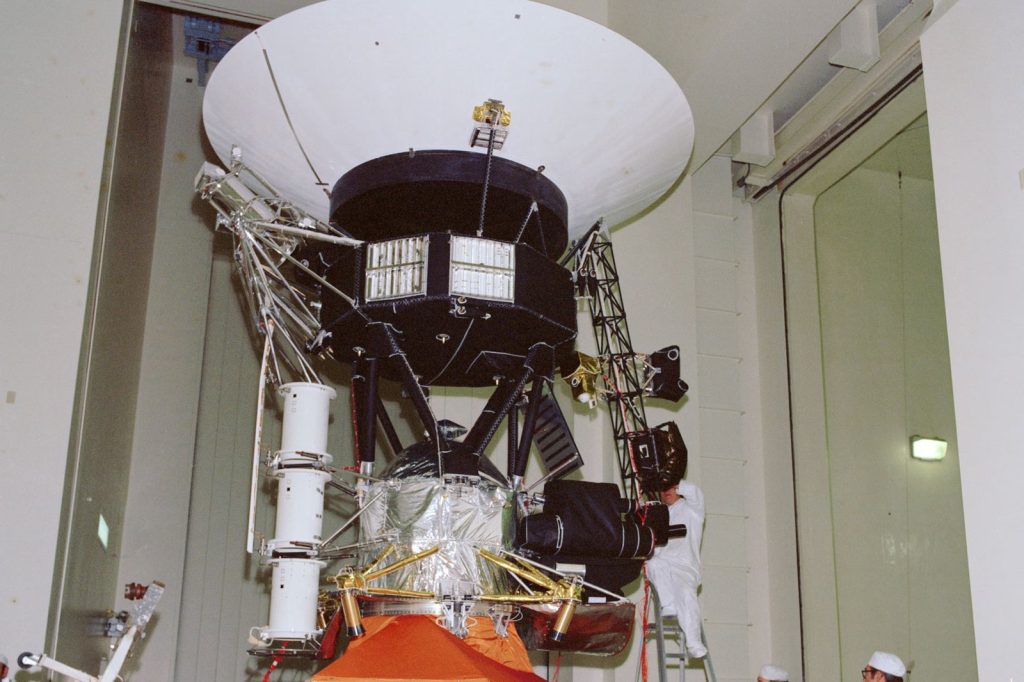
The news from the edge, dated October 30: NASA’s Voyager team is celebrating two developments aboard the agency’s longest-running mission. In September, engineers finished a months-long push to stretch Voyager 1’s dwindling power supply, and then on October 20 an unexplained loss of communication resolved itself after 48 hours, before troubleshooting commands could even be sent. The spacecraft is 16 billion miles (24 billion kilometers) out, and as ever at this distance, the drama travels slowly: the engineering is improvised, the fixes take months, and the patient is older than most of the people doctoring it.
Under the hood, the September effort was a swap meet with the thermostat in mind. Engineers powered down three devices and slid in three lower-power replacements, a piece of housekeeping the team nicknamed “Big Bang,” completed about six weeks after the identical exchange on Voyager 2. The probes run on radioisotope thermoelectric generators, turning the heat of decaying plutonium into electricity, and each spacecraft sheds roughly 4 watts a year as the plutonium decays; half a century in, the margins have gone thin. The detail that matters is heat: the six devices involved hold the spacecraft at working temperature in deep cold, and only a simultaneous three-for-three swap could cut power draw while spreading the warmth properly. Voyager 1 left Earth in 1977 carrying 10 dedicated science instruments; two have already been shut off in recent years, and without the Big Bang another would have gone dark as early as summer 2027.
The technical reality of the silence is stranger than the headline. On October 18 and 19, the Deep Space Network, the big dishes at three ground sites used to talk to spacecraft at the Moon and beyond, heard nothing from Voyager 1 in two scheduled attempts a day apart. The signal reappeared on its own a day later, and the team has held contact since. The early diagnosis: one group of thrusters went offline and its backups switched themselves on, an automated response the moment the onboard computers sense something amiss. The system is called fault protection, and it parks the spacecraft in a safe, stable configuration and pauses normal operations to give engineers time to work. “This is the first time we’ve seen the spacecraft do something like this, but we are also at a point in the mission where we have to expect the unexpected,” said Kareem Badaruddin, who manages the Voyager mission from NASA’s Jet Propulsion Laboratory, adding, “We’re relieved to be back in contact with Voyager 1 and are eager to understand what happened.”
Ahead lies a milestone with no instrumentation to mark it. On November 18, Voyager 1, speeding along at 38,000 mph (61,155 kph), will stand 16.09 billion miles from Earth, 25.89 billion kilometers in metric: one light-day, the distance light covers in a day. Commands take a full day to ride out to the probe and its replies take another day back, a latency that has become its own genre of engineering patience. “If you want to say ‘hello’ to Voyager, you send your message and then you go home and you wait two days before you finally get a response,” said Suzanne Dodd, the JPL engineer who manages the Voyager project. Nothing will change aboard the spacecraft when it passes the mark, and the machine will detect nothing new around it; the significance, as NASA frames it, is the vastness it demonstrates and the endurance of humanity’s most distant explorer, the farthest-flung human-made object there is.
The history explains why a probe in its fifth decade still commands attention. The twins rode a rare line-up of the four outer planets that comes around once every 175 years, and delivered: volcanoes on Io, a likely ocean under Europa’s ice, Saturn’s atmospheric chemistry and fresh rings, and still our only close-ups of Uranus and Neptune. Voyager 1 crossed the heliopause in 2012, the first machine to enter interstellar space; Voyager 2 followed in 2018 and surprised everyone by recording “a small trickle of solar particles streaming through the heliopause” where its twin had seen none. At 35,000 mph, a figure from the mission’s earlier era, the probes need three centuries merely to reach the Oort Cloud’s inner edge, 30,000 years to cross it, roughly 40,000 years for Voyager 1 to drift near another star and 300,000 for Voyager 2. Each carries a 12-inch gold-plated copper disc electroplated with ultra-pure uranium-238, carrying greetings in 55 languages, the project of a committee led by Carl Sagan. “Billions of years from now, our Sun, then a distended red giant star, will have reduced Earth to a charred cinder,” Sagan wrote, but “But the Voyager record will still be largely intact, in some other remote region of the Milky Way galaxy, preserving a murmur of an ancient civilization that once flourished” before moving, as he had it, to greater deeds and other worlds, “on the distant planet Earth.” A spacecraft too far to hear, carrying a record built to outlast the listener: as ever, the Voyagers keep the best jokes for the very long term.
Sources
- Voyager: What’s next for NASA's interstellar probes?
- Voyager 1 Interstellar Probe Conserves Power, Resolves Brief Communications Pause – Astrobiology