A cube has eight corners. A tesseract has sixteen. Nobody has ever held one, and nobody can draw one correctly on paper, yet the whole shape can be built with a rule a schoolchild can follow: take what you have and push it one step in a direction it has not gone before.
Four moves from a dot
Begin with a point, which has no size at all. Drag it in one direction and it traces a line segment. Drag that segment sideways, at a right angle to itself, and you get a square. Lift the square out of its own flat plane and you get a cube. Then comes the move that cannot be shown in a room: push the whole cube along a fourth direction, perpendicular to all three it already has. The result is a tesseract, the four-dimensional hypercube.
Each step doubles the corners. A point has one, a segment two, a square four, a cube eight, a tesseract sixteen. Carry on and the five-dimensional version, the penteract, has 32, and the six-dimensional hexeract has 64. The same logic runs the other way in a neat trick: a cube is two squares joined by four extra edges, and a tesseract is two cubes joined by eight.
What is inside
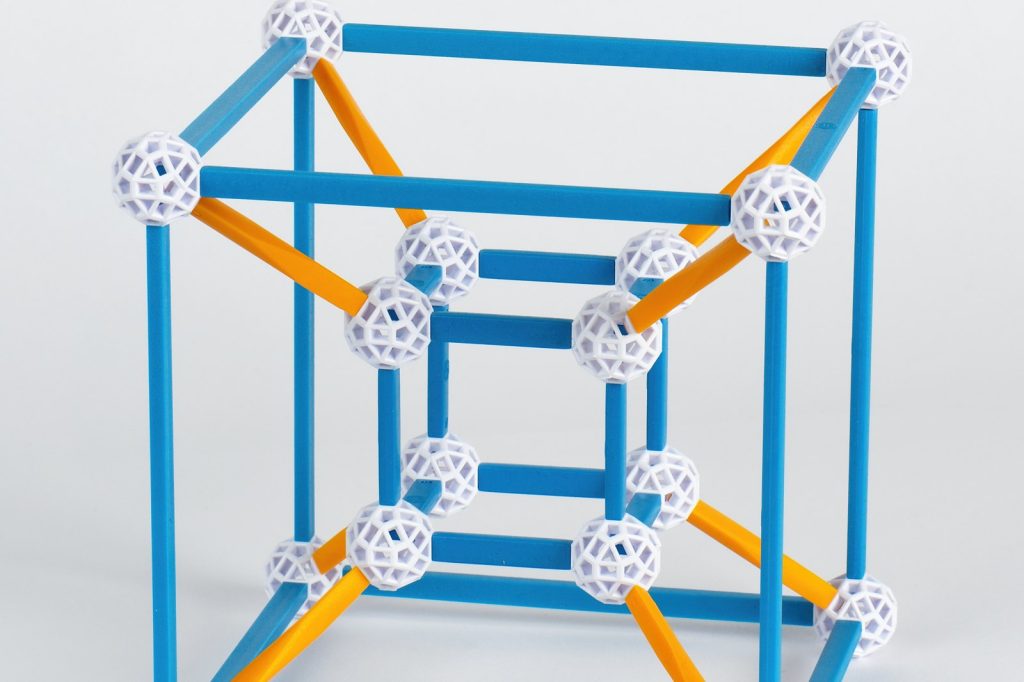
Take a tesseract apart and you find familiar pieces. It has 16 vertices, 32 edges, 24 square faces and 8 cells, each of which is a complete cube. A cube has six square faces; the tesseract has eight cubic ones, and they fit together in four-dimensional space without overlap, just as a cube’s squares do in three. Four edges meet at every corner, all at right angles, and every edge has the same length.
Brilliant, the maths education site, makes the point that this is impossible to reproduce perfectly in two dimensions or even to construct in three. Every picture is a compromise. The best known is the “cube within a cube”: a small cube nested inside a large one, with eight edges tying their corners together. Another route is to unfold it. A cube flattens into a cross of six squares, one of 11 distinct layouts. A tesseract unfolds into a three-dimensional cross of eight cubes, and there are 261 distinct ways to do it. Salvador Dalí painted one of them in 1954 in Crucifixion (Corpus Hypercubus), hanging a figure on that stack of eight cubes.
The name and the use
Charles Howard Hinton, a British mathematician, coined “tesseract” in 1888 in his book A New Era of Thought. He also coined “ana” and “kata” for the two directions along the fourth axis. Wolfram MathWorld lists the shape as the four-dimensional member of a family it calls the hypercube, also known as the n-cube or measure polytope. Its dual is the 16-cell, and a projection of the five-dimensional hypercube sits on the cover of H. S. M. Coxeter’s 1973 book on polytopes.
The shape is more than a curiosity. Computer scientists label each vertex of an n-cube with a unique string of n zeros and ones, which is why binary codes map so naturally onto it. Each vertex touches exactly n neighbours, and that makes the structure efficient for routing information between processors in parallel computing networks.
Sources
- What Is a Hypercube? From Cubes to Tesseracts – ScienceInsights
- Tesseract | Brilliant Math & Science Wiki
- Hypercube — from Wolfram MathWorld