
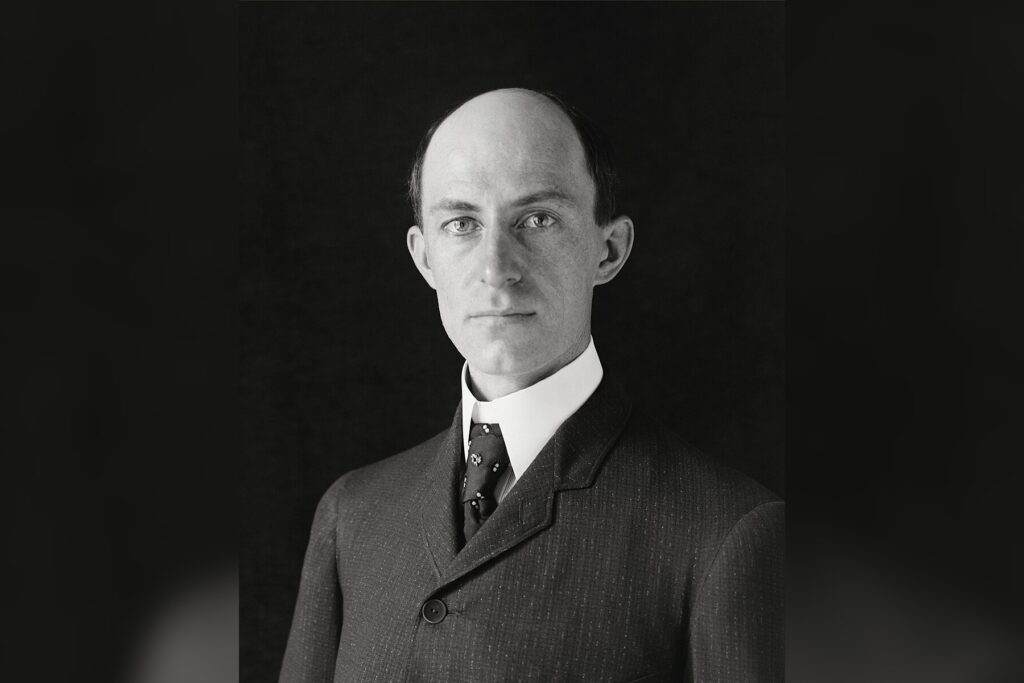
A customer bought an inner tube, and Wilbur Wright started fiddling with the empty box. According to the story Wilbur later told, twisting that box gave him the idea that solved the hardest problem in flight: if one wing tip is forced up while the other goes down, a pilot can control the roll of a biplane.
That small moment in a Dayton bicycle shop sits at the centre of how the Wright brothers got from a printing press and a repair counter to the first successful piloted, engine-powered airplane flight.
Reading before building
Tom Crouch, a senior curator of aeronautics at the National Air and Space Museum, describes Wilbur at the end of the 19th century as a man approaching 30, still under his father’s roof, unmarried, whose only record was two very small businesses run with the help of his younger brother Orville. He wanted a challenge to measure himself against. The airplane was one of the great technical ones of the day.
He began by reading everything within reach, from his father’s simple books on flight in nature to the Dayton Public Library’s handful of titles. When those ran out he wrote to the Smithsonian Institution, which sent pamphlets and a list of books to buy. He bought them.
An airplane needs wings that lift, a way to push them through the air, and a means of balancing in flight. Wilbur judged that the first two were largely handled. Otto Lilienthal’s gliders had carried him through the air on over 2,000 flights, and Samuel Langley’s wings had lifted heavy models. Dayton workshops were already building light engines for automobiles and motorcycles. Control was the neglected piece, so that is where the brothers put their effort.
Control over stability
Most experimenters wanted a machine that would right itself after a gust. The Wrights went the other way. They wanted a system giving the pilot command in every axis at all times, and they trusted people to learn it, because they were cyclists. Nobody who has never seen a bicycle would believe a person could balance on two narrow tires while steering, Crouch points out, yet once you learn, it becomes instinct.
Rudders had steered ships for millennia, and an elevator for pitch was no great leap. Roll was the hard axis. The brothers tried wing warping on a kite in the summer of 1899, tested in Dayton, and it worked reasonably well. Then came the 1900 glider.
Kitty Hawk
In 1900 they travelled from Ohio to Kitty Hawk, North Carolina. National Geographic Kids notes that the oceanside dunes offered regular breezes and soft, sandy ground to land on. They tested kites, then gliders, and both brothers took turns as pilots.
The gliders disappointed. They produced roughly 20 percent less lift than the calculations predicted, because the brothers had trusted a table of figures inherited from Lilienthal. To find the fault they mounted a bicycle wheel horizontally in front of a bicycle’s handlebars, with a flat plate and a curved plate attached to the rim, and meant to ride it through Dayton’s streets and see whether the wheel stayed still.
In 1903 they built the Wright Flyer I, with wooden propellers they had designed and carved themselves and a gasoline engine. After weeks of failed attempts, and with extra fabric added to stiffen the wings, it flew on December 17, 1903. The flight lasted 12 seconds and covered 120 feet. The brothers flew it a few more times that day.
Wilbur’s own attitude to risk shaped the whole effort. He wrote to his father that he and Orville would be careful, move slowly and take no risk they did not have to take. A little over 65 years later, Neil Armstrong and Buzz Aldrin walked on the moon.
Sources
- Taking Flight With the Wright Brothers | National Geographic Kids
- NOVA | Wright Brothers' Flying Machine | The Unlikely Inventors | PBS




