
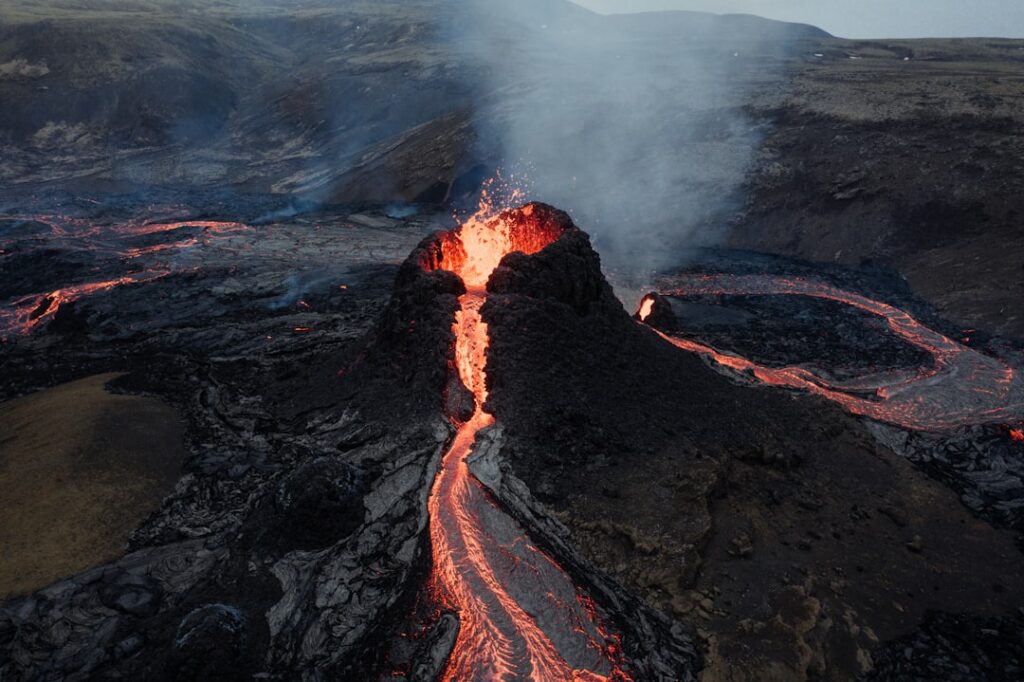
The magma is moving. That is the blunt reality behind Iceland’s declaration of a state of emergency. The Icelandic Meteorological Office has tracked a swarm of earthquakes near the Fagradalsfjall volcano, and the data points to one thing: molten rock is pushing upward from a depth of roughly five to ten kilometers.
The country is now bracing for what could come next. This is not a hypothetical.
The quakes are not random tectonic stress. They are the signature of magma forcing its way through the crust. When that movement reaches the surface, the result is an eruption.
The question is not whether the system is active. It is how fast the magma rises and where it breaks ground.
Fagradalsfjall sits on the Reykjanes Peninsula. That puts it uncomfortably close to Keflavík International Airport, the main gateway for transatlantic flights, and to Reykjavík, the capital. The last time this volcano erupted was 2021.
That event drew crowds, not catastrophe. But volcanoes are not predictable in the way a train schedule is. Each eruption has its own character.
The emergency declaration is a procedural step. It frees up resources.
It lets authorities move faster. It tells the public and the airlines that this is serious. The Icelandic Meteorological Office is the agency feeding the raw data.
They are the ones watching the seismographs jump. They are the ones calculating the odds.
Iceland sits directly on the Mid-Atlantic Ridge. The Eurasian and North American plates are pulling apart there. That rifting is what makes the island a volcanic hotspot.
The interior is a desert of lava fields and black sand. Most people live on the coast. That pattern of settlement is a direct response to the geology.
You build where the ground is less likely to open beneath you. But even coastal areas are not safe.
The 2021 eruption at Fagradalsfjall was a tourist attraction. It was a spectacle. It was not a disaster.
The concern now is that the next one might be different. An eruption close to an airport could shut down airspace.
Volcanic ash damages jet engines. That is not speculation. The 2010 eruption of Eyjafjallajökull grounded flights across Europe for weeks.
The economic cost ran into the billions. The authorities are preparing for that possibility. They are mapping evacuation routes.
They are coordinating with aviation officials. They are watching the magma.
The depth of the quakes is a key detail. Five to ten kilometers is shallow. That means the magma has already risen a long way from its source.
The shallower it gets, the closer the surface rupture. The closer the eruption.
There is no way to stop it. Iceland has no army. It has no technology to plug a volcano.
What it has is monitoring, planning, and a population that has lived with this threat for centuries. The country’s history is written in ash and lava. The settlements that survived are the ones that learned to read the ground.
The situation is unfolding. The Meteorological Office is issuing updates.
The state of emergency is in effect. The magma is moving. That is the story.
Everything else is waiting.




