
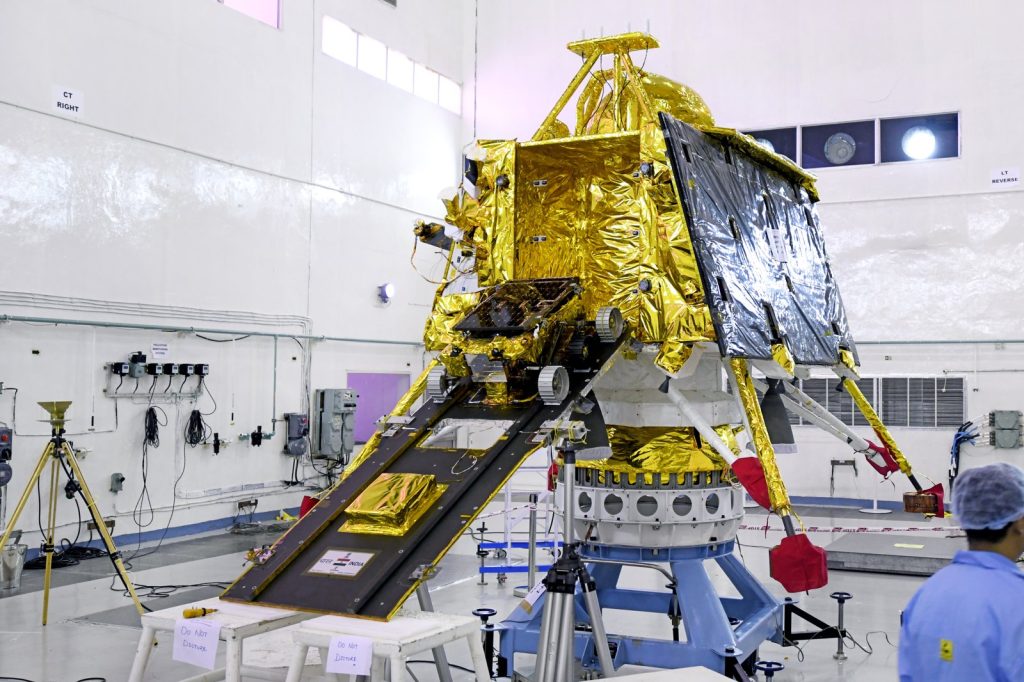
At 18:04 IST on 23 August 2023, the Indian Space Research Organisation (ISRO) achieved a historic soft landing when the Vikram lander of the Chandrayaan‑3 mission touched down near the Moon’s South Pole. The landing coordinates, 69° S, place the craft in a region that no spacecraft has ever visited before, joining only three prior achievers: the Soviet space programme, NASA and China.
The Soviet Union’s polar landings occurred decades ago, NASA’s were crewed missions, and China’s robotic lander touched down on the near side of the Moon. ISRO’s choice of a rugged, temperature‑extreme site at the far side of the lunar South Pole makes this accomplishment distinct. Chandrayaan‑3 lifted off from Sriharikota on 14 July 2023. After a cruise phase, the spacecraft entered lunar orbit on 5 August and spent 18 days circling the Moon while mission controllers waited for an optimal window.
When the moment arrived, the Vikram lander separated from the orbiter and executed a controlled descent, avoiding the crash that ended the Chandrayaan‑2 attempt in 2019. The successful touchdown demonstrated that the redesigns and lessons learned from the earlier failure were effective.
On the surface, the Vikram lander carries the Pragyan rover. Both are replacements for the lander and rover lost with Chandrayaan‑2, and they are now tasked with conducting scientific experiments and transmitting data back to Earth. This is more than a symbolic flag‑planting; it establishes a functional, albeit modest, scientific outpost on the Moon.
The South Pole is of particular interest because it is believed to contain water‑ice deposits. Such ice could be harvested for rocket fuel, drinking water or oxygen, giving any nation that can operate there a strategic advantage.
By proving it can reach and work in this environment, ISRO places India alongside the United States and the former Soviet Union as a power capable of exploiting these resources. Achieving a soft landing requires precise engine burns to reduce orbital speed to a standstill while navigating unknown terrain. One miscalculation could have sent Vikram into a crater.
ISRO’s successful execution underscores a high level of technical competence. The Chandrayaan programme has been an ongoing effort, not a single‑off stunt.
The current mission continues the series, with the orbiter still circling the Moon, the lander operating on the surface, and the rover set to roll across the terrain. Data gathered will feed into future lunar studies and potential resource utilization plans. India’s accomplishment also has broader implications for the global space landscape.
The addition of another capable lunar participant lowers the overall cost of access to the Moon’s South Pole and may encourage both national agencies and private companies to pursue similar goals. For India, the success signals technological sovereignty: the nation can design, build and launch complex interplanetary missions without external assistance.
As the mission proceeds, the world will watch the scientific output from Vikram and Pragyan. The landing, recorded in August 2023, has already written a new chapter in lunar exploration history, positioning India firmly within a very exclusive club of nations that have achieved a soft landing at the Moon’s South Pole.




