
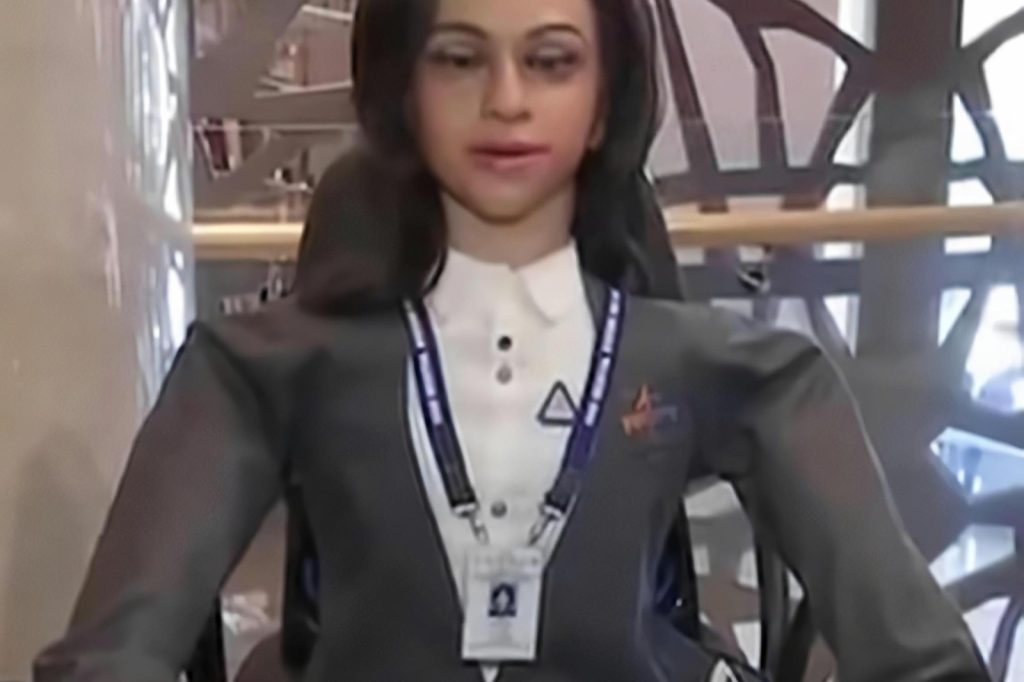
On 22 January 2020, the Indian Space Research Organisation (ISRO) introduced Vyag Mitra – a 90 cm, 45 kg half‑humanoid designed to accompany the nation’s first crewed mission, Gaganyaan, slated for 2021. The robot, whose name means “sky friend” in Sanskrit, will be the centerpiece of an unmanned launch scheduled for December, serving as a final check of life‑support systems before any Indian astronaut flies. Vyag Mitra’s torso is built from an aluminium alloy frame covered with carbon‑fibre panels, then sheathed in fire‑retardant fabric that mirrors the saffron‑white‑green colour scheme of the crew capsule interior.
The design omits legs, a deliberate choice to keep the centre of gravity low inside the confined space. Its silicone face can smile, blink and nod, while five‑fingered hands are capable of turning switches or handing a screwdriver to a human crew member.
Inside the chest cavity, a compact motherboard runs a customised Linux operating system that integrates data from fifteen sensors monitoring temperature, pressure, carbon‑dioxide, sound, vibration and proximity. This real‑time health map enables Vyag Mitra to react quickly to emergencies – for example, pulling the appropriate breaker, closing a valve or deploying a fire‑suppression canister if oxygen levels fall or a fire ignites. Speaking both English and Hindi with a neutral accent, the robot can switch languages instantly, a feature ISRO hopes will ease communication for future crew members under stress.
Voice samples from four Indian actors were processed through a recurrent neural network that compresses speech to 16 kbps, suitable for the spacecraft’s 2 Mbps downlink. Vyag Mitra can respond to 150 pre‑programmed technical queries and 50 casual conversation prompts drawn from daily news feeds.
During the December uncrewed flight, the robot will be strapped into the commander’s seat, its eye‑cameras streaming 1080p video back to Bengaluru. Engineers will observe how its articulated neck tracks panels as the capsule experiences thrust‑induced vibrations. Successful completion would make India the fourth nation – after the United States, Russia and China – to place a human‑class robot in orbit from its own launch pad. ISRO’s human‑factor team is already pairing Vyag Mitra with astronaut candidates at the Astronaut Training Facility in Challakere.
In a mock‑up capsule, the robot reads checklists aloud, repeating instructions when a trainee misses a step, thereby shortening procedure training time by roughly 20 percent, according to project scientists. Veteran astronaut Rakesh Sharma, who flew aboard a Soviet Soyuz in 1984, welcomed the addition, noting that a responsive onboard presence would have been reassuring during his mission.
Sharma, now an adviser to Gaganyaan, expects future crews to treat the robot as a trusted junior officer rather than a mere machine. Vyag Mitra follows a lineage of space‑borne humanoids. Russia’s 180 kg biped Skybot F‑850 visited the International Space Station in 2019 but struggled with balance software.
NASA’s Astrobee free‑flyers, while useful for inventory tasks, lack manipulators. Japan’s 34 cm companion Kirobo demonstrated the psychological benefits of social robots during an 18‑month stay on the ISS.
Learning from these examples, ISRO kept Vyag Mitra legless to avoid balance issues while preserving the fine‑motor capabilities needed for switches, knobs and Velcro‑lined pouches. At 45 kg, it is one‑fourth the mass of Skybot, saving significant launch cost (approximately $20 000 per kilogram to low‑Earth orbit). The December mission will launch from the Satish Dhawan Space Centre aboard a GSLV Mk III, the same booster planned for the crewed Gaganyaan flights.
The capsule will orbit at 400 km for 168 hours, during which Vyag Mitra will execute 15 scripted procedures, from cabin leak checks to parachute‑deployment sensor tests, and downlink about 100 GB of telemetry. A clean bill of health will prompt ISRO to seek government approval for a crewed launch in December 2021.
Two Indian Air Force pilots, currently training in Russian at the Gagarin Cosmonaut Training Centre, are preparing to operate Soyuz‑grade life‑support hardware that serves as a backup for the Indian‑built system. Their eventual seven‑day mission could coincide with India’s 75th Republic Day, marking a historic step for the nation’s space ambitions and opening opportunities for low‑cost robotic assistants in future lunar and planetary projects.




