
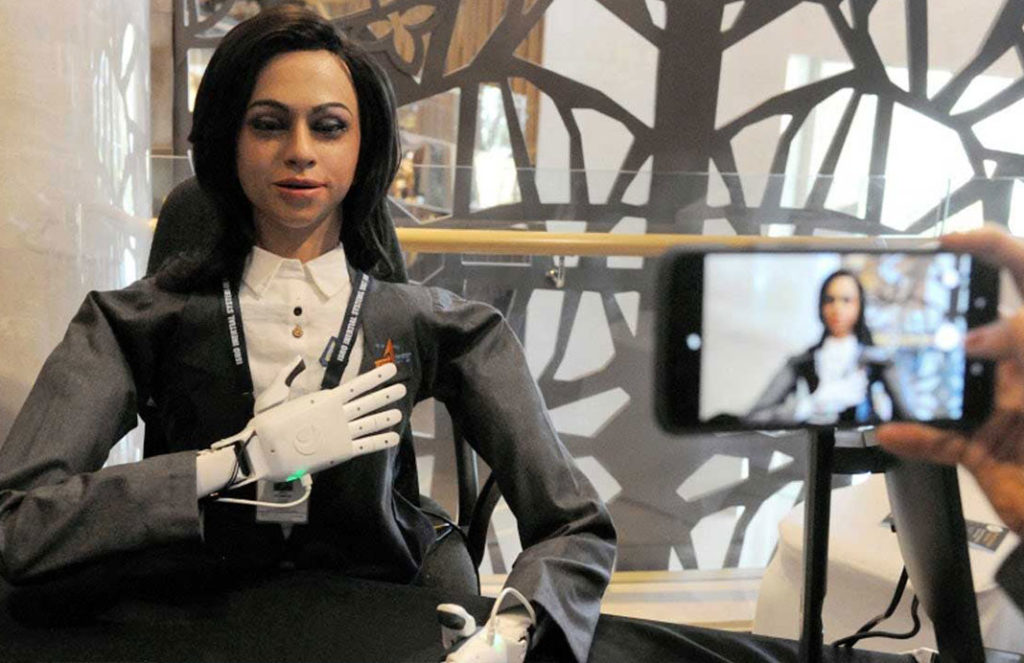
The Indian Space Research Organization (ISRO) stole the limelight in the technology sector this week as it unveiled its first half-humanoid robot that is intended to travel space in December.
Claimed to have the ability to operate as a companion, the robot was named Vyom Mitra which translates from two Sanskrit words— Vyom means Sky or Heaven and Mitra means friend.
Scientists said the robot will be initially sent to space this year as part of ISRO’s unmanned mission.
The robot is designed to perform several functions including the ability to operate switch panels to control the capsule, conduct life support operations and respond to astronauts’ queries.
Vyom is bilingual and its semi-anthropomorphic nature allows it to provide valuable data and tips to astronauts based on its experience in the first unmanned mission.
ISRO is optimistic that Vyom can later assist human astronauts once the crewed orbital spacecraft dubbed “Gaganyaan” officially takes flight by 2021.
According to reports, the Indian invention is not the first robot with human-like structure or abilities to advance toward space.
Russia’s Skybot earlier made its way to ISS while NASA, on the other hand, is trying spheroid robots called “Astrobee” that are projected to help space explorers.
The development of robot astronauts like Vyom Mitra is part of a broader trend in the space industry, where space agencies and private companies are increasingly turning to robotics and artificial intelligence to support human spaceflight. As space travel becomes more complex and ambitious, the need for reliable and efficient systems that can assist astronauts has grown. Robots like Vyom Mitra are designed to perform a range of tasks, from routine maintenance to emergency response, allowing human astronauts to focus on more critical aspects of their missions.
The use of robots in space exploration also reflects the growing recognition of the challenges and risks associated with human spaceflight. Space travel is inherently hazardous, and the harsh conditions of space can pose significant risks to human health and safety.
By developing robots that can operate in space, space agencies can reduce the risks associated with human spaceflight and improve the overall safety and efficiency of their missions. Additionally, robots like Vyom Mitra can provide valuable insights and data on the effects of space travel on human-like systems, which can inform the development of future human spaceflight missions. The Indian Space Research Organization’s (ISRO) development of Vyom Mitra is also significant in the context of India’s growing space program.
In recent years, India has made significant strides in space technology, including the successful launch of numerous satellites and the development of a range of space-related technologies. The development of Vyom Mitra reflects ISRO’s commitment to advancing India’s space capabilities and its ambition to become a major player in the global space industry.
As ISRO continues to develop its space program, the use of robots like Vyom Mitra is likely to play an increasingly important role in supporting its missions and achieving its goals.
The development of robot astronauts like Vyom Mitra also has significant implications for the future of space exploration. As space agencies and private companies continue to push the boundaries of space travel, the use of robots and artificial intelligence is likely to become increasingly important. Robots like Vyom Mitra can provide critical support to human astronauts, enabling them to travel farther and longer than ever before. Additionally, the development of robots that can operate in space can also pave the way for more ambitious missions, such as the establishment of permanent human settlements on the moon or Mars. As the space industry continues to evolve, the role of robots like Vyom Mitra is likely to grow, enabling new and exciting opportunities for space exploration and discovery.




