
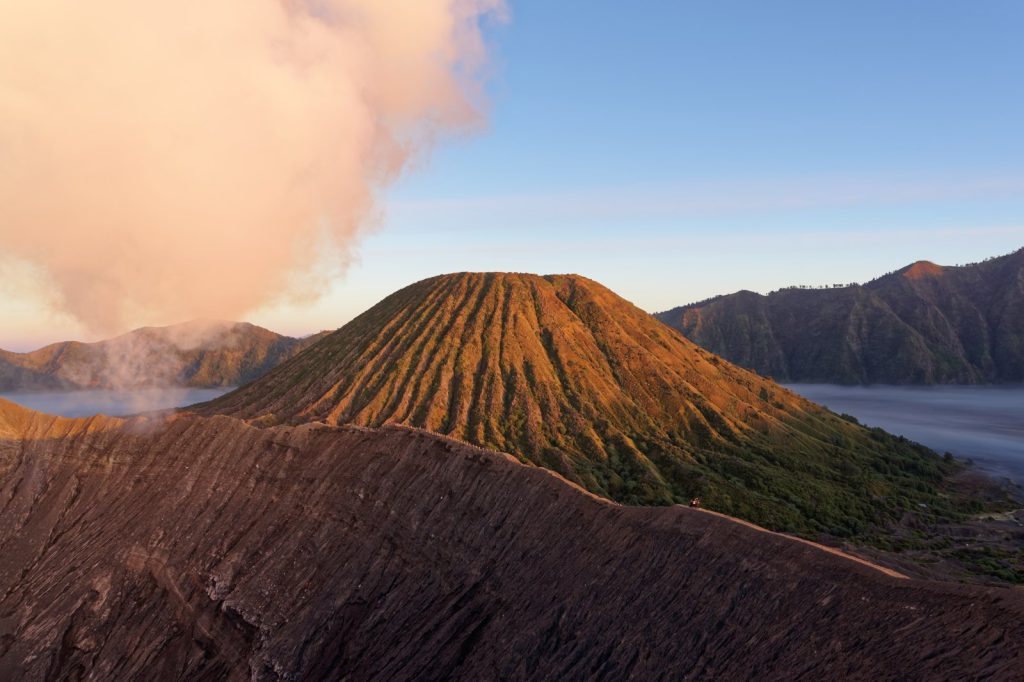
The Ring of Fire is a path along the Pacific Ocean, about 40,000 kilometers (24,900 miles) long, where volcanoes erupt and the ground shakes more often than almost anywhere else. National Geographic puts 75 percent of Earth’s volcanoes there, more than 450 of them, along with 90 percent of its earthquakes. That includes the most violent ones.
Indonesia sits on that belt, and the shift people notice is simple: when several volcanoes make headlines in the same week, it feels like a pattern. It is mostly geography.
What drives the belt
The ring traces the edges of several tectonic plates: the Pacific, Juan de Fuca, Cocos, Indian-Australian, Nazca, North American and Philippine plates. Along most of it, one plate overlaps another at a convergent boundary called a subduction zone. The lower plate gets pushed down. As that rock sinks into hotter mantle, it heats up and melts into magma, which then rises through the plate above and spurts out at the surface.
When the upper plate is ocean floor, the result can be a chain of volcanic islands, such as the Marianas. Those zones also hold the planet’s deepest trenches and deepest earthquakes. One stretch is different. Where the Pacific and North American plates meet, they slide sideways past one another. No new magma there, but plenty of earthquakes as built-up tension in the crust lets go.
Who lives with the risk
Deutsche Welle lists Indonesia, the Philippines, Malaysia, Japan, Australia, New Zealand and Papua New Guinea among the places where lives are under near-constant threat, along with island nations from the Solomons and Fiji to many across Melanesia, Micronesia and Polynesia. The coasts of the Americas are on the list too. Risk varies with distance from the epicenter, whether the quake strikes at sea or on land, and the standard of housing.
The biggest quakes on record mostly fall inside the ring. Chile’s 9.5-magnitude quake on May 22, 1960, tops the U.S. Geological Survey’s list. Alaska followed in 1964 at 9.2, then northern Sumatra on December 26, 2004, at 9.1, the Indian Ocean tsunami. Off Honshu, Japan, on March 11, 2011, a 9.0 quake set off a tsunami and the nuclear disaster at Fukushima.
Does one eruption set off another?
Probably not, and prediction is out of reach. Most experts say forecasting earthquakes has so far proved impossible. Even when two strike close together inside the ring, it is hard to say one had anything to do with the other. A single quake does not necessarily cause another.
What the region does have is constant tension: a quake releases it for a while, then it starts building again. Hence the advice for people living there: stay aware of the danger, consider living further inland, and build earthquake-resistant homes. Nations everywhere, DW says, should improve their oceanic and land-based early-warning systems.




