
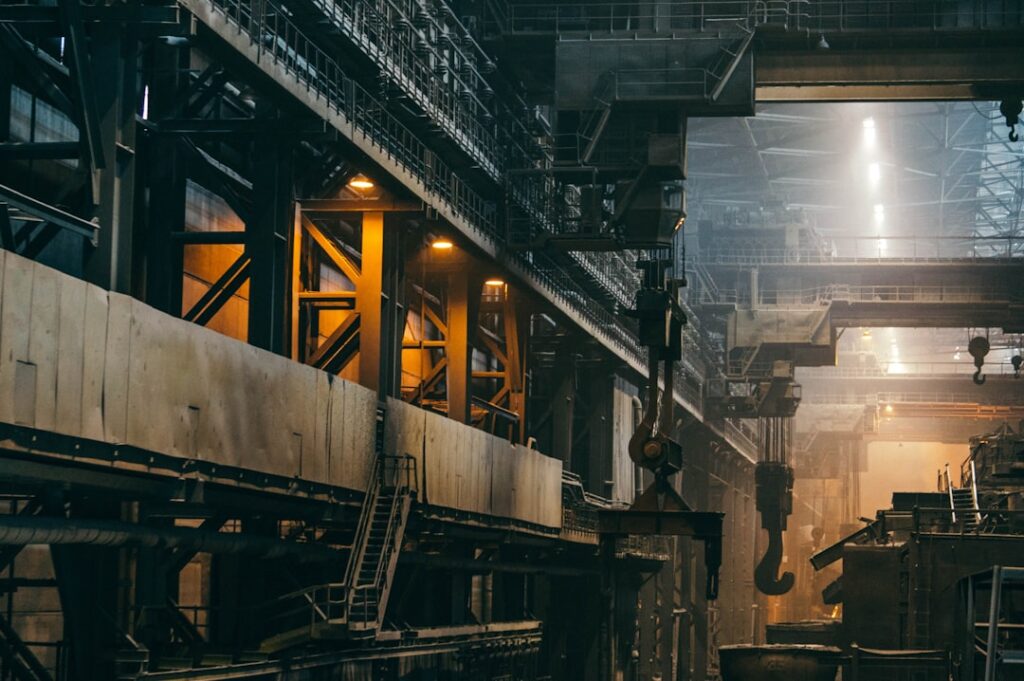
The ladle was full, swung into place over Continuous Casting Machine-2, and waiting for its slide gate to open. The gate never moved. At about 4.15 pm on June 8, the steel blew.
That is the sequence put together by the Joint Chief Inspector of Factories in a preliminary report on the blast at Steel Melting Shop-1 (SMS-1) of the Visakhapatnam Steel Plant, run by Rashtriya Ispat Nigam Limited. The Department of Factories believes the likely culprit was a “sudden release of entrapped gases in the liquid steel.”
How trapped gas becomes a bomb
Under the hood, the physics is not exotic. Molten steel can hold oxygen, hydrogen and nitrogen in solution. If enough of it builds up and then comes out all at once, pressure spikes and the metal can erupt violently.
The blast was so fierce that inspectors could not initially say whether it began in the ladle or in the tundish, the vessel that receives the metal below it. A fireball climbed to the roof of the shop floor, and an overhead crane working nearby caught fire. One worker at Machine-4 reportedly saw flames reach the ceiling right after the explosion. “The workers positioned near Machine-2 bore the brunt of the impact,” the report noted.
The inspectors were careful about their own conclusion. They described it as preliminary and said a detailed technical investigation would be needed to establish what happened, step by step. Several people died and others were injured.
Committee and complaints
A three-member committee set up by the Ministry of Steel has started its own inquiry. Its members are Priya Ranjan, Director-in-Charge of the Bokaro Steel Plant at the Steel Authority of India Limited (SAIL); Jitendra Kumar, a Chief General Manager at SAIL; and Gopal Singh, a former Chief General Manager there. They reached Visakhapatnam on Tuesday. Bhupathiraju Srinivasa Varma, Union Minister of State for Steel and Heavy Industries, also went over the progress of the inquiry.
Inside the plant, workers are telling a less tidy story. Employees alleged that molten metal spilled at Steel Melting Shop-2 only 15 to 20 minutes before the fatal blast at SMS-1. Nobody was hurt there, though a vehicle was damaged. Workers said a major accident had been narrowly avoided. Several of them, speaking anonymously, said the June 8 explosion was not a one-off but the end point of long-running operational and safety worries.
A long record
The plant has been here before. On June 13, 2012, an explosion during a trial run at the oxygen plant attached to SMS-2 killed 19 people, senior officials among them. Weeks earlier, on May 1, 2012, two contract workers died and two more were hurt in an explosion at Blast Furnace-3.
Two contract engineers died in June 2014 after a carbon monoxide leak while they inspected a ladle during expansion work at SMS-2. On December 18, 2020, ladle hooks gave way in SMS-2 and molten steel spilled, leaving four workers with severe burns. On November 16, 2021, molten material surged onto an earthmover during slag removal at Blast Furnace-3, and four workers were killed.
In May 2026, a blast furnace gas leak in the thermal power plant area knocked four workers unconscious. All of them survived after help arrived in time.
Sources
Sources
- Gas build-up may be cause of steel plant blast: Preliminary factory…
- See the latest updates, context and perspectives about this story.




