
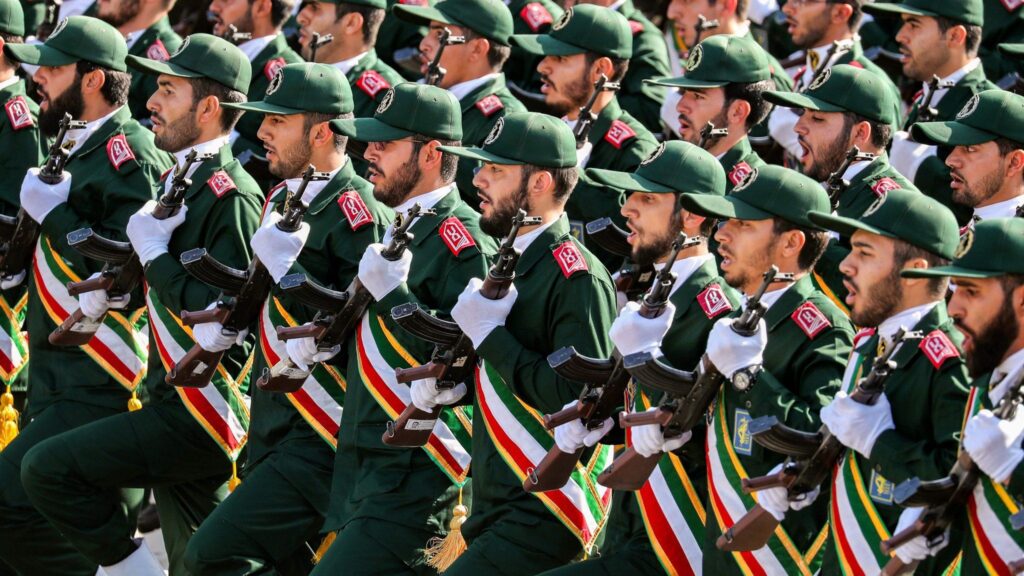
The Strait of Hormuz, a narrow waterway that serves as the only maritime passage from the Persian Gulf to the open ocean, has become the focal point of a fast-moving strategic crisis. Iran’s Islamic Revolutionary Guard Corps (IRGC) has announced it would close the waterway, a move that immediately confronts the United States and its allies with a constrained set of diplomatic and military responses.
The strait, located between the Iranian coast and the Musandam Peninsula, has long been a point of tension, but disruptions to this route carry consequences far beyond the immediate region. Because it carries a large share of the world’s seaborne oil trade and liquefied natural gas, and because several Gulf states rely on it as their only maritime outlet, a closure can produce severe supply shortages for markets in Asia and Europe. While other straits have been closed during past Middle East conflicts, this passage remained open for extended periods until now.
Diplomatic Calculus at the United Nations
At the United Nations, the Security Council could convene under Article 39 of the UN Charter, a provision that empowers the body to determine whether a threat to international peace and security exists. If that determination is made, Washington could push for a resolution demanding that the strait be reopened.
However, any such resolution faces a formidable obstacle: Russia and China, both permanent members of the Security Council with veto power, have previously opposed sanctions on Iran. That opposition makes the passage of a clear resolution unlikely under current circumstances. The United States already has sanctions in place that target Iran under the 1996 Iran Sanctions Act, which was renewed in 2021, and under Executive Order 13876, signed in 2019, which specifically targets IRGC officials.
Those measures, already active, have not altered Iran’s strategic calculus, leaving the diplomatic track at a standstill.
Military Preparations and Historical Precedent
The United States has a military option rooted in historical precedent. The U.S. Fifth Fleet could escort merchant vessels through the strait, a mission modeled directly on the 1987–1988 Tanker War, when the U.S. Navy escorted Kuwaiti tankers under the code name Operation Earnest Will.
In that campaign, similar challenges of mine clearance and convoy protection were tested in the same waters. A complementary option would be to activate the International Maritime Security Construct (IMSC), a multinational naval coalition that, as of 2024, included 11 nations. Iran has deployed naval mines and anti-ship missiles, including the Noor and the Khalij Fars, that could threaten ships transiting the waterway. The risks of escalation are significant.
Iran’s allies in the region, including Hezbollah in Lebanon and the Houthis in Yemen, could launch attacks against U.S. assets in the broader theater, broadening the conflict beyond the immediate naval engagement.
The Nuclear Dimension and Broader Implications
Separate from the immediate crisis over the strait, the International Atomic Energy Agency’s Board of Governors could refer Iran to the UN Security Council for non-compliance with the Nuclear Non-Proliferation Treaty, which Iran signed in 1968. That referral would add a nuclear dimension to an already strained set of diplomatic interactions. For the United States and its allies, the present situation presents a stark dilemma: diplomatic channels at the Security Council remain blocked by veto-wielding powers that have opposed sanctions, existing sanctions have failed to shift Iran’s position, and any military response carries the risk of igniting a regional war.
The Strait of Hormuz, as the only sea route from the Persian Gulf to the open ocean, remains a chokepoint where those three constraints converge. With each passing day, the gap between the severity of the threat and the available tools to address it becomes more pronounced.




