
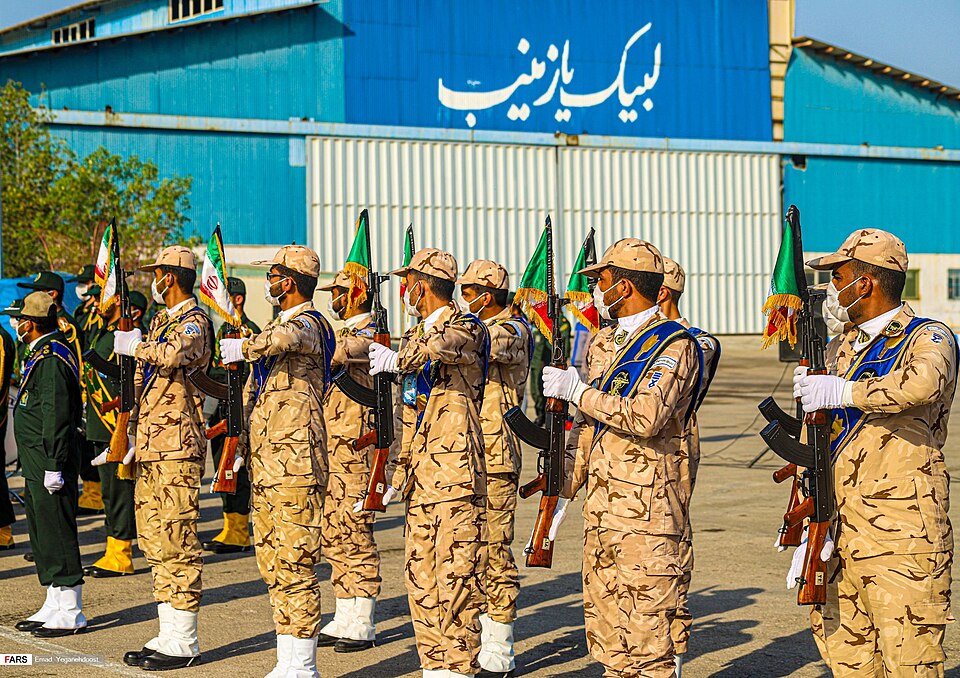
For decades, the Islamic Revolutionary Guard Corps Navy has operated as a distinct military force alongside Iran’s conventional navy, purpose-built for asymmetric warfare in the restricted waters of the Persian Gulf. Its existence carries direct implications for the global energy trade because the force exercises primary control over the Strait of Hormuz, a narrow waterway through which a large share of the world’s seaborne oil traffic passes.
Communities across Asia that depend on the uninterrupted flow of oil from the Persian Gulf have a material stake in the IRGCN’s capabilities and the threats its commanders have repeatedly issued.
Origins and Doctrine
The Islamic Revolutionary Guard Corps itself was born from the upheaval of the 1979 Iranian Revolution. Ayatollah Ruhollah Khomeini ordered its creation as a counterweight to the regular military, which was viewed as loyal to the former monarchy.
The new force’s constitutional mandate was to protect the Islamic Republic’s ideological integrity and prevent foreign interference. Over time, the IRGC grew from a revolutionary militia into a sprawling institution with its own ground, naval, air, and intelligence branches. The IRGC Navy was established in 1985 and operates alongside Iran’s conventional navy but follows a distinct doctrine.
It is often described as a guerrilla navy, relying on small fast-attack craft, anti-ship missiles, and mines rather than traditional warships. The force also serves as Iran’s de facto coast guard, exercising primary control over the Persian Gulf and the Strait of Hormuz.
As of the latest open-source assessments, the IRGCN fields about 20,000 personnel and more than 100 small craft. Its arsenal includes the Noor and Qader anti-ship missiles, with ranges between 120 and 200 kilometers, and the Khalij Fars anti-ship ballistic missile. The force also maintains thousands of naval mines and operates unmanned aerial vehicles. This inventory is designed to offset the conventional naval superiority of the United States and its allies through swarms of fast-attack boats, coastal anti-ship missiles, and mines.
Exercises and Confrontations
The IRGCN has conducted exercises simulating the closure of the Strait of Hormuz. In 2022, the force staged the “Great Prophet 17” exercise, which rehearsed blocking the strait. Rear Admiral Alireza Tangsiri, the IRGCN’s commander, has repeatedly threatened to block the strait if Iran’s oil exports are halted.
Such threats carry weight given the force’s history of confrontation. In 2019, the IRGCN seized the British tanker Stena Impero in the Persian Gulf, an escalation that drew international condemnation.
The incident highlighted the force’s willingness to use its small craft and missiles against commercial shipping. Beyond the naval realm, the IRGC has expanded into nearly every sector of Iranian society and the economy. It runs businesses in energy, construction, and food production; some news reports have described it as a business empire.
The force maintains its own media arm inside Iran and operates the Quds Force, a unit that arms and trains allied militias abroad, including Hezbollah and the Houthis. The IRGC is currently designated as a terrorist organization by many countries, including the United States and the European Union, as well as by several Arab and Western states.
That designation reflects its overseas operations and its role in Iran’s ballistic missile program, which is managed by the IRGC Aerospace Force and has grown steadily since the 1990s, posing a concern for regional security and nonproliferation efforts.
What to Watch Next
With Rear Admiral Tangsiri’s threats continuing to echo through diplomatic channels, the potential for a confrontation remains. The IRGCN’s growing arsenal of anti-ship missiles and unmanned aerial vehicles suggests it is preparing for a conflict that could directly affect the energy security of Asian nations. For readers, the force’s repeated exercises threatening to block the Strait of Hormuz matter because any disruption to oil shipments would affect global energy prices and supply chains across Asia and beyond.
The IRGC’s history of seizing commercial vessels and its expanding asymmetric arsenal have made it a central factor in Persian Gulf security. Its influence inside Iran also shapes the country’s domestic politics and international posture, making the IRGC a subject of lasting relevance far beyond military affairs.




